
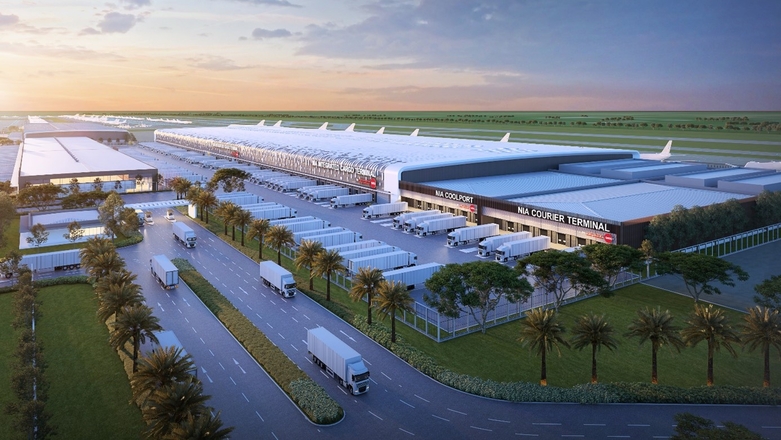
The chronically overloaded airport in India’s capital Delhi, Indira Gandhi International (DEL), is bursting at the seams. Getting a suitable slot is like winning the lottery for passenger and cargo airlines. But relief is on the way. The new Noida International Airport, located about 20 km southeast of Delhi, is scheduled to open before the end of the year and will have five runways when fully completed. It will be one of the largest airports in the world.
At present, however, the oppressive spirit of Berlin still hangs over the 4,755-hectare site on which Noida is being built. Uttar Pradesh’s government gave the green light for the greenfield project back in 2001. However, due to an objection from India’s largest private airport operator, GMR Airports Limited, which is closely affiliated with France’s Aeroports de Paris (ASDP), the Noida project was put on hold. In 2014, after an alternative location was ruled out, the original plan was revived. Zurich Airport received the building permit, along with an operating concession for a period of 40 years. The Swiss invested the equivalent of around 815 million euros in the project. According to the announcement at the time, the first aircraft was scheduled to take off in 2022.
Still pending: the official opening date
But delays have repeatedly pushed back the inauguration of the airport until today. According to latest announcements by local politicians, the airport will be inaugurated before the end of the year. However, no precise date has been named yet.
Different construction phases
Meanwhile, roofing work on the passenger terminal has been completed, and multiple technical trials are underway. A comprehensive Operational Readiness and Airport Transfer (ORAT) program is in progress, covering system checks, simulations and stakeholder training. This includes trials for baggage handling systems, security equipment, check-in counters and boarding gates.
The entire project is split into various phases. Initially, Noida will become operational with one runway and an annual passenger capacity of estimated 12 million. Once fully developed, the airport will house five runways and handle up to 300 million passengers annually, positioning it among the world’s largest airports.
Freight plays a key role
In addition to passenger traffic, air freight is also an important pillar of the airport’s business. The government of the state of Uttar Pradesh named the airport in a statement “a game-changer for India’s logistics and air cargo ecosystem. Seamlessly connecting manufacturers, markets, and global supply chains across North India, from arrival to final dispatch every stage is digitally monitored to ensure speed, safety, and transparency. With ample slots and competitive ATF [Aviation Turbine Fuel] pricing, it drives growth in the world’s third-largest aviation market while enabling cost-efficient airline operations.”
Phase 1 offers 19 truck docks, nine X-ray machines and 12 ULD roller decks, including 2 dedicated freighter bays with 24×7 seamless operations. The cargo center includes domestic, international, and express air freight terminals. The facilities are directly connected to the nearby Yamuna Expressway, allowing for fast road feeder movements.
Aviation is on the rise in India
Once the operating license has been issued by the Indian regulator, Directorate General of Civil Aviation (DGCA), Akasa Air, Indigo, and Air India Express will be the first users. The number of aircraft they intend to base there is still open. Initially, they will fly domestic routes within India, for example to Kolkata, Chennai, Mumbai, or Hyderabad. However, in the medium term, flights to neighboring countries and the Middle East are also planned. Overall, the Indian aviation industry is currently experiencing tremendous growth. This can be seen in the constantly rising traffic figures and the recent massive aircraft orders placed by Air India and Indigo. India is thus on its way to becoming the world’s third-largest aviation market after the U.S. and China.