
Automation features heavily in air cargo company visions when conference panels discuss the future of air cargo. Coupled with digitalization and AI, it is seen as a core enabler of future competitiveness. And yet, when does the future begin? In places like China, there are already impressive examples of fully automated operations but, on the whole, air cargo lags behind when it comes to automation maturity. And yet Fraunhofer IML (part of Germany’s Fraunhofer Gesellschaft, Europe’s largest applied research organization) and its Digital Testbed Air Cargo (DTAC), funded by the German Federal Ministry for Digitalization and Government Modernization (BMDS) to the value of €13.7 million, are testing an increasing number of cargo automation projects together with air cargo industry stakeholders.
CargoForwarder Global asked Manuel Wehner (MW), Project Manager and Research Associate at the Fraunhofer Institute for Material Flow and Logistics IML, to elaborate on his research topic. The result is a three-part interview series that looks at the overall autonomous robots testing situation in Part 1, details the DTAC trials in Part 2, and offers a broader discussion on robots and circular economy, cybersecurity, and the human element in Part 3.
CFG: What are currently the biggest challenges in getting autonomous robots to be a fixed part of air cargo processes?
MW: So far, most stakeholders conduct trials with just one or a few robots. This is understandable, given the fact that airports are highly safety and security-relevant, processes and environments are dynamic, the global regulatory framework is still being developed and revised, and that local requirements differ even between different airports and federal states within a certain country. The goal in these trials is mainly to gain experience and to prepare for the future. However, at some point, economies-of-scale need to be considered – and this is currently the challenge. Of course, there are certain examples of fleet implementations, when there is enough space (e.g. CDG), in greenfield projects (e.g. AMS), or when the local context allows for scaling up of a specific solution (e.g. HKG), but most stakeholders are still in the piloting phase.
CFG: So how does Fraunhofer IML help here?
MW: What we seek to do with our Fraunhofer IML R&D efforts is twofold: Firstly, we support visionary approaches. As we develop our own solutions from scratch, we are well-aware of technological capabilities and limitations. Secondly, as a neutral, independent, non-profit partner, we support the industry in getting rolling. This includes our know-how and robot developments in the level 3 and 4 context, but even more so we are now investigating level 5 autonomy. These levels describe the degree of automation, see, for example, SAE’s J3016TM Recommended Practice.
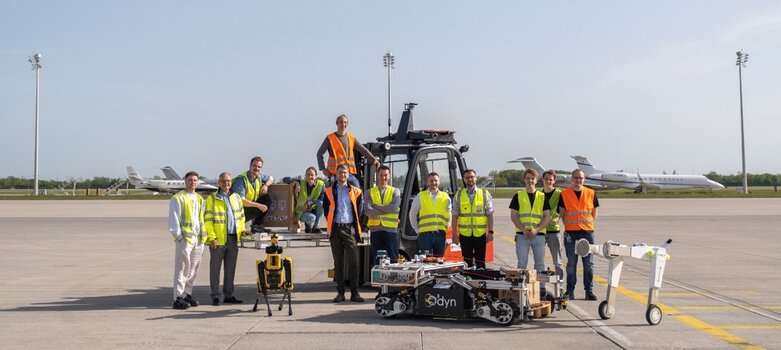
Fraunhofer IML complements the given stakeholder context of airports, airlines, handlers, policymakers, and others, by sharing research openly in presentations, panels and discussions as part of industry groups, trade shows, industry events and scientific papers, without promoting certain solutions. We often contribute to events hosted by IATA, ACI, TIACA, and other global stakeholders. We also recently published a detailed double-blind reviewed paper about the O³dyn tests in the Logistics Research journal, which is called ‘Air cargo logistics automation and digital airport process management: comprehensive empirical insights from Germany’ and available online (open access). These tests are part of the Digital Testbed Air Cargo (DTAC), which we will discuss more thoroughly in Part 2 of this interview series.
CFG: What do you think will be the ratio of robots to humans in five years’ time, in an air cargo warehouse?
MW: The only appropriate short answer would be: ‘it depends’. There are certainly early adopters in the market, who already investigate fleet approaches of dozens of self-driving vehicles. The vast majority of air cargo warehouse operators and other stakeholders, however, will keep testing specific solutions for the time being, preparing for bigger investment decisions in the future.
Many stakeholders in most regions still rely on manual processes. The pressure caused by the lack of skilled workers is not felt the same way in different parts of the planet yet. To give some numbers, in five years and on a global scale, I expect less than 10% of automated vehicles at airports, while on a local or national level, we might already be seeing a share of 50% and more automation solutions as early as 2030.
CFG: Will robot control centers move off airport, do you think? Will there be an increase in remote work?
MW: In the given context of cyber and data security, we do not see control centers moving off airport, at least apart from temporary trials and local initiatives. It is possible to remotely control robots at airports, however, we see more potential for on-premise solutions, where remote controllers, if required, will be located at the airport, and the data will be processed in secure local networks.
Remote work might increase, because it will take time to develop and roll out autonomous solutions. Hence, all stakeholders have the choice to invest in level 4 (automation without safety driver or human controller) or in lower-level automation (including remote control options) or in level 5 functionalities, or all of the above. More important are the vision and the business plan for the robot fleet that shall operate in 3, 5, 10 years.
Certainly, the number of human workers will decrease, allowing those remaining to specialize and focus more on tasks such as damage assessment, unusual cargo, and robot control. This can make airport jobs more attractive again and add another facet to business considerations besides the typical job-cutting argument. Automated solutions will relieve human staff from doing exhausting and repetitive tasks, while enabling them to engage in an exciting work environment as automation increases to support all types of operations. That is an exciting outlook.
CFG: What are the current limits for today’s robots?
MW: There are product specification sheets for each robot, which I will not cite here. The truth is that air cargo automation still requires lots of trial-and-error at the lowest possible risk for humans and (expensive) assets. Robots, which are advertised as capable of towing dollies, end up failing to tow even unloaded containers in real-life testing. A certain kilogram threshold might only be applicable in ideal-world scenarios, which are exceptions in daily operations.
Automated operations are compromised when there is oil spilled on the warehouse floor, when pieces are sticky with tape or unevenly loaded, or when other vehicles or aircraft do not obey speed limits. We simply do not have designated areas for robot operations at most airports yet, but we are trying to deal with difficult brownfield environments as well as possible. These are as dynamic as intralogistics can be, which is why we do not look too much at product sheets but at the real capabilities in our test environments.
We contribute to shaping policymaking and standardization efforts with our research. International legislation, handling manuals, standards, guidelines and certifications can help bridge the gap between theoretical, laboratory limits and real-life airport limits in dynamic, sometimes chaotic traffic situations.
CFG: Which airport (in the world) is currently the most advanced when it comes to robot applications?
MW: We see many early adopters and airports keep on rolling out technologies in several regions, including Americas, Europe, the Middle East, East Asia, and Asia Pacific. We have identified more than 60 different use cases for air cargo automation in 16 countries worldwide since 2017. These are publicly known as they have been featured in press releases, research or other publications. It depends on the overall strategy, i.e. is the airport aiming for level 5 operations eventually, or are level 3 to 4 operations sufficient for the current business? We currently do not see one particular airport being far ahead of the rest, but there are certainly all shades of experience levels between none to extensive.
Thank you, Manuel Wehner. We will be back next week to delve deeper into Digital Testbed Air Cargo’s specific trials with the five robots at Munich (MUC) and Stuttgart (STR) airports.
More information
About Manuel Wehner:
Manuel Wehner specializes in aviation logistics and autonomous air cargo handling at the Fraunhofer Institute for Material Flow and Logistics IML. In the Digital Testbed Air Cargo (DTAC), led by Fraunhofer IML and funded by the German Federal Ministry for Digital and Transport (BMDV) with €13.7 million, he oversees the development and testing of autonomous robotic systems for air cargo handling at airports.
On behalf of the DTAC consortium, he accepted TIACA’s ‘Sustainability Award’ in Hong Kong in June 2025 and Stat Times’ ‘International Award for Excellence in Air Cargo’ in Nairobi in February 2025 for the tests of a heterogeneous robot fleet at the DTAC partner airports MUC and STR in 2024.
Wehner studied Management and Technology (M.Sc.) in Munich and Mexico, as well as Aviation Management (B.A.) in Frankfurt and Saudi Arabia. He is a lecturer and co-founder of the Institute for Aviation and Tourism (IAT). As a project manager for Fraport AG, he led the test operation of autonomous minibuses at Frankfurt Airport in 2017.
In November 2025, Wehner was featured in the CargoForwarder Global’s weekly ‘Spotlight on…’ series.
About the Fraunhofer IML:
The Fraunhofer Institute for Material Flow and Logistics IML is part of the Fraunhofer-Gesellschaft, Europe’s largest applied research organization, which employs around 32,000 staff and has an annual research budget of 3.6 billion euros.
Fraunhofer IML is considered the top address for integrated logistics research. Interdisciplinary teams put together according to project and customer requirements create cross-industry and customer-specific solutions in the field of material flow technology, business process modeling, and in the areas of transport systems and resource logistics, among others. Other current research priorities include the sections of artificial intelligence and smart robotics, smart finance, the resilience of supply chains and the sustainable transformation of logistics. The institute is also the initiator of the non-profit Open Logistics Foundation, which promotes open-source applications in logistics, and part of the Lamarr Institute for Machine Learning and Artificial Intelligence, which is permanently funded as part of the German government’s AI strategy.
Fraunhofer IML’s Department for Aviation Logistics specializes in various logistics challenges related to air traffic and airport operations, including airport digitalization, airport automation, and green aviation topics.
Find more information here: https://www.iml.fraunhofer.de
About the Digital Testbed Air Cargo (DTAC):
The Digital Testbed Air Cargo (DTAC), led by the Fraunhofer IML, is funded with 13.7 million euros by the German Federal Ministry for Digitalization and Government Modernization (BMDS). The DTAC aims to enhance the air cargo industry through digitalization and advanced technologies. It serves as a platform for testing and validating new concepts, processes, and technologies related to air cargo logistics. The testbed brings together stakeholders from various sectors, including airlines, logistics providers, and technology companies, to collaborate on solutions that improve efficiency, transparency, and quality in air cargo operations. By leveraging data standards, AI-based predictive analytics, as well as automation and robotic autonomy, the DTAC addresses key challenges in the air cargo supply chain concerning both physical and digital processes.
Besides the Fraunhofer IML as the consortium leader, the DTAC consortium consists of Cargogate Munich Airport GmbH, CHI Deutschland Cargo Handling GmbH, Flughafen Köln/Bonn GmbH, Fraport AG Frankfurt Airport Services Worldwide, KRAVAG-Logistic Versicherungs-AG, Lufthansa Cargo AG, LUG aircargo handling GmbH, Mitteldeutsche Flughafen AG, Schenker Deutschland AG, and Sovereign Speed GmbH. The grant number is ‘FKZ: 45KI14A011’.