
Each week, CargoForwarder Global’s ‘Spotlight On…’ brings a different segment of the air cargo industry to the fore, to illustrate the many functions involved in carrying cargo from A to B. Without pilots, there would be no air cargo. Pilots are key to the safe, efficient, and timely transportation of all kinds of commodities. They deal with ever-changing circumstances, and their responsibilities include aircraft handling, flight and route navigation, weather assessment, and team work with air traffic control and others to ensure optimal flight operations, minimal risk of delay, and best fuel use, for example. This week, Teresa Galán Barrios, Cadet Pilot at Aerodynamics Academy, takes us through her role and views.
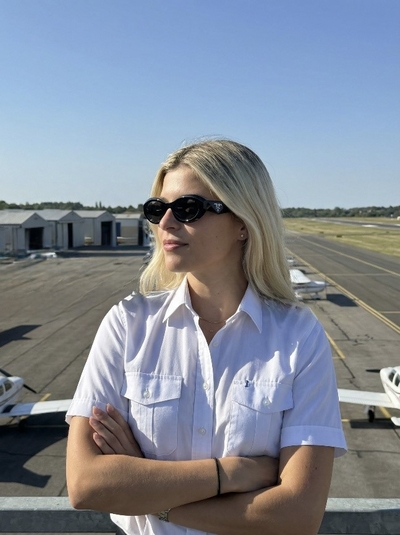
CFG: What is your current function and company? And what are your responsibilities?
TG: I currently hold the position of a cadet pilot and am in the process of completing an integrated ATPL [Air Transport Pilot License] course at Aerodynamics Academy in Málaga, Spain. My role involves the intensive study of topics like Mass and Balance, Performance, Meteorology, Human Factors, and Air Law. In addition to this, I also have to ensure the complete operational readiness of each flight. This includes analyzing METARs and ATIS messages, reviewing NOTAMs, performing performance calculations, mass and balance sheets, navigation logs, briefings, and flying the Tecnam P2008JC.
To me, being a pilot in training is far more than just flying. It involves understanding each and every system of an airplane, memorizing each and every procedure, and dealing with hypothetical emergency situations with a composed and disciplined mindset. I know that the better I understand each and every topic on the ground, the better I’ll feel once I get into the cockpit. In aviation, every flight begins long before the engine starts.
CFG: What does a normal day look like for you?
TG: Certainly, a day in aviation is unlikely to be considered ‘normal’, but there are daily rituals that provide some structure to my day-to-day life. I enjoy reading about the latest happenings in aviation journals every morning. I value the importance of knowing the context of a situation in relation to my studies. I also appreciate the importance of knowing the current state of weather at my school’s nearby aerodromes. I am a frequent reviewer of METARs and ATIS reports.
My days are sometimes spent studying at home doing preparation of documents for planned flights which includes draft meteorological analysis, NOTAMs, route drafts and Mass & Balance along with performance calculations. Other days, I am at the academy for ATPL classes where I am able to advance my knowledge of the various subjects and get my questions addressed by the teachers.
The flying days can get quite intense. There’s meticulous planning involved for things like the route, the weather, NOTAMs, ATIS, aircraft mass, and balance. Then, an instructor briefing is done, and all the last-minute questions are solved before departure. After flying, a long debrief is done, and all things are analyzed like what went well, what could be done better and how to keep improving.
Classroom days are just as important since they give me the chance to help solidify the theory and join the instructors’ experience.
It happens when you look at the clock during the day, just to realize that it is already nighttime. When you are properly engaged, time tends to fly. I consider myself tremendously fortunate to be in the field even if I finish the day dead tired, because I get to do exactly what I love.
Aviation teaches you that ‘preparation builds confidence’ – a saying that has been repeated by one of my teachers. He has been spot on every single time. This is especially true on the ground, because the more I learn, the more I am able to control the plane in the air.
CFG: How long have you been in aviation, and what brought you to it?
TG: I started my flight school journey this past September, but my history is much longer and meaningful. My grandfather, who I never met, was a commercial pilot. He died in a plane crash while on his 800th hour of flying. Growing up, I developed a fear of flying and avoided anything to do with aviation. I even chose to become a biomedical engineer working in bionic prosthetics, which I thought was a great field to stay in for the rest of my life. Later, I moved into management consulting, which was interesting but didn’t feel like the right fit. A significant moment for me was an unplanned trip to Disneyland. A close friend of mine was flying the plane, and I was invited to the flight deck. I had a sudden revelation that my fear of aviation was irrational, and I was simply apprehensive of something I didn’t understand. I wanted to be part of that world.
Still under the influence of my grandfather’s stories, I began looking into becoming an air traffic controller and took the selection exams for ENAIRE. I tried my best to visit control towers and flight decks, secretly hoping that one day I would be in the aviation world. Then, I got the unexpected chance to enroll in one of the top aviation academies in Spain, Aerodynamics in Málaga. There, I was able to train to be a pilot and say that I am in a place that I would love to be for the rest of my life. I am certain that my grandfather would also love to see me here.
CFG: What do you enjoy most about your job?
TG: What stands out the most, is the sense of meaning behind every single action done in aviation. Things are not done habitually or instinctively. Decision making, communication, and checklists follow a set of guidelines designed to achieve specific outcomes. I appreciate being in a sphere in which being prepared is not optional and the burden of responsibility is taken without being asked. The strict adherence to guidelines and the high degree of control engenders an environment in which the entre practical and operational realms are held to a single standard end.
I appreciate the collaboration and teamwork on this project. Apart from the obvious and from what many people may think, winning in this domain is not only about the people in the cockpit. Aviation is a highly elaborate and synchronized multidisciplinary team effort. Coordination from the pilots, air traffic controllers, ground operations, and maintenance and logistics teams is needed. The complexity of the system and the fluidity and ease with which it operates is mind-blowing.
There is one instance, in particular, that is very personal to me and very difficult to fairly communicate to others. It is the instance where the engines spool up and the command inputs come to life. It is a technical engagement but it feels very personal. I think of my grandfather a lot, and I wonder if he experienced the same feelings of control and the mix of emotions.
The most special and exciting thing about flying is that people have the misconception that it is all about the machine. The operator sitting in the front, is in control of a system that is not fully theirs to control. The owner of the machine is not the only one who can control the machine.
CFG: Where do you see the greatest challenges in our industry?
TG: The two primary obstacles I see as a pilot working toward an ATPL license are:
Referral prospects: Aviation as a profession is very exciting. However, it is still very poorly understood. People don’t know what to study, how to go about it, whether to take a modular path or an integrated path, or what the financial requirements are. It is all very overwhelming. Because of this simple and accessible information, a lot more people would be able to enter the profession as a pilot.
The job market: My training colleagues and I often speculate on our future prospects. Some people see themselves at airlines and others at executive aviation; some think of cargo operations, and others of more niche roles like aerial firefighting. But getting into a niche sector is not straightforward. I recall university and corporate webinars, and I think career focus initiatives like those would be very helpful for students after they get a frozen ATPL.
CFG: What advice would you give to people looking to get into the air cargo industry?
TG: You should first grasp the magnitude and the implications of the responsibility that comes with the job. Being a pilot is not just a matter of flying an airplane. You facilitate a crucial part of the world economy. Air transport of anything, from crucial medical supplies and industrial goods to thousands of people, is what keeps the world working. Understanding that is what should ultimately change your perspective on the training.
Regarding preparation, a strong technical background is vital, as is having a good foundation in operations, logistics, flight training, engineering, or airport management, depending on the relevant career choice. Equally, if not more important, are the ability to think critically, demonstrate strong analytical capacity, having a solid culture of safety and the ability to work as part of a team.
I recommend acquiring as much experience as you can, as early as you can. Aviation can be learned in books and, with the right experience, it can be understood through the entire system in operation.
Most importantly, this is an industry of learning. Regulations change, technology is always getting better, and the way we operate is not the same for too long. Therefore, having knowledge of the industry is essential, but being curious and humble will be just as, if not more important.
CFG: If the air cargo industry were a film/book, what would its title be?
TG: The Invisible Engine of the World. It quietly connects the continents, sustains tourism, supports supply chains and operations and keeps the world moving.
Thank you, Teresa.
If you would like to share your personal air cargo story with our CargoForwarder Global readers, feel free to send your answers to the above questions to cargoforwarderglobal@kopfpilot.at We look forward to shining a spotlight on your job area, views, and experiences.