
Munich Airport (MUC) is in an enviable position: Air freight volumes keep growing constantly but uplift capacities are barely keeping pace with increased market demands. This is despite the fact MUC’s intercontinental route network has grown lately and carriers have upped their frequencies. Nevertheless, there is still a gap between supply and demand. To avoid bottlenecks, MUC is now further expanding its ground infrastructure.
According to forecasts tabled by the airport’s cargo division, 334,000 tons of air freight will be handled at Munich Airport in 2025, which translates into an 8.5% year-on-year increase. By the end of OCT25, the throughput was 279,000 tons. Compared to other German airports which report average air freight increases of a meager 1.1% in 2025, Munich’s figures are remarkable.
They could be even higher if there were more flights to and from MUC. “As soon as a new intercontinental airline commences serving our airport, it can count on high tonnage figures right from the start,” says Markus Heinelt, the airport’s head of cargo. In short: The demand is there; new facilities will limit the capacity shortage. As a result, some of the road feeder services coming from the Czech Republic, Slovakia, Hungary, Poland, Austria or the Balkan states bypass MUC and continue their journeys to Frankfurt because of the dense intercontinental network offered by airlines there.
More would be possible
They could be even higher if there were more flights to and from MUC. “As soon as a new intercontinental airline commences serving our airport, it can count on high tonnage figures right from the start,” says Markus Heinelt, the airport’s head of cargo. In short: The demand is there, but also a capacity shortage coupled with a limited global network that limits higher volume growth. As a result, some of the road feeder services coming from the Czech Republic, Slovakia, Hungary, Poland, Austria or the Balkan states, bypass MUC and continue their journeys to Frankfurt because of the dense intercontinental network offered by airlines there.
The demand is there; new facilities will limit the capacity shortage. As a result,
Belly cargo dominates
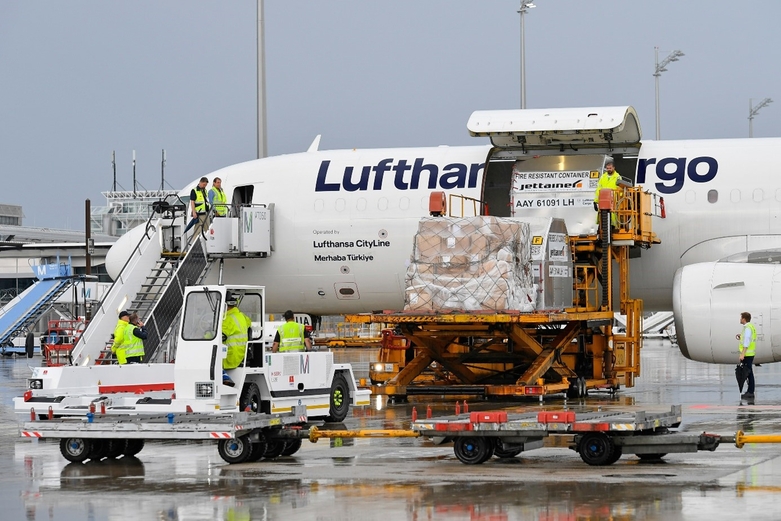
However, the Bavarian airport is catching up step by step. Since mid-2025, Cathay Pacific has been serving Munich Airport four times a week, operating A350 passenger aircraft. Vietnam Airlines has increased its Dreamliner flights from 4/7 to 5/7. Lufthansa will serve Sao Paulo and Johannesburg with its A350 passenger aircraft year-round and not just seasonally. The carrier also offers daily passenger flights from Munich to Beijing. And its leisure subsidiary, Discover, connects Munich with Orlando, Florida, thrice a week, operating Airbus A330s, thus bypassing the overcrowded Miami Airport. In addition, its logistics sister company, Lufthansa Cargo flies twice a week with an A321 freighter from Istanbul to Munich and back. The freighter aircraft can accommodate 30 tons per flight. Incidentally, this is the first all-cargo aircraft operated by the Lufthansa Group to serve Munich. Finally, Etihad is returning to double daily flights between Abu Dhabi and Munich, thus returning to pre-Covid capacity levels. “This means that all three Gulf carriers, including Emirates and Qatar Airways, are serving Munich twice a day with long-haul aircraft which provide ample cargo capacity in their lower deck compartments, with most of the consignments transiting at their hubs in the Middle East to end up in the APAC region or India,” summarizes Manager Heinelt.
Infrastructure initiatives
The airport also announced that a 13,000 m² staging area will be developed where build-up pallets and containers can be stored temporarily before being loaded onto an aircraft or, in the case of import shipments, onforwarded by truck to their final destinations. Construction work is expected to be completed in Q3, 2026.
The development of a 60,000 m² area in the second line, behind the existing cargo facilities, will take a little longer, namely until 2029/30. The concept was developed by Hamburg Port Consulting, whose solutions for connecting the second with the first line include a corridor wide enough to enable cargo vehicles to pass by without getting in each other’s way. There is already strong demand for these plots, says manager Heinelt. “We want to attract freight customers, freight forwarders, and airlines to the site.” René Droese, Vice President Real Estate Development and Sales at Munich Airport, is responsible for developing and leasing the space. Until 31MAR24, he was head of cargo at Budapest Ferenc Liszt International Airport. Together with Jost Lammers, the former CEO of BUD and now helmsman of Munich Airport, Droese designed and built the cargo center at the Hungarian airport. Due to growing freight volumes, it has since been enlarged several times.