
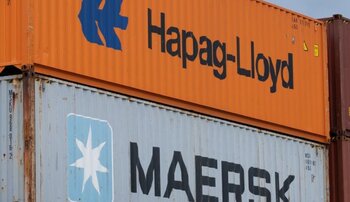
The Gemini network alliance between Maersk and Hapag-Lloyd, which has been in place since 03FEB25, could inspire other players to follow suit. This was indicated by Hapag-Lloyd CEO, Rolf Habben Jansen, during his shipping company’s traditional New Year’s dinner with media representatives in Hamburg’s Hafen City last week. The impetus for this are the positive performance and convincing results achieved by the maritime partnership since its inception.
Outstanding schedule punctuality
Currently, 350 container vessels from Maersk and Hapag-Lloyd are operating under the Gemini flag. The result from the perspective of the Hamburg-based shipping company: After initial adjustment processes, costs decreased and the on-time arrival rate surpassed the 90% mark at the end of last year. According to Xeneta, the leading ocean and air freight rate analytics platform, this highlights “that the Gemini Cooperation occupies a prominent position due to strategic decisions such as reducing port calls and utilizing vertically integrated terminals. These measures, along with a strong focus on the North American market, have favored the daily operations of the alliance.” With this reliability rate, Gemini has left the competition far behind, as a comparison by Xeneta shows. This adherence to schedules fosters customer loyalty and ultimately pays off in the form of more volumes and higher sales.
Further above-market growth is expected
Asked about Trump’s punitive customs policy and its impact on Hapag-Lloyd’s U.S. business, Habben Jansen said that the tariffs had indeed had a negative effect on his shipping company’s traffic to and from the States. Tariffs are poison for international trade, but above all, the constant back-and-forth on tariffs makes supply chain planning a lottery, the executive criticized. In contrast to the contraction in tonnage to and from the U.S., traffic on the routes between Europe, South America, Africa, and Asia grew by 6.5% in 2025. That is 1.5% above market average. For 2026, he expects a slightly lower increase in shipment volume, reaching +5%. If this happens, it would be the third consecutive year in which Hapag-Lloyd has grown above the global ocean transport market.
Suez transit remains critical
The focus of the evening was on the pros and cons of Red Sea transits. CMA CGM and Maersk have already completed their first passages through the Suez Canal. However, a few days ago, CMA CGM made a U-turn, announcing that it would stop transits of its FAL1 and FAL3 rotations connecting Asia and Europe via the Suez Canal, and return to lengthier sailing around the Cape of Good Hope.
Habben Jansen commented: “Three or four weeks ago, I was still optimistic about the Suez routing. However, new threats from the Houthis have made these Red Sea crossings unsafe again. Therefore, we will continue to circumvent Africa until further notice, even if this adds 10 or 12 days to a vessel’s journey. Our primary goal is to protect our seafarers and ships as best we can and to stabilize supply chains. A policy of constant ins and outs produces nothing but chaos.”
Eyeing e-commerce
When asked by CargoForwarder Global whether e-commerce could become an interesting business area for Hapag-Lloyd should the Red Sea risks be eliminated and sailing times significantly reduced, the manager confirmed his shipping company’s interest. “Even if e-commerce would only add 1% to our total cargo volumes, it would increase our sales.” A sea-air combination is also a feasible option, he said.
In contrast, he denied any ambitions to enter the sea transport of military goods. Hamburg, the home port of Hapag-Lloyd, is developing into an important hub for military equipment. However, there are specialists with experience and professional handling expertise for the maritime transport of these goods, he replied.
Finally, the executive confirmed growth plans for the subsidiary, Hanseatic Global Terminals, to acquire stakes in/or take over additional port facilities. Its portfolio currently comprises 22 assets. By the end of 2026, this figure is expected to rise to 23 or 24, with 30 terminals planned by 2030.
Gemini rival CMA CGM and investor Stonepeak inked Terminal JV
The joint venture named United Ports LLC is backed by USD 2.4 billion and based in the USA. It spans 10 major CMA CGM-operated port terminals worldwide.“The creation of United Ports LLC […] marks an important step in the development of our terminal activities in the United States and globally,” stated Rodolphe Saadé, Chairman and CEO of CMA CGM Group. The executive went on to say: “Through this strategic partnership, we bring together ten CMA CGM-operated terminals across six countries, including major facilities such as FMS in Los Angeles, Port Liberty in New York, Santos in Brazil and Nhava Sheva in India. By joining forces with a partner with strong infrastructure expertise, we strengthen our ability to invest further in our port terminals, secure access to key gateways and enhance service quality for our customers.”
Both players state that their JV forms the basis for a long-term relationship between their companies, including the potential to develop and support future investment capacity and new terminal projects in the U.S. and globally. As part of the transaction, Stonepeak will have the opportunity to contribute an additional USD 3.6 billion in funding for future joint terminal projects.
“Container terminals play an essential role in global trade and are among the most difficult to substitute or replicate transportation infrastructure assets,” said James Wyper, Senior Managing Director, Head of U.S. Private Equity, and Head of Transportation & Logistics at Stonepeak.
The transaction is expected to close in the second half of 2026, subject to customary regulatory approvals, including relevant antitrust and foreign direct investment approvals.