
Every week, CargoForwarder Global’s ‘Spotlight On…’ highlights the many different paths into and across the air cargo industry. An airport’s air cargo volumes and attractiveness to air freight operators is largely dependent on what it offers by way of infrastructure – from warehouse space through to office facilities, cargo community systems and networks, customs processing, road and rail connections, etc. The stronger the focus on providing that infrastructure for air cargo, the better it works. Brussels Airport Company regularly punches above its weight in number of cargo fields – particularly high-value, time-critical segments such as vaccines and life-sciences, which has earned it a reputation as Europe’s ‘pharmaceutical gateway’. This week, Birthe Deckers (BD), Business Analyst – Cargo & Logistics at Brussels Airport Company, talks us through her work and shares views and advice on forging a career in the air cargo industry.
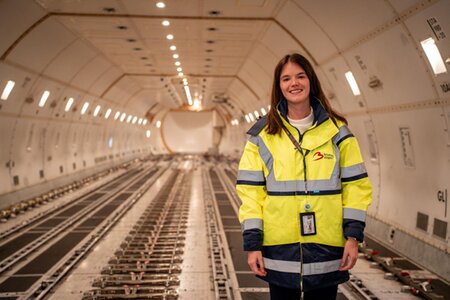
CFG: What is your current function and company? And what are your responsibilities?
BD: I work as a Business Analyst at Brussels Airport within the Cargo & Logistics Management Department, a role I have held since February 2024.
My main responsibility is to analyze and visualize data from various cargo‑related sources to provide insights into market performance and operational efficiency. I translate complex data into clear, meaningful information that supports decision‑making opportunities to optimize processes.
I work closely with internal colleagues to discuss findings and improve workflows, and I regularly present insights to external stakeholders during cargo clusters and steering groups.
In addition, I collaborate with IT specialists to automate manual reporting and data processes, improving efficiency, reliability, and data accessibility across the organization.
CFG: What does a normal day look like for you?
BD: There are very few standard working days in air cargo, and my role is no exception. I usually start the day with a clear plan, based on ongoing analyses or projects, but priorities often evolve as ad-hoc questions arise from colleagues across the organization.
Responding to these requests frequently involves quick analyses or clarifications based on available data. This balance between structured planning and adapting to changing priorities reflects well the dynamic and fast-paced nature of the air cargo industry.
CFG: How long have you been in the air cargo industry, and what brought you to it?
BD: My interest in aviation started at a young age and strongly influenced both my studies and career choices. During my education in Logistics Management, a turning point came in 2017, when I attended an Air Cargo Belgium event on the recommendation of a lecturer. That experience confirmed my interest in air cargo, and I soon joined the Young Airfreight Network (YAN).
Alongside my studies, I gained practical experience through roles at DHL Global Forwarding Brussels, Caterpillar Distribution Services Europe, and TUI fly Belgium, as well as an airfreight internship at DHL Global Forwarding in Dubai.
My first full‑time role was at Nallian, an IT company specialized in digital air cargo solutions, where I worked closely with a wide range of industry stakeholders and gained a strong end‑to‑end understanding of the cargo ecosystem.
In parallel, YAN has played an important role in my professional development. I have been actively involved since 2017, joined the organizing committee in 2022, and became a member of the YAN Management Team in September 2025. Through this role, and through my position at Brussels Airport, I collaborate closely with Air Cargo Belgium to support initiatives for young professionals in the cargo community.
CFG: What do you enjoy most about your job?
BD: What I enjoy most is the unique airport environment. Whether in the passenger terminal or the cargo zone, it truly feels like a city of its own, built on strong collaboration and a close‑knit community.
This becomes especially visible during moments of disruption, when all stakeholders work together to ensure that critical goods reach their destination quickly and safely. Although my role as a Business Analyst is mainly behind the scenes, I find it particularly rewarding to see how data‑driven insights translate into concrete solutions and tangible value for our customers.
CFG: Where do you see the greatest challenges in our industry?
BD: The greatest challenge lies in finding the right balance in an industry that is unpredictable, capital‑intensive, and heavily regulated, while expectations continue to rise. Air cargo is already becoming faster and more sustainable, all while coping with volatile demand, high costs and strict compliance requirements. Successfully managing these competing demands will require close cooperation across the entire supply chain.
CFG: What advice would you give to people looking to get into the air cargo industry?
BD: Passion and genuine interest are essential, as air cargo is a fast‑paced environment where adaptability is key. The ability to work under time pressure, prioritize effectively, and make decisions with limited information is a major asset.
From a training perspective, backgrounds in logistics, supply chain, aviation, or data analysis are valuable, especially when combined with hands‑on operational experience. Industry‑specific courses such as IATA cargo or Dangerous Goods training can also be a strong advantage.
Above all, curiosity, resilience, and a willingness to learn continuously are crucial for building a long-term career in air cargo.
CFG: If the air cargo industry were a film/book, what would its title be?
BD: ‘The Invisible Lifeline’. When people look up to the sky, they usually think it is a plane with passengers. Air cargo operates largely behind the scenes, yet plays a vital role in keeping the world running by transporting critical goods across continents at speed.
It becomes most visible when disruption occurs, and its importance suddenly becomes clear.
That combination of indispensability and invisibility makes The Invisible Lifeline a fitting title for the industry.
Many thanks, Birthe!
If you would like to share your personal air cargo story with our CargoForwarder Global readers, feel free to send your answers to the above questions to cargoforwarderglobal@kopfpilot.at We look forward to shining a spotlight on your job area, views, and experiences.