
The seed for a close SAF collaboration was planted at a previous ILA. There, India’s solar-power operated airport Cochin showcased a potential eSAF concept and an alternative to powering the facilities and buildings with fossil energy. Four years later, not much progress was made in the world regarding eSAF. India, however progressed in renewable energy deployment and expressed its interest to partner with like-minded players in the EU. To some extent, this collaborative intent was driven by German peers. At the recent Berlin-held air show ILA, the status of Sustainable Aviation Fuel in aviation, particularly cargo traffic, was one of the hottest topics discussed on and off stage.
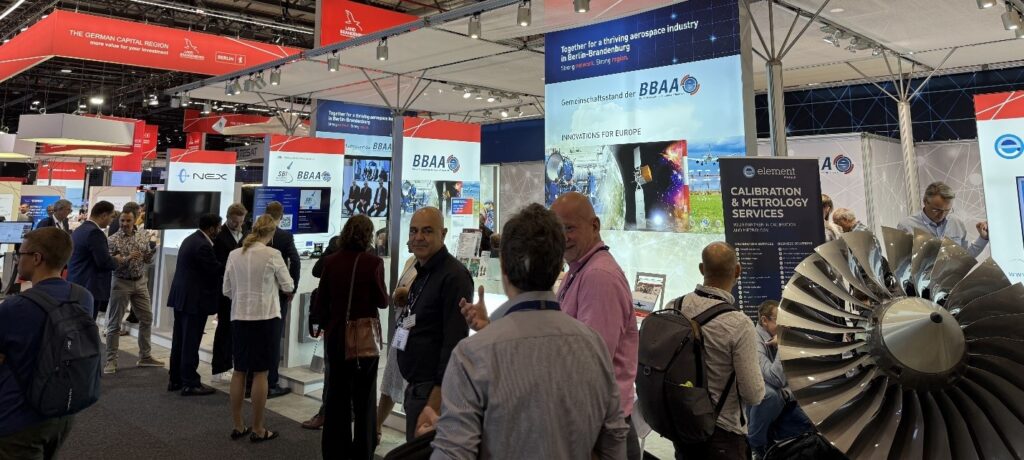
Renewable energy can be stored and exported as Green Hydrogen, or its derivative green ammonia for shipping purposes. This is part of Germany’s fuel resilience plan, in combination with decarbonization and greenhouse gas reduction, as demanded by ReFuelEU. But where are the SAF plants that can make use of economical Green Hydrogen from India? What hinders faster development? This subject was intensely discussed at a panel hosted by our author, Hugo Duchemin, during the recent Berlin air show (ILA) at the BBAA (Berlin-Brandenburg Aerospace Allianz) stand. Replay of Panel
Adamant support by Hydrogen Europe
The institution’s aviation manager, Laurent Donceel, clearly deplored the slow pace with which EU-India MoU’s get transformed into concrete action, and moreover, that they don’t develop more quickly into broader opportunities such as methanol as a pathway to SAF. He emphasized the fact that mandates are not taken seriously enough as targets for transition to SAF, but rather pushed aside by some airlines, with the excuse that not enough SAF is available. That more than welcomed critical statement was supported by the two panelists of Germany’s global cooperation agency GIZ, one on stage and the other online connected from India: engineers Torsten Schwab and Sarthak Agarwal commented from a technical and logistical point of view how the precious feedstock from India can contribute in very realistic ways to ramping up SAF not only in Germany but across the block’s 27 member states.
No more excuses!
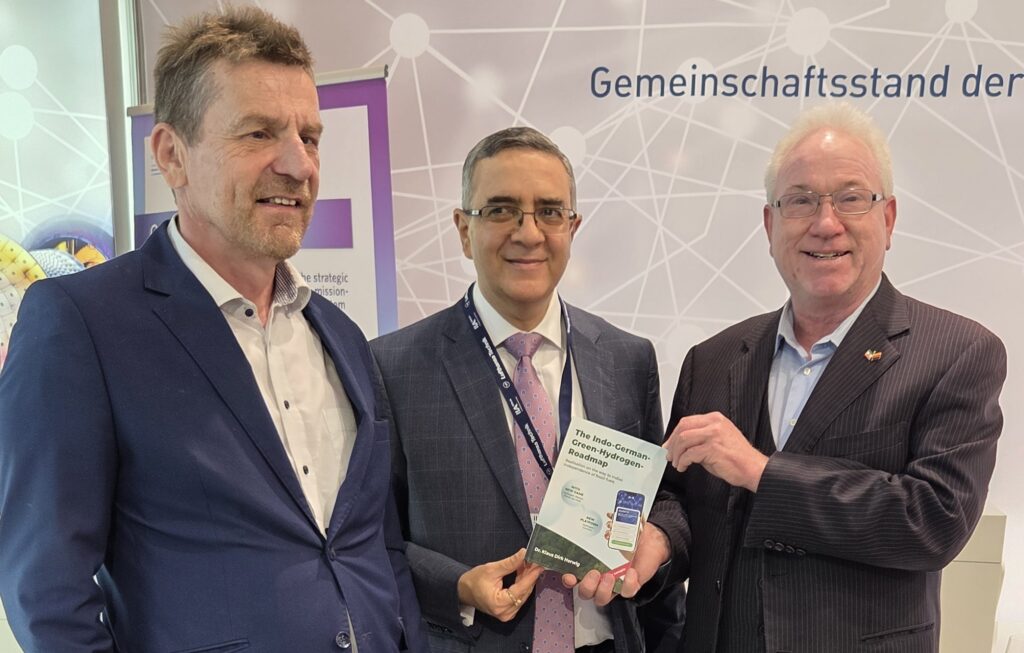
Olaf Krawczyk of Invest in Niedersachsen (Lower Saxony) then hit on that same nail with another hammer, explaining how the German North Sea ports Wilhelmshaven and Stade are offering a growing and meanwhile well-developed infrastructure for hydrogen imports, including ammonia-cracking and hydrogen pipeline extension. That is of course in the DNA of this federal state, having already the strongest renewable energy production of the nation, with respective hydrogen project development. Last but not least, hydrogen professor Dr. Klaus Dirk Herwig calculated for everyone’s benefit how importing hydrogen from India results in double-digit bottom-line savings, all transportation and transformation cost included.
India opens the gates to progress
Celebrated the day before on the same stage with India’s ambassador to Germany, Mr. Ajit Gupte, the growing partnership must be more than an enabler, rather an engine. Several delegation visits to India by Dr. Herwig with the Indo-German Chamber of Commerce have brought suppliers into constructive discussions with German hydrogen specialists and led to a major trust basis. Concrete projects like joint eSAF development will bring even more partnerships in engineering, aviation and aerospace. The Federation of Aviation Industry in India was represented in another panel the same day by their board member Dr. Vandana Singh. The message is clear: a dynamic and beneficial industrial and commercial exchange will fire up mutual innovation impulse on each side.
The sky is not the limit, it’s where to start!
This mantra can be taken literally when considering the brand-new space research partnership between Berlin and Bangalore, with many Indian guests being welcomed by BBAA’s CEO Dr. Karsten Mühlenfeld & team, and a more formal long-term agreement to be sealed at the Bengaluru Space Expo 7-9 September. And since space rockets fuel on hydrogen, here are eSAF synergies again.
Main takeaway: Collaboration between Indian airports and initiatives and their German peers on SAF has begun, seen by the airport of Cochin and its German partner BBAA. What is needed now are not new documents or presentations on SAF’s contribution to curbing greenhouse gas emissions from aviation, but practical steps that serve as examples and as inspiration for follow-up projects. Fact is that the foundations have been laid. After four years of consultation and discussion, the practical implementation of the announced SAF cooperation between Indian fuel providers and their German / EU contractors must now take place – to the mutual benefit of both sides. To be followed up at the Paris Air Show 14-20 June 2027, where BBAA has their own stand for the first time, with more SAF panels and clear targets. The countdown is on!
Hugo Duchemin