
Qualified logistics professionals are highly sought after by the industry. For young talent, a university degree (bachelor / master) is a welcome foundation to launch a career, as is a completed apprenticeship, such as in freight forwarding. However, there is a third option: retraining from a completely different field to become a specialist in air freight import/export, or a customs broker, to name just two job options. This opens up additional recruitment opportunities for companies looking to fill staffing gaps.
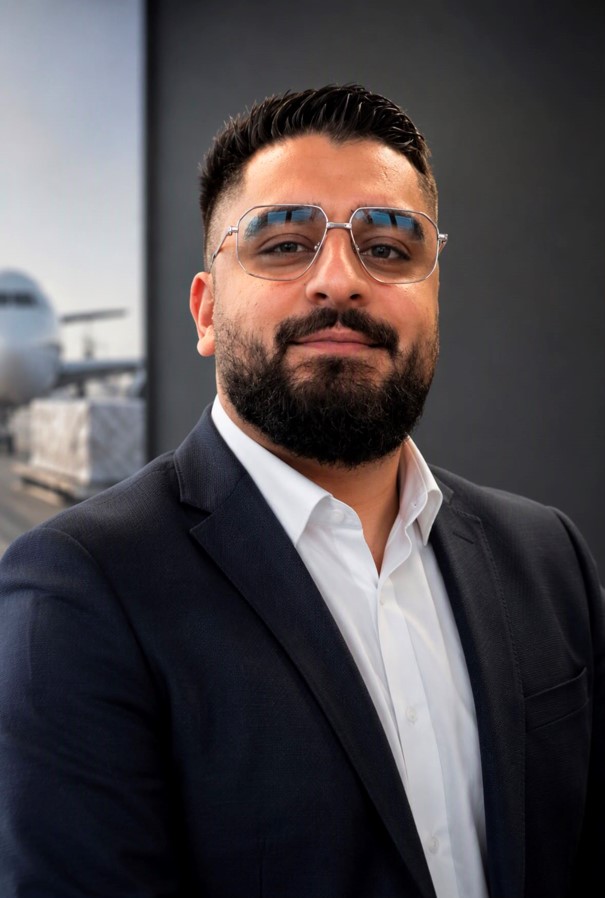
Can Han (CH) has taken this path. Thanks to participating in a training course at the Frankfurt Logistic Training Center (LTC), he now works as an expert in air freight import and export. We spoke to him about his journey to finding a new career and the experiences he gained along the way, which might encourage others to follow suit.
CFG: Can, welcome to the world of air freight. What motivated you to take this step?
CH: After earning my vocational high school diploma, I worked for various companies, including jobs in the meat wholesale and automotive industries. Then my uncle, who himself had completed retraining at the Logistics Training Center many years ago, recommended that I do the same. Through conversations with him, my interest in air freight and the broader logistics industry was piqued. To be fair, the better pay in logistics was also a motivating factor for me, compared to my previous jobs.
CFG: How did you manage the transition from your training courses at LTC – which included hands-on activities – to your current professional position?
CH: Fortunately, I didn’t experience culture shocks during the transition. Thanks to the technical and theoretical knowledge imparted by the LTC experts during my retraining, I was able to familiarize myself quite quickly with the operational processes in air freight and wider logistics. The technical knowledge I gained in class, and the practical case studies presented by the instructors, made it much easier for me to understand the real-world processes of day-to-day operations. It quickly became clear just how essential communication skills, flexibility, and organizational skills actually are in the day-to-day work of a cargo or freight forwarding company.
Following the LTC training, I found my footing after a relatively short time at my new employer and became an integral part of the team there. This was also due to the fundamentals taught at LTC being perfectly tailored to the demands of the workplace. As a result, my onboarding at the company went smoothly. Of course, the support and acceptance of my new colleagues helped a great deal.
CFG: Which phases during your training did you find most challenging, and how did you overcome them?
CH: I think that for many people, retraining represents a major turning point in their professional lives. After all, it’s a transition in one’s career: the transition from a familiar environment to a completely new job and industry. This requires courage, determination, and the willingness to go back to school and continuously acquire new knowledge. In my case, I benefited from the understanding and support of the instructors, as well as the regular and very open exchange with other course participants.
CFG: Were there any particularly positive or negative surprises during your vocational training?
CH: For me personally, the versatility and dynamism of cargo and logistics were a positive surprise – something I hadn’t expected. Today, I experience on a daily basis that the logistics world never stands still, which is what makes the industry so fascinating. Examples of this constant change include digitalization and the growing use of AI to make processes more efficient and optimize workflows. Personally, I find this very exciting, enriching my daily work. On the other hand, I can understand that some people might feel overwhelmed by this rapid change.
CFG: When looking back, how relevant to real-world situations was the training at LTC?
CH: The course instructors taught sound theoretical logistics fundamentals with a very practical connection to everyday work. Through self-discipline, regular studying, and constant interaction with other course participants I was able to overcome initial challenges and manage the large volume of teaching material, while the instructors provided us students with tailored support. Thanks to these experiences, my confidence grew even during the retraining program, which – at least for me – contributed significantly to my vocational success.
In particular, the combination of structured organization, forward-looking planning, and the independent solving of complex, practical tasks has raised my interest in this professional field.
CFG: If you were in a similar situation, would you choose this path again?
CH: Absolutely. That said, course participants are expected to be eager to learn and to take the initiative. Anyone who doesn’t have those qualities should pursue a different career path.
CFG: Can Han, thank you for your insights, and we wish you continued success as an expert in air freight imports and exports.