
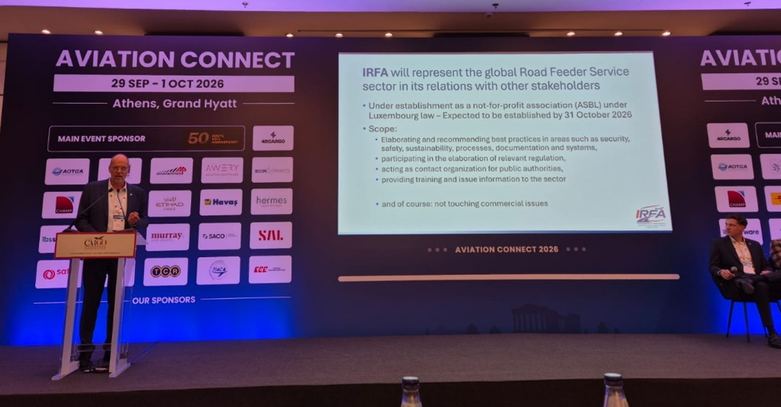
Bang in the middle of Aviation Connect’s 3-day conference agenda in Athens/Greece, this year, was a lunchtime slot bearing the enigmatic title: “The Big Reveal”. Initially sold as a press event, it was opened up to all interested parties, without the slightest indication as to the actual topic. Curiosity trumped hunger and, at 13:00 on 30SEP26, a good many pairs of ears and eyes bore witness to what turned out to be an historic and long sought-after industry milestone: the birth of an interest group dedicated solely to the many challenges facing the road feeder industry all across the globe. Introducing the International Road Feeder Association – or IRFA, for short.
Two years ago, following the RFS stream’s successful debut at the Aviation Connect event in Türkiye (CFG reported), Jason Breakwell, then Commercial Director of Wallenborn Transports (now CCO), underlined: “RFS is an increasingly important part of the air cargo ecosystem and needs to have a seat at the table prior to infrastructure developments, digital integration, or sustainability policies.” That seat at the table is now being prepared.
Two years in the making
Ram Menon, Wallenborn Transports’ COO, revealed that the IRFA idea had been conceived at the bar one evening at that Istanbul event in 2024. The concept was revisited in Copenhagen the following year, with the decision to bring it to fruition landing on the RFS stream’s lengthier to-do list. “We’ve been working on this for two years, now,” Ram explained, lightheartedly, “Thanks to Henrik [Ambak] who has been bullying us to get it sorted and is really the driver behind this.” More seriously, he emphasized: “IRFA has been a long time in the making and long time necessary. The criticality of RFS is huge – if trucks don’t run, planes don’t fly full. Yet, we’ve never had a voice.”
Six founding fathers and an experienced Chairman
At least 7 voices have now come together: six RFS companies representing Europe, the USA, and Australia, and Henrik Ambak as the association’s veteran Chairman, have formed the foundation of what promises to be a fast-growing group even before its official registration as a not-for-profit association under Luxembourg law is completed by the end of this month.
Why Luxembourg? Henrik Ambak tells CFG that it was a choice between Luxembourg and Switzerland, as those two countries offer the most favorable conditions for NPOs, and geographically, Luxembourg was most convenient for the current circumstances. That IRFA has secured Ambak as its Chairman, is also a huge benefit, since his entry to the world of logistics began at the deep end of RFS network planning, already back in 1985. Over the past 41 years, there isn’t much of the air cargo industry that he hasn’t seen or been involved in.
Signing the statement of intent
Five of the six founding fathers came forward to officially sign their Statement of Intent in launching the International Road Feeder Association, on stage on 30SEP26, and share the reasons for its creation. Announcing the news, Henrik Ambak, IRFA Chairperson and Secretary, ceremoniously stated: “RFS companies representing the world, proudly present the International Road Feeder Association!”, before inviting each company representative to sign the Statement that already bore the signature of Justin Bailey, CEO of Wymap Transport in Australia, who unfortunately had been unable to attend the event. Introducing Arthur Welter Transports, Georgi Transporte, Jan de Rijk, and Wallenborn – all from Europe, and Thor Xpress Transport LLC from USA, Ambak shared that the 6 companies alone have a combined fleet of more than 2,100 trucks, and support airlines in moving over 8.2 million tons of air cargo every year.
Why IRFA?
Christian Georgi, COO, Georgi Transport in Germany, explained that “RFS has been around for many years, starting in the 1970s as cargo aircraft and hubs began.” The trucking industry has become increasingly important as it connects offline stations and destinations with the global air cargo network. “In Europe,” he said, “more than a third of all air cargo to or from the continent starts or ends its journey with an RFS service provided by an airline.” Yet, in its current form, there are many areas for improvement.
Ram Menon, COO of Wallenborn Transport, Luxembourg, illustrated the slow and complex process of agreeing on legal contract aspects, and revealed that the IRFA would be concentrating on rolling out an international Service Level Agreement similar to the Standard Ground Handling Agreement that is in place between airlines and ground handling service providers. “A standardized template would help tender, contracting, and service follow-up processes for both airlines and RFS providers,” and would serve as a form of credibility to airlines.
From legal standards to many other standards
Kirk Ejdys, Owner of Thor Xpress in the USA, added that IRFA would also “focus on correspondence and data information coordination with GHAs, information flow, digital slot allocation, timing, and many things that we as the trucking community feel could be more efficient when we show up at the GHA.” The key aim – to reduce redundant waiting times, which not only add massively to a cargo journey, but also risk knock-on effects of drivers running out of legal driving time, resources being used inefficiently, and possibly failing to serve other customers because of these delays.
David Smorenburg, Business Development Manager at Jan de Rijk, Netherlands, pointed out that “driver shortage is a big topic” and pointed out that the factors that could attract more interest from people to become drivers, were fitting facilities and the right treatment. Drivers should have access to showers, toilets, rest areas and facilities, and a good work environment that ensures a safe journey and offers respect.
Sustainability and data transparency
Michael Rau, CSO of Arthur Welter Transport, Luxembourg, brought up sustainability: “It is no longer a future topic, but a shared responsibility across the entire supply chain of air cargo, today. Many of us are investing in modern, efficient fleet and following the development of electric and hydrogen RFS, but infrastructure is needed here, so IRFA wants to bring together stakeholders to accelerate development, create a platform to develop standards, share BDPs, and combine industry interests.”
On behalf of Justin Bailey, CEO, Wymap Transport, Australia, Henrik Ambak spoke of data transparency being essential for shipment movements from origin to destination “so IRFA will ensure best possible support for best possible visibility.” He also encouraged the audience to keep track of the association’s landing page (it will grow into a website shortly) at www.irfa.aero, and to contact info@irfa.aero for more information. More members would be welcomed with open arms.
A welcome move!
Glyn Hughes, as outgoing Director General at The International Air Cargo Association (TIACA), was the first to congratulate the new association: “We welcome IRFA to TIACA and look forward to collaborating!” The general response both in the room, in the later RFS panels and online, was one of relief that the segment was coming together. At least two more RFS companies (one of them in India) pledged their support and interest in joining IRFA.
With the vast number of regional and global challenges, IRFA has its work cut out for the future, however, with greater collaboration and the industry speaking as once voice, improvement should be on the horizon. David Smorenburg declared: “We want a bigger voice at the table and press the GHAs to become more efficient, more quickly, so that we can use our resources more efficiently,” and Kirk Ejdys agreed: “IRFA gives us an opportunity to get a seat at the table, and like the saying goes: if you’re not at the table, you’re on the menu!”