
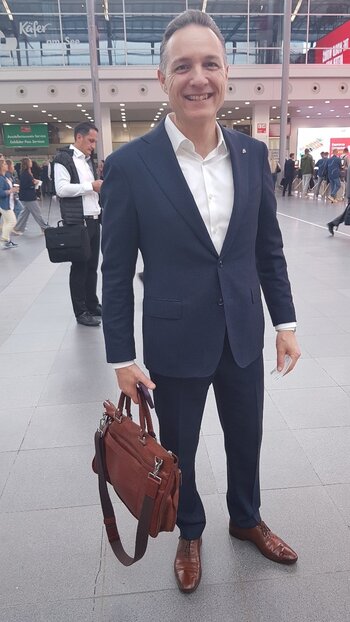
Alain Chisari (AC) heads Swiss WorldCargo since 01OCT24. He succeeded Lorenzo Stoll, who left the company. Since taking the helm of the cargo division, the 53-year-old has not yet given an interview to any media. So, CargoForwarder Global (CFG) is proud to be the first publication given this opportunity.
CFG: You have held various positions at SWISS since 2008. However, you have only had marginal involvement with air freight so far. How would you describe the learning curve since you have been responsible for Swiss WorldCargo?
Alain Chisari: It has been extremely strong so far and continues to be so. This is because the cargo business is very different from the passenger business in many respects. It is very complex because many players are part of the supply chain. You have to get to know this community and understand their needs. When comparing the two sectors, I have noticed that air freight lags behind passenger traffic in terms of technology, which is due to the complexity of the processes and the involvement of many different parties along the supply chain.
Small yet powerful
CFG: Swiss WorldCargo has made a name for itself as a quality carrier. “Cheap is cool” is not part of your pricing model. Apparently, this does not bother forwarders and shippers, as sales figures evidence.
AC: Our reputation for quality that has its price, precedes us. Since they fit our home and key markets, we have a strong focus on special products such as valuables, pharmaceuticals, works of art and express items, to name but a few. In a nutshell, ‘small yet powerful’ best characterizes our business model.
CFG: What is Swiss WorldCargo’s carbon footprint?
AC: To be honest, it is still too high, but we are highly committed to doing our homework. We adhere to the EU requirement that 1% of our kerosene must consist of green fuel, increasing to 2% next year. To this end, we participate in the Lufthansa Group’s kerosene pool. We also established a partnership with Climeworks, an innovative Swiss-based company that stores part of the emitted CO2 emissions underground through plants built in Iceland. In addition, we use containers from various providers which are lightweight. Furthermore, we use cardboard pallets (made of recyclable materials) to reduce weight on some routes as trial cases. Through various efforts for a more sustainable air freight industry, we intend to remain pioneers in sustainability, and we will continue, with our improvements, to meet our targets.
CFG: Freighters are still not an issue for SWISS – are they?
AC: No, we are marketing the lower deck compartments of our passenger fleet. Ten A350s are on the horizon for SWISS and Swiss WorldCargo – the first of which will be delivered in the second half of 2025. In return, four A340s will be retired. All in all, that’s an increase of six long-haul aircraft, with the corresponding underfloor capacity for cargo transportation.
There will be no cannibalization
CFG: What role do the Edelweiss bellies play in your concept?
AC: Our subsidiary, Edelweiss, is a leisure airline operating its own network. It therefore covers complementary markets than our core fleet. It focuses, for example, on destinations in Central America, the Caribbean, or Tampa, Denver, and Seattle in the USA, to name just a few. The lower deck capacity of its fleet is marketed by Swiss WorldCargo. In 2023, Edelweiss also introduced services to Bogota and Cartagena in Colombia. That said, flights to some other destinations will be increased as well.
CFG: In your previous role within the Lufthansa Group as Implementation Officer, you paved the way for the integration of ITA into the Group. What is your verdict on the outcome?
AC: It was a long start-up phase, but the processes have now been settled. With 99 aircraft, ITA’s fleet is approximately half as large as that of its predecessor, Alitalia, in 2012. Expanding the long-haul routes is interesting from the Lufthansa Group’s point of view and also from an air freight perspective.
Speaking about cargo: There will be no cannibalization. The customer in northern Italy or Tyrol, for example, decides whether a shipment is flown with Swiss WorldCargo, ITA, or Austrian Airlines, and whether this is done via Zurich, Vienna, Munich or Rome. The multi-hub, multi-brand strategy applies, from which shippers and consignors benefit equally
CFG: Alain, thank you very much for this interview.