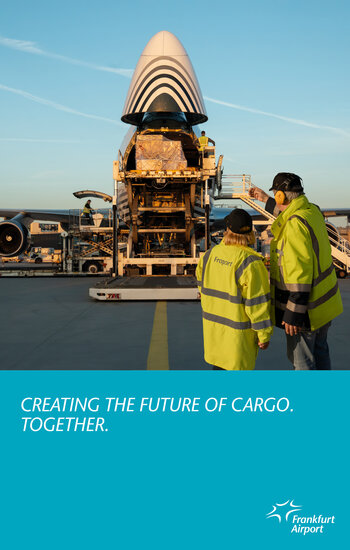

The annual trade shows orchestrated by the Air Cargo Community Frankfurt (ACCF) have meanwhile become legendary. The upcoming event, the tenth in a row, is out to set completely new standards. It will take place from 03-04SEP25, and be held at the Adler Business Club lounge of Deutsche Bank, located within the stadium of soccer club, Eintracht Frankfurt. Not only is the location unique, but the agenda is packed with hot industrial and political topics. Hence, the two days promise plenty of excitement, discussions and many new insights. And there will be ample opportunity for networking in a relaxed atmosphere.
To whet our readers’ appetite for the event, CargoForwarder Global (CFG) asked Felix Toepsch (FT), Head of ACCF, to illustrate and comment on the key points of the trade show.

CFG: Von der Leyen and Trump recently agreed on a tariff deal. It provides for customs duties of 15% imposed on most goods produced in the EU and sent to the U.S. Will this very controversial accord and its impact on international trade and the transport industry, be an item on the ACCF agenda?
FT: We have been observing a highly dynamic geopolitical environment for several months now. Many of these changes have a direct or indirect impact on air cargo demand, transport routes, pricing, and more. Of course, it was immediately clear to us that the dynamic shifts and their implications for international trade and the transport industry, must be addressed at the conference.
Therefore, we will begin the event with the topic block ‘General Economics and Outlook’. Dr. Vincent Stamer (Senior Economist, Group Research, Commerzbank AG) will kick off the session with ‘The Future of Europe’s Trade: Risks and Realities’. Following this, Glyn Hughes (Director General, TIACA) will provide an assessment of the developments and their impact on the air cargo industry.
What makes this topic particularly interesting is that, due to the almost daily news and developments, we cannot predict what the global landscape will look like by the time of the conference in early SEP25. These ongoing uncertainties are one reason why we expect that this year’s presentations will likely be finalized at the very last minute.
CFG: Even though many points still need to be negotiated, the question already arises as to how the U.S. – EU deal should be assessed from the perspective of air freight operators transporting goods across the Atlantic, for example: between Frankfurt (FRA) and New York (JFK).
FT: This question needs to be addressed at the conference – both during one of our panel discussions and through the various networking opportunities available throughout the event.
From our perspective, a key issue is how the European air cargo community can collaborate even more closely in the future and present a united front when engaging with other regions of the world. This is an important consideration given the increasing complexity and competitiveness of the global air freight market.
I am therefore particularly looking forward to our Airport Panel on Day Two. We are very proud to have the leading five cargo hubs in Europe live on stage. Timo Stroh will interview the responsible board and executive members from the airports of Amsterdam (AMS), Brussels (BRU), Paris Charles de Gaulle (CDG), Frankfurt (FRA), and London Heathrow (LHR). This promises to provide deep insights into how European air cargo players can respond strategically and collectively.
CFG: Airport operator, Fraport, is eager to upgrade and enlarge its cargo infrastructure: What is the status, and which construction projects are next on the agenda?
FT: As part of the Masterplan CargoHub, Fraport is reorganizing existing areas in CargoCity South to strengthen Frankfurt Airport’s role as a leading cargo hub. This smart redevelopment will significantly enhance the airport’s future viability. Negotiations for the first area are ongoing and will be finalized by the end of the year. The next areas will be available in 2026. We expect the remaining areas in CargoCity South to be available by 2028.
Meanwhile, Fraport is planning the development of a new LogisticsHub West with a sustainable, digital, and smart infrastructure on a space totaling 250,000 m². The marketing of the first logistics warehouses is scheduled to start in 2028. The second phase includes the potential for airside access and a trimodal hub with a combined transport terminal.
CFG: Regarding the upcoming event taking place from 03-04SEP25, at the Adler Business Club (Deutsche Bank Park), Frankfurt am Main: The ACCF orchestrated meeting will celebrate its tenth anniversary. How does it stand out from other cargo conferences or symposiums, i.e.: what is its USP?
FT: Just like our industry, the conference itself has evolved dynamically over the past years. To mark the tenth anniversary, we are taking a significant leap forward with many exciting innovations.
One of the highlights will be the impressive setting of Deutsche Bank Park – where the heart of the European air cargo industry will gather in the so-called ‘Heart of Europe’. For the first time, we are introducing a dedicated exhibition area, giving companies the opportunity to present themselves and their products to the community. Additionally, on the first evening, we will celebrate our anniversary with a special party featuring BBQ, cocktails, and music. Guests will also have the chance to experience exclusive areas of soccer club, Eintracht Frankfurt, during two stadium tours, and enjoy many other highlights.
Beyond that, the program includes start-up pitches, an Innovation Award, insights into Formula 1 logistics and the logistics command of the German armed forces, as well as a range of carefully curated keynotes and discussions.
Of course, we have also prepared some surprises for our guests – but I won’t reveal those just yet!
However, one thing remains unchanged: The personal, familiar, and straightforward atmosphere that defines our conference and its participants. This unique spirit is what truly sets the ACCF apart from other cargo conferences and symposiums, and we are proud to carry this tradition into our tenth anniversary edition.
CFG: The conference will be held in close cooperation with the logistics start-up Lab HAUS61, and the Mobility & Logistics division of Messe Frankfurt Exhibition GmbH. The official announcement promises that the partners will create a platform which brings together established players and innovative minds to tackle the next steps in air freight. From ACCF’s perspective, what exactly are the next steps?
FT: From ACCF’s perspective, the next steps in air freight are about tackling industry challenges through the right combination of people, technology, and financial resources. Together with Lab HAUS61 and Messe Frankfurt, we are building a platform that brings established players and innovators together to shape the future of air cargo.
At this year’s conference, we will give visibility to new ideas, technologies, and solutions for our industry. The best of these will be recognized with the Future Cargo Innovation Award, supported by Lufthansa Cargo.
Digitalization, automation, sustainability, and stronger collaboration are key priorities.
CFG: And finally, how far has Frankfurt Airport and the cargo industry come in implementing data-driven, sustainable processes? Or to put it more bluntly: when will paper be a thing of the past?
FT: To drive digitalization and implement data-driven, sustainable processes, Fraport and the software company, DAKOSY, established the joint venture, allivate. The goal of allivate is to increase transparency, accelerate processes, and optimize resource use. One current project is the ‘Smart Pickup’ initiative, developed with allivate and the Air Cargo Community Frankfurt. This initiative replaces paper-based import pick-up procedures with a digital system via FAIR@link. This enhances efficiency, reduces costs, and improves security. A central component is the ‘Digital Authorization for Pickup’, which replaces the previous collection order. Pilot operations began in MAY25, and the full rollout across Frankfurt Airport is planned for the second half of 2025.
But digital transformation doesn’t stop there: In the future, additional paperwork such as the work order and the delivery receipt will also be eliminated. This means the process is not just becoming less paper-intensive – it’s evolving into a truly paperless import process.
CFG: Felix, thank you for your time and input.