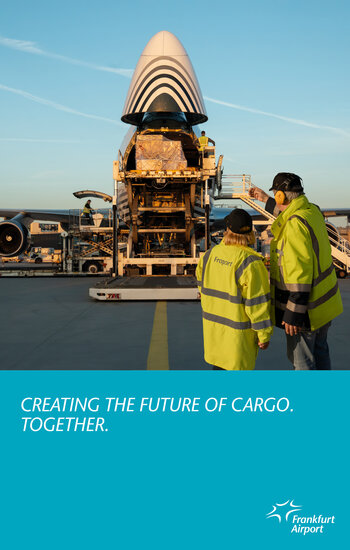

Global trade is entering a new phase of realignment, and Frankfurt Airport’s cargo hub has proven its strength in navigating shifting market dynamics. CargoForwarder Global’s guest author, Sebastian Bartscher, Senior Business-Analyst Cargo at Fraport AG, illustrates Frankfurt CargoHub’s 2025 achievements in the face of rising trade tensions and tariff adjustments, and how the German hub continues to consolidate its role as Europe’s gateway for cross-border e-commerce and resilient supply chains.
Frankfurt CargoHub stays resilient in 2025: e-Commerce and Asian exports boost air cargo amid trade conflicts.
The international trade landscape is undergoing a noticeable transformation. While some regions are forging ahead with impressive momentum, others remain at a standstill. In the first half of 2025, global trade grew by 4.9% year-on-year, driven primarily by strong exports from Asia (up 10.4%), whereas exports in Europe stagnated. With the overall macroeconomic situation improving, trade relations remained robust in regions not affected by tariff increases. So far, the negative effects of U.S. tariff hikes and ongoing trade uncertainty have been lower than expected, as other countries – apart from China – have refrained from implementing significant countermeasures. As a result, the WTO has revised its global trade forecast for the full year 2025 upward – from -0.2% in April to +2.4% in October. Reflecting this positive trend, global air cargo volumes are also projected to increase by approximately 2.5% overall. The main growth drivers are airports in Asia, which are forecast to achieve robust growth of about 5% in 2025. In contrast, European airports are likely to experience more moderate growth of around 2%, while North American airports are expected to stagnate.

The effects of de minimis
The abolition of the de minimis trade rule in the U.S. – which previously allowed low-value imports to enter the country without payment of customs duties or taxes – has caused notable shifts, particularly in global e-commerce shipment patterns. As a result, China’s exports to North America fell by 13.6% during the first nine months of the year (down 18.5% to the U.S. alone), while exports to Europe soared by 58.5% year-on-year. This development reflects a broader trend in how trade adapts to changing regulatory environments in key markets. Several European countries, including Belgium, Hungary, and Germany, experienced substantial growth in e-commerce volumes from China, with Germany recording an 83.8% increase in value and reaching a total of around USD 1 billion.
At Frankfurt Airport (FRA), cargo unloaded from China flights has once again become the main growth driver, with 214,500 metric tons of air cargo marking a 32.3% increase and setting a new historic record. Notably, the share of e-commerce tonnage on routes from China to Frankfurt has risen sharply and is currently estimated at around 35%. This momentum underscores the growing importance of the e-commerce sector as a key growth driver for the Frankfurt CargoHub.
Sino-German collaboration
To further strengthen the freight corridor between Asia and Europe, Frankfurt Airport and Shanghai Pudong International Airport recently signed a Memorandum of Understanding, establishing a strategic cargo partnership. Building on years of close cooperation – including last year’s roadshow in China – the new partnership aims to streamline regulatory processes, enhance efficiency in cross-border e-commerce, and jointly set new standards for handling global cargo flows. With e-commerce volumes between China and Europe rising sharply, and Shanghai serving as an important strategic market, the enhanced collaboration will enable both hubs to respond even more effectively to dynamic market developments.
With around 106,000 metric tons handled at FRA between January and September 2025, cargo from Shanghai accounted for about half of the incoming tonnage from China, an increase of about 20% compared to the previous year. In 2024, the Frankfurt–Shanghai route was Europe’s top air cargo route, with around 120,000 metric tons of cargo unloaded at Frankfurt Airport and a total volume of about 215,000 metric tons.
Air cargo forecast 2026: stable outlook despite global risks
For 2026, the WTO has revised its trade forecast downward from +2.5% in April to only +0.5% in October, partly due to the expected pull-forward effects from the increase in U.S. tariffs in 2025 and their long-term impact. In contrast, the Airports Council International (ACI) projects higher growth of around 3% for European and global airports in its latest World Airport Traffic Forecast for 2026.
Given developments in 2025, the ACI forecast for Europe appears optimistic but not unattainable, as air cargo traffic performed better than initially expected. For Frankfurt Airport, we anticipate moderate growth in 2026, comparable to that of 2025.
The decisive factor will be how the main trade routes develop amidst the ongoing tensions between the U.S. and China, the two largest air cargo markets. Overall, most industries have remained stable despite the global uncertainties, with key economic indicators such as Purchasing Managers’ Indices (PMIs) recently rising again. Air cargo demand has been growing for over two years now, driven primarily by strong e-commerce. However, there is a risk of growth being dampened in the coming year by persistent trade tensions, new EU regulations in e-commerce – including the planned abolition of the 150-euro duty-free threshold from 2026 – and a gradual shift from air to sea transport.
Flexibility is key
For logistics providers, flexibility remains crucial for responding quickly to short-term changes. Frankfurt’s CargoHub demonstrates its strength above all through close cooperation with a strong network of international partners. In an environment shaped by changing regulations, shifting trade flows, and geopolitical uncertainties, these partnerships form the backbone of a resilient and future-proof cargo hub. The air cargo industry as a whole has shown its ability to adapt flexibly to evolving circumstances – an advantage that benefits Frankfurt as well. By maintaining open dialogue with stakeholders and continuously adapting to market needs, the Frankfurt CargoHub will continue to successfully navigate challenges and seize opportunities in global air cargo. This strong partner network ensures that Frankfurt Airport remains competitive and well-equipped to meet the diverse requirements of customers – both now and in the years to come.
Author:
Sebastian Bartscher
Senior Business-Analyst Cargo, Fraport AG