
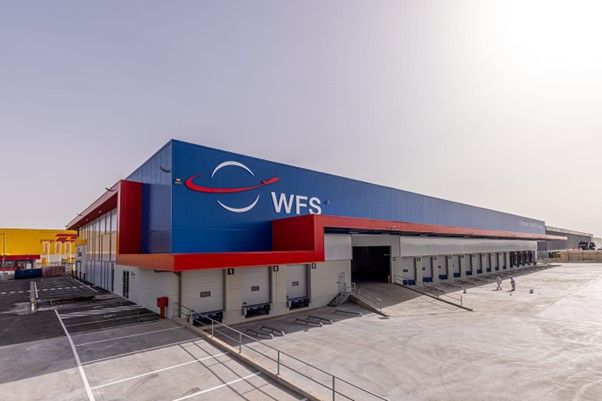
Cargo growth at Madrid-Barajas is no longer just a headline statistic – it is reshaping how cargo is handled on the ground. As volumes continue to rise and shipment profiles shift toward e-commerce and intercontinental transfers, ground handlers are under pressure to process more freight with fewer touchpoints. At WFS Madrid, that pressure is accelerating a practical digital transition focused less on technology buzzwords and more on reducing paper-based documentation, managing truck flows, and redeploying manpower where it adds operational value.
Madrid-Barajas Airport remains Spain’s leading air cargo gateway, handling close to 60% of the country’s air freight volumes. After strong growth of 22% in 2024, volumes continued to rise in 2025 with an additional 10% increase, supported by connectivity to markets such as Doha, Istanbul, and Bogotá. Sources: Aena and MADCargo.
Within this broader growth context, WFS Madrid is advancing its own digital roadmap, focusing on process efficiency, truck management, and paperless operations at station level. CargoForwarder Global spoke with Rosa María Míguelez, Technology Business Partner – EMEA Cargo, at WFS.
Digital reality for a Ground Handler
For ground handling companies, digitalization has not been optional. “Our job is to move cargo, not data,” Míguelez explains. “But the industry reality means we have to manage both.”
Despite long-standing industry initiatives, the electronic Air Waybill (eAWB) is still not fully adopted. WFS Madrid continues to receive a significant number of paper AWBs which then require manual processing and digital conversion before being transmitted to airlines. This gap alone has justified targeted investment in document handling and data conversion tools.
Another constraint is the lack of early shipment information from freight forwarders. Without advance data, workforce and dock planning remain difficult, and traditional peak days – particularly Mondays and Fridays – continue to dominate operations.
At station level, digital tools are still often seen as a cost rather than an efficiency-driver. At WFS Madrid, the focus is on reducing manual documentation and redeploying staff to higher-value operational tasks, where return on investment is tangible.
Truck flow management and visibility
Among WFS Madrid’s current initiatives is the implementation of truck pre-announcement and self-service kiosks to manage arrivals and pre-assign dock doors. The system is already in use, with full functionality planned for 2026.
“In continental Europe, we subcontract all transport including a large share of Road Feeder Services,” Míguelez says. “Pre-assigned dock doors help us manage throughput and reduce congestion.”
To reduce peak-hour bottlenecks, WFS is also building slot-booking into the process, allowing transport providers to request loading and unloading windows in advance, and helping stations plan resources more accurately.
WFS has launched an RFP for truck traceability solutions to replace today’s fragmented tracking – often handled through phone, email, or messaging – and to manage consolidated loads carrying multiple manifests. Initial deployment will focus on Spain, France, and Belgium, with the longer-term objective of integrating a Transport Management System and creating a real-time ‘control tower’ view of truck movements.
Toward zero paper at station level
Document management is another pillar of WFS Madrid’s digital roadmap. The objective is to eliminate paper across flight-related processes, including the flight pouch, dangerous goods declarations, and operational documentation.
Standardization remains challenging. Even within Spain, cargo security procedures differ between Madrid, Barcelona, and Valencia. “We are talking about one country, but with different processes,” Míguelez says. “In many cases, Madrid is the final security step, which adds operational complexity.”
Lean Six Sigma as a decision framework
WFS uses Lean Six Sigma methodology to prioritize digital initiatives and allocate resources. Digitalization projects are assessed alongside other process improvements, supported by ongoing internal training programs that involve a growing share of employees.
The impact is measurable. WFS Madrid has reduced working hours in import operations and lowered staffing needs at reception points through automation, while maintaining service levels.
A changing cargo profile in Madrid
Operational change is also being driven by shifts in cargo flows. Madrid was traditionally a key European entry point for perishable imports from Latin America, supported by connectivity and established customer hubs.
“That has changed significantly over the past two years. We are still a transit point for perishables, but the growth of e-commerce – especially from China – has been decisive,” Míguelez explains.
According to WFS, much of this volume has shifted from Zaragoza to Madrid. Rosa Miguélez was not fully certain about the reasons, but she believes the main driver is the stronger logistics connectivity offered by Madrid, which is more convenient for e-commerce.
Zaragoza was traditionally an important cargo airport for pharma and medical equipment, a segment that has significantly declined in Spain. In addition, Zaragoza is the export hub for Inditex (Zara, Massimo Dutti, etc.). Its relevance is largely due to its equidistant location from the main Spanish production centers (Madrid, Barcelona, Bilbao, and Valencia), which historically made it very convenient for domestically produced goods. Due to the reduction in pharma and medical equipment volumes, the airport has likely also lost overall cargo traffic.
To reduce imbalances as freighters frequently arrive full and depart empty, WFS has reconfigured storage space, increasing the focus on ULD management, and expanding the use of rolling equipment.
Madrid is also increasingly used as a stopover for cargo originating in China and destined for Latin America, reinforcing its role as an intercontinental transfer point.
The need for a stronger Cargo Community
Despite progress at company level, Míguelez points to a structural weakness at Madrid-Barajas: the absence of a strong, unified cargo community. “Airlines, forwarders, handlers, and transport companies still work too independently,” she says.
In other major European cargo gateways, airport-level cargo communities play an active coordinating role, aligning stakeholders around shared digital platforms, security processes, and operational standards. At Madrid, that level of coordination is still fragmented, limiting the effectiveness of individual digital initiatives.
As volumes rise and cargo flows become more complex, she argues that Madrid’s next competitive step will depend less on infrastructure and more on collective governance.
At Madrid Airport, airlines can choose between different cargo handling agents. IAG Group member, South, is the largest local player, followed by WFS and Swissport. Some smaller ones have specialized in live animal transport or cargo traffic to and from the Canary Islands.