
Following IndiGo’s CEO, Pieter Elbers recent resignation, the next helmsman of an Indian carrier has quit his job: New Zealand-native Campbell Wilson. He steps down from his post at Delhi-based Air India after accomplishing the privatization and merger of four airlines under Tata ownership. Wilson will remain in office until a successor has been appointed by the supervisory board.
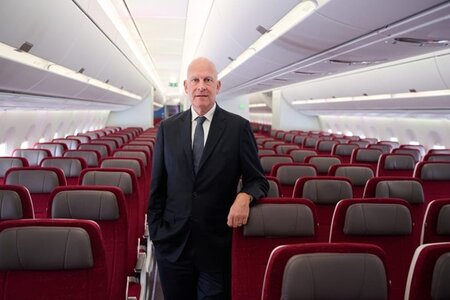
His decision does not come as a surprise, as the executive had previously announced his intention to step down in 2024 but remained in charge of ensuring a seamless transition of leadership: Wilson was appointed in 2022 after the Tata Group took over the loss‑making Indian flag carrier.
During his tenure, the merger of four airlines (Air India, Air India Express, Vistara, and AIX Connect) was executed, streamlining different work cultures rooted in public and private sectors.
A multitude of challenges
Since the privatization of Air India in 2022, the Tata conglomerate has embarked on an ambitious fleet overhaul, ordering hundreds of aircraft to replace ageing and fuel-thirsty jetliners. Simultaneously, the intercontinental network was expanded.
Wilson led efforts to improve passenger and cargo services, modernize operations and integrate the group’s aviation businesses, but faced persistent headwinds, including aircraft delivery delays, airspace closures caused by the 2025 India‑Pakistan conflict, and disruptions linked to the war in the Middle East and Iran, causing widespread airspace closures that required longer flights on alternative routes.
Wilson’s most severe setback during his tenure came in JUN2025, when Air India Flight AI171, bound for London Gatwick, crashed right after takeoff from Ahmedabad Airport (IATA: AMD), killing all but one of the 242 people on board and 19 people on the ground. This fatal crash marked the first total loss of a Boeing 787-8 (Dreamliner) worldwide, bringing the carrier’s maintenance and safety schemes under scrutiny at a time of accelerated growth.
Leaving the red remains the primary goal
Following the Ahmedabad crash, Air India strengthened its Safety Management System (SMS), upped its investment in technical infrastructure, and revised crew training and fatigue management. In the meantime, the airline is building an MRO facility and a training academy equipped with simulators for the Boeing 787 and Airbus A350 long-haul variants to manage the delivery of 570 Boeing and Airbus aircraft as part of its five year long transformational plan, with first deliveries taking place in 2027.
Campbell’s successor, whoever that may be, is likely to be judged primarily on the airline’s financial recovery. After all, the Indian flag carrier continues to incur significant losses. Improving the reputation of the company, which has been tarnished by numerous complaints about poor service, also remains a constant concern.