
Air cargo is being hit from three sides at once: capacity is collapsing, costs are rising, and demand is turning unpredictable. Jet fuel prices have surged from roughly USD 90 to nearly USD 200 per barrel at peak levels, forcing airlines to raise fuel surcharges by as much as 34% in some cases.
The conflict in the Middle East has disrupted operations through airspace closures, grounded fleets, and rising fuel and insurance costs, while demand volatility adds further pressure. Real-time visibility is still missing – and in a market like this, flying blind comes at a cost. Information is now the single, most important advantage.
COVID crisis revival
Six years ago, the aviation industry faced what many believed would be its worst crisis. Airlines entered survival mode, with many forced into restructuring under Chapter 11, triggering longer sales cycles, more complex negotiations, and a sharp increase in stakeholder involvement.
During that period, airlines rapidly repurposed passenger aircraft for cargo operations – so-called preighters – in many cases removing seats to increase capacity. Carriers such as Turkish Airlines and Ethiopian Airlines were among the early adopters, with both emerging as clear winners as cargo operations offset losses in passenger traffic.
Not all carriers survived – but those that did, emerged stronger and, in many cases, more profitable than before. Today, the industry faces a different kind of disruption, and the question is no longer whether pressure will build, but how the market will respond – and where the opportunity lies.
Lower capacity
The conflict involving the United States, Israel, and Iran, has led to targeted disruptions across key Gulf hubs, including Abu Dhabi, Bahrain, Kuwait, and Dubai, with airports and surrounding airspace still affected. These closures are directly constraining cargo flows to and from the region, with air freight experiencing the most immediate impact among all transport modes. Global air cargo capacity has dropped by roughly 22%, with Asia–Europe corridors via the Middle East down nearly 40% (Reuters).
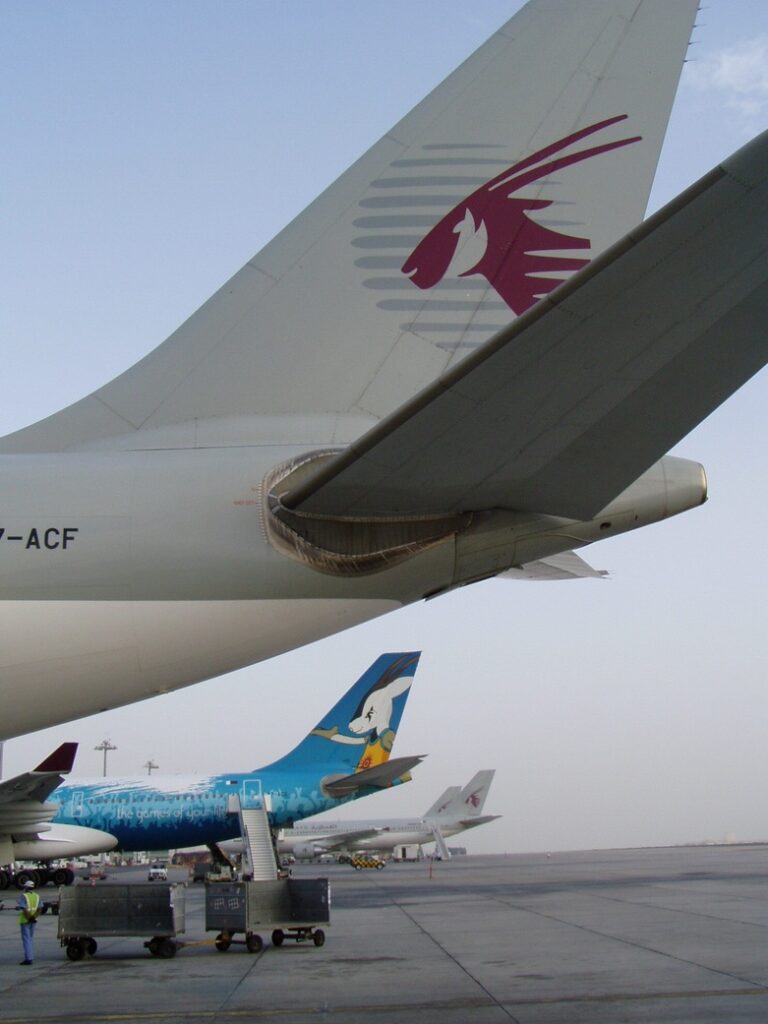
At the same time, Emirates, Qatar Airways, and Etihad handle a significant share of global air cargo flows, with the Middle East region accounting for roughly 13% of global air cargo traffic (IATA), and a large portion of China–Europe traffic moving through their hubs. Even short-term movements have seen rates jump 5–6% within days on disrupted lanes. Their reduced operations have created a substantial capacity gap, pushing rates sharply higher across major trade corridors.
Where are the planes?
As operations contract, aircraft are not disappearing – they are being repositioned. Some airlines have moved planes to safer regions, while others have kept them parked in secondary airports or abroad to reduce risk exposure.
According to flight-tracking data from Flightradar24, around 20 Qatar Airways aircraft have been relocated to Teruel Airport in eastern Spain, a state-owned facility known as one of Europe’s largest aircraft maintenance and storage sites.
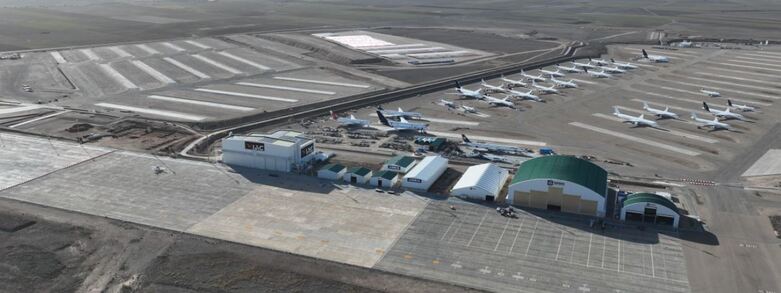
Teruel is a remote airport in rural Spain, which previously served as a major parking facility for grounded aircraft during the COVID-19 pandemic, when it hosted around 140 planes, according to Reuters. The move reflects the airline’s reduced flying schedule, with fewer aircraft needed as airspace restrictions limit operations from its hub in Doha.
Emirates did not move everything to one storage location. Instead, planes remain distributed across its network footprint, with many stranded globally, avoiding fleet concentration in a single high-risk location. On the other hand, Etihad keeps its planes closer to home, with most of its fleet parked in Abu Dhabi and a second cluster in Asia.
European key players – Lufthansa, Air France-KLM, and British Airways – after cutting or suspending Middle East routes, are redeploying capacity toward Asia as rising fuel costs and airspace disruptions force network adjustments. In the U.S., capacity cuts are not showing as long-term parked aircraft but rather as what can be described as ‘soft grounding’, with reduced utilization and fewer rotations.
As a result, a large portion of the global fleet is either idle, underused, or mispositioned as capacity cuts of over 20% ripple through the system.
Disrupted intelligence
Right now, nobody in air cargo has a reliable real-time picture of which flights are actually operating, where capacity is available, which routes are at risk, or how prices are moving. Decisions are still being made based on outdated schedules – and sometimes on gut feeling.
The network becomes chaotic and reactive. Shipments sit at origin, get rolled last minute, or miss connections entirely. Ground handling teams are overwhelmed by unpredictable volumes, while capacity is either wasted or unavailable where it is needed most. Paradoxically, global cargo demand is still growing – up 5.6% year-on-year in early 2026 – while capacity is lagging behind at just 3.6% (IATA). Constant rebooking turns operations into firefighting.
Current data sources include Automatic Dependent Surveillance–Broadcast (ADS-B) flight tracking, NOTAMs (airspace restrictions), airline schedule changes, and unofficial airport congestion signals. What matters is not more data, but the ability to act on it.
Forwarders and airlines need to know which routes are about to fail, which lanes remain stable, and when to shift capacity before disruption hits. The advantage lies in deciding – early and with confidence – where to route cargo, which carrier to trust, and when to avoid a corridor entirely.
Even the major booking platforms – cargo.one, CargoAi, and WebCargo by Freightos – have digitized booking and rate aggregation, but they still lack predictive disruption intelligence and do not show, in real time, which carriers are actually operating reliably or where capacity is truly available.
Routing optimization engine
The gap between quoted rates, booked rates, and actual executed rates is widening with rate movements of up to 70% on key lanes within weeks, making static pricing models increasingly unreliable. What is missing, is a system that can show the true market price – per lane, per day – along with price trends and airline price differences.
The highest leverage right now, lies in the ability to predict airspace closures, congestion spikes, and route instability. Traditional routes are broken, yet many still operate within outdated lane structures.
A system capable of suggesting alternative routings, including hybrid solutions such as air+truck or sea-air, would add immediate operational value. What is needed is a ‘Bloomberg terminal’ for air cargo – replacing long-term contracts with dynamic decision-making tools that reflect the reality of volatile markets.
The missing layer
Today, most companies have data, but they neither share it nor monetize it effectively.
Pricing data sits in one system. Capacity signals in another. Disruption indicators are scattered across tracking feeds, NOTAMs, and operational updates. None of it connects fast enough to be useful.
Systems capable of delivering pricing intelligence, capacity reliability scoring, and disruption prediction – answering the question ‘what should I do now?’ – are still missing.
In a world of continuous disruption, the model itself needs to change. How data is collected, shared, and monetized will define the next phase of the industry and who captures the value.
This is the moment to rethink how data is shared in air cargo, not as isolated datasets, but as a real-time decision layer.
In an industry that moves roughly one-third of global trade by value, even small informational advantages translate into significant financial impact. The next winners won’t control aircraft. They’ll control information – and act on it faster than everyone else.