
How far should Artificial Intelligence be allowed to influence operational decisions without weakening human oversight? AI is no longer a futuristic discussion topic in air cargo. It has arrived in everyday operational reality. In our two-part report we examine the growing role of AI in air cargo operations, analyze how intelligent systems are already reshaping decision-making, and influence workforce structures across global cargo networks.
Whether at major trade fairs such as the Munich-held Transport Logistik, within cargo digitalization platforms, or in increasingly automated operational environments, AI has become one of the industry’s dominant strategic themes. The discussion is no longer centered on whether air cargo companies should invest in AI, but rather on how deeply these systems should be integrated into operational decision-making.
The timing is hardly surprising. The industry continues to operate under enormous pressure. Geopolitical instability, fluctuating demand, fragile supply chains, capacity volatility, labor shortages, and growing customer expectations are forcing airlines, freight forwarders, handlers, and logistics providers to rethink traditional operating models.
In this environment, AI promises something the industry needs: faster, more intelligent decision-making that goes far beyond simple process automation. Part One focuses on AI as an operational “co-pilot”, while Part Two of this report will be published next week. Please stay tuned.
From Digitalization to Decision Intelligence
Air cargo has spent years digitizing its processes. Electronic air waybills, automated customs filing, booking portals, and cargo visibility platforms have already transformed large parts of the industry. AI, however, represents something fundamentally different.
Traditional digital systems organize and distribute information. AI increasingly interprets information and recommends actions. In many operational environments, it effectively functions as a “cognitive co-pilot” capable of supporting real-time operational control.
Predictive decision making
This development is particularly relevant because cargo networks have become too complex for purely manual decision making. A delayed freighter in Asia can affect trucking schedules in Europe within hours. A weather event in North America may disrupt pharmaceutical transfers in the Middle East. Capacity shortages, airport congestion, labor disruptions, and political instability create operational volatility that changes by the minute. AI systems can evaluate these variables simultaneously and generate alternative operational scenarios within seconds.
Instead of reacting to disruptions after they occur, operators are increasingly moving toward predictive decision environments where systems anticipate operational problems before they escalate. The industry has discussed this transition for years. What is different now is that AI capabilities are finally becoming operationally usable at scale.
The real debate begins when AI starts prioritizing
Automation itself is not controversial anymore. Most companies already accept automated workflows in areas such as documentation processing, shipment tracking, or customer communication. The real debate begins when AI starts influencing operational priorities.
Which shipments should receive limited capacity during disruptions? Which cargo should be rerouted first? Should profitability outweigh urgency? How should systems prioritize humanitarian shipments, temperature-sensitive cargo, or high-value freight? These decisions are no longer purely operational. They involve judgment, responsibility, and sometimes even ethics. This creates a growing tension between operational efficiency and human oversight.
Contextual comprehension is AI’s weak spot
The air cargo industry has historically been built around clearly defined accountability structures. Human operators remain responsible for operational outcomes, especially in safety-sensitive environments. Yet AI systems are increasingly influencing decisions that were once entirely dependent on human experience and intuition. And while AI is exceptionally good at pattern recognition and optimization, it still lacks contextual understanding. An experienced cargo operator understands things that rarely exist inside datasets, such as political sensitivities, customer relationships, local operational culture, or the practical realities behind a disruption. This is one reason why many industry experts continue to emphasize the importance of “human in the loop” operational models. The future of air cargo may become highly automated, but it is unlikely to become fully autonomous.
At least for now
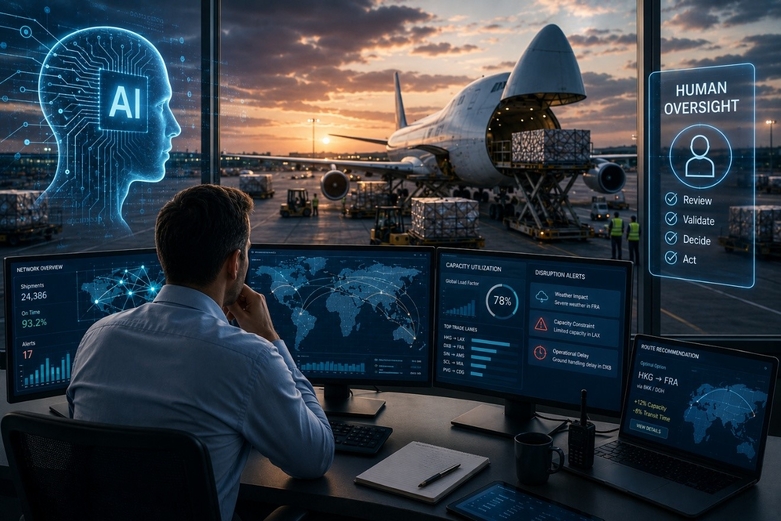
The industry currently describes AI as a “co-pilot”, an intelligent operational assistant supporting human decision-making rather than replacing it. Even CFG uses AI to create graphics similar to the one illustrating this article. Yet every co-pilot traditionally still operates under the authority of a captain responsible for the final decision. In our case, we had to try several prompts and different approaches to create the right graphic.
The critical question, however, is whether the balance between AI decision making, and human oversight will remain permanent.
As AI systems become faster, more predictive, and increasingly capable of optimizing operational scenarios in real time, the line between operational support and operational control may gradually begin to blur.
Air cargo may therefore be approaching a future in which humans no longer make every operational decision themselves but increasingly supervise systems that have already proposed, optimized, or effectively pre-selected the decision beforehand.
The industry’s defining question
Artificial Intelligence offers enormous opportunities for air cargo. It can improve resilience, optimize capacity usage, accelerate operational reactions, and strengthen decision-making in an increasingly unstable global environment.
But the deeper AI becomes integrated into operational control, the more important transparency, accountability, and human oversight become. Because ultimately, the defining question is not whether AI can make operational decisions. The real question is:
Which decisions should the industry ever allow machines to make? That answer may ultimately shape the future structure of global air cargo operations far more than the technology itself.
Outlook to Part Two
Artificial Intelligence will undoubtedly become one of the defining technologies, shaping the future of air cargo. The operational advantages are too significant to ignore, and the competitive pressure to adopt AI-driven decision environments will only continue to increase.
At the same time, the industry is approaching a critical turning point: The deeper AI becomes integrated into operational control, the more urgent the questions become concerning responsibility, governance, transparency, and power. Part Two of this report, published next week, will therefore focus on the broader strategic implications of AI in air cargo, including:
- Governance and operational oversight
- Regulation and emerging legal frameworks
- Liability and accountability for AI-driven decisions
- Concentration of technological power
- Safety, security, and control in increasingly autonomous logistics systems
Ultimately, the future of AI in air cargo will not only be defined by what technology can do, but by how much control the industry is willing to hand over to its fast-emerging co-pilot. This said, the question arises as to whether the co-pilot will be sitting in the driver’s seat in the foreseeable future. If so, a fundamental shift in the human-machine relationship would take place. Time will tell.
Authors:
Anastasia Kazantzis / Gerton Hulsman