
For over 30 years, pharma operations managed by DHL GF were not fully harmonized and often fragmented across business units across different countries and borders. Dedicated pharma corridors and end-to-end cold chain solutions are part of a more recent strategic build-up to connect key healthcare markets with standardized logistics processes, connecting technology, processes and solutions to deliver continued visibility and limiting break in cold chain, and improving a reduced carbon footprint.
Meanwhile,DHL Global Forwarding has expanded its air freight network for temperature sensitive products and strengthened its end-to-end cold chain capabilities on the Europe – North America trade lane. Following the introduction in 2026 of a dedicated temp-controlled Boeing 777 freighter operating a 6/7 schedule, DHL has further enhanced its GDP-compliant end-to-end cold chain process with specialized ground handling technology and facilities. These changes will ensure resilient and compliant transportation and storage of sensitive healthcare shipments on this flagship route, reads a release.
Comprehensive service solutions
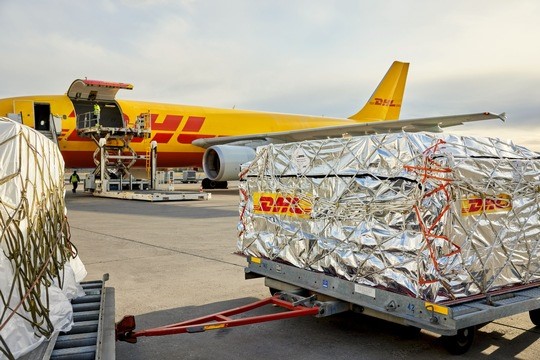
Additional investments in the infrastructure on this lane are planned throughout 2026, including the expansion of DHL-owned cold-chain capabilities on- and off- airport at Cincinnati. DHL is also introducing multiple temperature-control dollies, mobile refrigeration units that transport air freight containers and pallets between the aircraft and warehouse, ensuring that shipments always remain within the required temperature range. DHL has further validated the use of multi-layered thermal blankets in combination with developments in materials sciences (e.g., phase-change materials that can adapt to fluctuations in heat to maintain the desired temperature) to offer more efficient passive packaging solutions.
Shipments get smaller but volumes grow
Life Sciences & Healthcare is a key growth segment for the integrator, supported by significant ongoing investments, emphasizes DHL-GF in a statement. However, the company declined to reveal fixed percentage figures, nor did it unveil the scale of sales activities in the pharmaceutical/healthcare segment. All it says is that demand for healthcare logistics is growing rapidly, particularly for biopharmaceuticals, cell and gene therapies, and clinical trial materials, amongst others. Shipment volumes are expected to increase further, with an estimated double-digit growth. Each lane or route shows a unique growth pattern, based on customers on both inbound and outbound lanes. This is emphasized by Annette Naude, Global Head of Life Sciences & Healthcare at DHL Global Forwarding: “The market for biopharmaceuticals, gene and cell therapies, and clinical trial materials is growing at an above average rate. The typical shipment is becoming smaller, and almost all of these products require strict temperature control – typically between 2 and 8 degrees Celsius. At the same time, a significant number of pharmaceutical patents are set to expire in the coming years, which will drive a rapid increase in shipment volumes. To illustrate: for every pallet of an original drug, up to eight pallets of generics are typically shipped once the patent expires. We are making these targeted investments to ensure that our customers have the capacity and specialized logistics support they need to manage this unprecedented growth. Our Brussels-Cincinnati end-to-end solution is an effective blueprint for other major trade as we continue to build out our DHL pharma airfreight network.
BRU-CVG serves as a blueprint
Although Brussels is a key European pharma gateway, DHL is not limited to only using Zaventem Airport (BRU). The network strategy is based on broader growth anticipated from various regions. This said, the Brussels-Cincinnaticorridor approach serves as a blueprint for scaling similar developments worldwide, DHL told CargoForwarder Global upon request.
We asked the integrator if their Tripple Seven freighters operated on this transatlantic route are powered by Sustainable Aviation Fuel (SAF)? Here is the answer: “Sustainability is a core focus for DHL: beyond fuel considerations, we emphasize optimized routing and reusable/reduced packaging solutions to reduce emissions and waste. Our cold chain solutions are designed to minimize breaks, improve efficiency, and lower the overall carbon footprint.”
The first air freight connection between DHL’s hubs in Brussels (BRU), Belgium, and Cincinnati (CVG), United States, is now fully operational – linking a leading European pharma gateway with a rapidly growing U.S. life sciences and logistics hub. Following the introduction in 2026 of a dedicated temperature-controlled Boeing 777 freighter operating a 6 day per week schedule, DHL has further enhanced its GDP-compliant end-to-end cold chain process with specialized ground handling technology and facilities. These changes will ensure resilient and compliant transportation and storage of sensitive healthcare shipments on this flagship route.