
In Part 2 of this series, we examined how Artificial Intelligence is beginning to reshape operational decision-making inside the air cargo industry. AI is no longer limited to automation or process optimization. Intelligent systems are increasingly influencing disruption management, operational prioritization, forecasting, and real-time cargo control. In Part 3 we examine how AI is increasingly changing the role of human operators.
Operational expertise is gradually evolving from direct execution toward supervision, validation, and control of machine-supported environments. The deeper AI moves into operational workflows, the more important governance, transparency, and human oversight become.
But this development also creates entirely new strategic risks.
As AI systems gain operational influence, questions surrounding accountability, liability, cybersecurity, and technological dependency are becoming impossible for the industry to ignore.
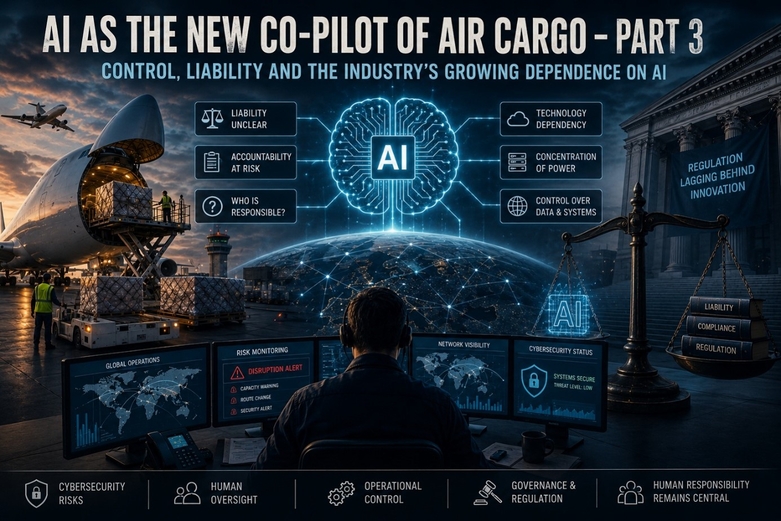
Liability remains one of the industry’s biggest unresolved issues
The deeper AI moves into operational decision-making, the more sensitive the issue of liability becomes.
AI-supported systems are increasingly influencing decisions connected to routing, shipment prioritization, compliance management, and operational recovery processes. In highly sensitive cargo environments involving dangerous goods, pharmaceutical shipments, sanctions compliance, or security-sensitive freight, these decisions carry significant operational and financial consequences.
At present, however, legal and regulatory responsibility structures remain unclear in many AI-driven scenarios.
Advanced machine-learning systems often operate inside highly complex environments that are difficult to fully explain, even for their developers. Recommendations are frequently generated through probabilistic modeling processes that cannot easily be reconstructed afterward in complete detail.
Structural challenges increase
The industry has historically been built around traceability, accountability, and clearly assigned operational responsibility. AI increasingly complicates this model because intelligent systems themselves become part of the operational decision chain.
As operational dependence on AI grows, the gap between technological capability and legal clarity may also continue to widen. Industry experts increasingly expect future regulations to focus heavily on defining accountability structures surrounding AI-supported operational environments.
The issue is no longer theoretical. It is becoming operational reality.
The Industry Is becoming increasingly dependent on technology ecosystems
Another development receiving growing attention across the logistics sector is the concentration of technological power.
Historically, air cargo has operated as a fragmented ecosystem consisting of airlines, handlers, freight forwarders, airports, GSAs, trucking companies, and specialized logistics providers spread across decentralized global networks.
AI changes competitive dynamics because AI development strongly favors scale.
The organizations controlling the largest data environments, cloud infrastructures, and AI ecosystems are gradually gaining increasing influence over operational intelligence itself. This creates new strategic dependencies throughout the logistics sector.
Many companies are no longer dependent solely on physical infrastructure and transportation assets. Operational visibility, forecasting capability, dynamic pricing, and network optimization are increasingly linked to external digital ecosystems and technology providers.
As AI expands into booking systems, operational control towers, customs integration, and digital cargo marketplaces, the influence of large technology companies continues to grow.
This shift may fundamentally reshape competitive structures within air cargo over the next decade.
Operational advantage may increasingly depend not only on network size or transportation assets, but on access to operational intelligence, data ecosystems, and AI-driven infrastructure.
Control over information is gradually becoming as important as control over physical cargo capacity itself.
Safety continues to define the boundaries of automation
Despite growing enthusiasm surrounding AI, aviation remains fundamentally different from many other industries because operational safety remains non-negotiable.
Efficiency may drive innovation and investment decisions, but safety continues to define the limits of acceptable automation.
AI systems are becoming exceptionally effective at identifying operational patterns, forecasting disruptions, optimizing routing scenarios, and accelerating response times. Nevertheless, highly automated environments also introduce new forms of operational risk.
Cybersecurity concerns surrounding connected AI-driven systems are increasing rapidly. As cargo systems become more interconnected and autonomous, exposure to cyberattacks, data manipulation, and operational interference also grows.
At the same time, aviation experts continue discussing the long-term impact of automation on human situational awareness. Extended supervision of highly automated systems may gradually weaken operational intervention capability during critical situations.
This challenge is already well documented in other highly automated industries and is becoming increasingly relevant for aviation logistics.
The industry therefore faces a delicate balancing act:
increasing operational automation while preserving human competence, oversight, and intervention capability.
This balance may ultimately determine how far AI integration can safely progress within air cargo operations.
Human oversight Is becoming more important – not less
One of the biggest misconceptions surrounding AI is the assumption that human involvement will automatically decrease as systems become more advanced.
The opposite may prove true.
The more operational influence AI systems gain, the more important human oversight becomes. Humans remain responsible for contextual judgment, escalation management, ethical prioritization, and strategic accountability.
Operational environments are therefore evolving toward models in which professionals increasingly supervise intelligent systems operating at speeds far beyond normal human processing capability.
This fundamentally changes the operational role of cargo professionals.
Future operational teams may function less as traditional process managers and increasingly as supervisors, validators, risk evaluators, and escalation authorities overseeing AI-supported environments.
In that context, the “co-pilot” analogy discussed in Part 1 becomes even more relevant.
AI may increasingly support operational control, optimize decision environments, and influence network management. Yet the industry still expects humans to remain responsible for final accountability, operational trust, and strategic authority.
The technology may continue advancing rapidly.
But human responsibility remains firmly embedded at the center of aviation operations.
The industry is entering a defining phase
Artificial Intelligence will almost certainly become one of the defining technologies shaping the future of global air cargo.
The operational and competitive advantages are too significant for the industry to ignore. AI-driven operational environments will continue expanding across logistics networks, airlines, handling operations, and cargo control structures.
However, the next phase of AI adoption will no longer be defined purely by technological capability.
It will increasingly be defined by governance, regulation, operational trust, accountability, cybersecurity, and the industry’s ability to maintain meaningful human oversight within increasingly autonomous environments.
Because ultimately, the future of air cargo will not only depend on how intelligent AI systems become. It will depend on how effectively the humans inside the industry remain capable of controlling them.
Authors:
Anastasia Kazantzis / Gerton Hulsman