
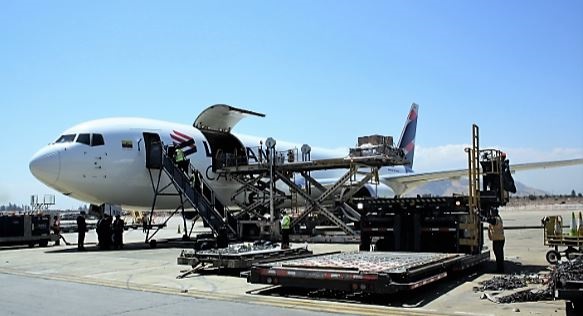
The first flight took place on 23MAY26, departing from Frankfurt and heading via São Paulo Guarulhos to Antofagasta in northern Chile. A B767F is now deployed on this route every Sunday, enabling customers to pick up their shipments on Monday morning. Following the introduction of direct flights from Frankfurt to Florianópolis and Curitiba, Antofagasta is another destination that LATAM Cargo offers European shippers and forwarders to make use of. In the meantime, IATA rolls out its CASS tool across Latin America.
In this case, the initiative for the flight came from the Frankfurt air freight division of the Hamburg-based freight forwarder, Five Star Global Logistics. “We transport components and spare parts on this route for our client Komatsu. With the new direct connection, we save three to four days compared to flights to Santiago de Chile and the onward transport of shipments by truck to Antofagasta, which is over 1,400 km away,” reports Jan Gerlach, a manager at Five Star. Since the logistics provider has been using LATAM Cargo for shipments to South America for some time, he can objectively estimate the airline’s performance:
Happy with LATAM Cargo’s service
“All I can say, is that the carrier is reliable and performs well. In case of utilizing Avianca, shipments would have been transferred at Bogota Airport to connecting flights, which is time-consuming. In the case of Lufthansa Cargo, the prices per kg are slightly higher, and the booking process is less flexible compared to LATAM Cargo,” Gerlach reasons.
Hamburg-based logistics heavyweight, Senator International had been managing the Komatsu business until JUN22. However, following the takeover of Senator by the Danish Maersk Group, the Japanese industrial giant decided to switch to Five Star.
“Northern Chile is home to mining and industrial projects that demand precise logistics. By offering a direct flight from a strategic European hub like Frankfurt, we not only significantly reduce transit times, but also reaffirm our role as a partner capable of providing the network that the industry requires in the region,” said Jorge Carretero, Cargo Sales Director for Europe at LATAM.
More shippers / higher volumes = lower prices per kg
If the export sector reacts positively to the new capacity offer, LATAM Cargo will consider increasing the frequency of flights, Jorge adds. In addition to Komatsu, which operates its supply chain für mining equipment out of Düsseldorf, there are several companies in Central Europe that are directly involved in the Chilean activities of the mining industry. “We intend to target them specifically to increase volumes, which promises more favorable rates for all parties involved,” states Gerlach. From Antofagasta, the B767F flies back to Europe via Lima or Bogotá, loaded with fruit, vegetables or flowers for the EU market.
Antofagasta is part of LATAM Cargo’s consolidation strategy aimed at offering customers direct freighter flights between Europa and Latin America, to speed up supplies. However, according to Manager Carretero, following the launch of the new route, LATAM Cargo has no further South American destinations currently that it plans to serve directly.
IATA rolls out CASS in Latin America
In the meantime, IATA announced plans to focus increasingly on Latin America by rolling out their Cargo Accounts Settlement System (CASS) throughout the sub-continent. The move is attributed to the 3.3% year-on-year average growth in freight volumes reported by carriers based in the region in the 10 years to April 2026, resulting in a cumulative growth of 38.8% over the decade, states IATA.
In Mexico, CASS Domestic operations began in April 2026 on the strong foundations laid by the CASS Export operations which started in 1987. Mexico is one of the largest air cargo markets in the region. In 2025, the domestic air cargo segment transported over 125,000 tons of air cargo, accounting for 15.8% of the total tonnage transported from, to and within Mexico.
In Paraguay, CASS Export will be implemented in the last quarter of 2026, with strong industry uptake anticipated as cargo volumes grow. In 2025, Paraguay transported over 42,000 tons of air cargo, up 225.3% YoY.
CASS facilitates business between carriers and forwarders
In neighboring Brazil,IATA plans to introduce CASS Domestic from early 2027. This builds on the strength of CASS Export, which has operated in the market for more than two decades. In 2025, carriers serving Brazil transported over 791,000 tons of air cargo, of which 7.9% was domestic traffic. Overall, air cargo transported 5.9% of Brazil’s exports by value in 2025, although these high-value, low-density exports accounted for only 0.3% of the total weight of Brazilian exports. CASS plays a vital role in streamlining the global movement of air cargo by simplifying the billing and settlement of accounts between airlines and freight forwarders. In 2025, CASS processed US$ 47.5 billion, with an on-time settlement rate of 100%. Globally, IATA operates 89 CASS Export operations, 9 CASS Import operations, and 2 CASS Domestic operations, including the newly launched Mexico Domestic CASS.