
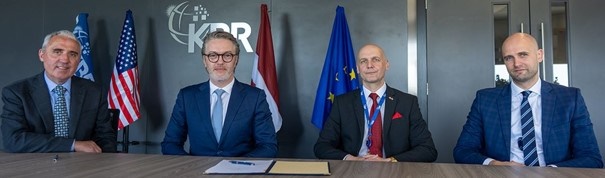
Both companies signed an agreement for the development of Europe’s first commercial-scale facility, capable of producing 100% drop-in sustainable aviation fuel (SAF/eSAF). PureSAF has the potential to power existing aircraft without being blended with traditional fossil fuels. The projected plant will be erected in Latvia, the home of SAF developer, NorSAF.
KBR, founded in 1998 in Houston, Texas, as Kellogg Brown & Roof, focuses primarily on energy management. So does Latvian NorSAF, albeit on a smaller scale. Both companies have now signed an agreement for the deployment of PureSAF technology. The project’s estimated financial volume: over 1 billion euros. Once the plant is operational, which is expected to be in 2030, it will become Europe’s first commercial-scale facility capable of producing 100% drop-in sustainable aviation fuel. The facility will combine 2nd generation bioethanol, renewable hydrogen produced via electrolysis, and captured biogenic carbon dioxide to synthesize aviation fuel, cutting emissions while reusing CO₂ that would otherwise be emitted to the atmosphere.
83% reduction of CO2 emissions
In contrast to conventional SAF, which typically must be blended with fossil kerosene, a 100% drop-in fuel is designed to chemically mimic conventional jet fuel, allowing it to be used in existing aircraft and fueling infrastructure and aircraft turbines without modification. NorSAF said the production process could reduce greenhouse gas emissions by about 83% compared to conventional jet fuel production. The company also intends to source feedstock within Europe to support energy independence and industrial resilience.
NorSAF’s new plant is expected to annually produce 100,000 tons of sustainable aviation fuel and e-SAF, and distribution of SAF is planned for aviation companies across the Baltics, Northern Europe, and additional European markets.
Fuels at EU airports must contain 6% of SAF by 2030
Europe has set one of the world’s most ambitious frameworks for aviation decarbonization in pursuit of climate neutrality by 2050. With aviation among the continent’s hardest sectors to abate, binding sustainable aviation fuel mandates are an inevitable path forward. Under EU legislation, minimum SAF blending requirements are established by the ReFuelEU Aviation Regulation. Brussels mandates that aviation fuel supplied at EU airports must contain at least 6% SAF by 2030, rising progressively to 70% by 2050.
Energy sovereignty is a security matter
“We are delighted to have collaborated with KBR to bring PureSAF technology to Europe,” said Jānis Kisiels, Board Member of NorSAF. “Recent global events have underscored that energy sovereignty is no longer just an economic goal, but a matter of national and regional security.”
Jay Ibrahim, President of KBR Sustainable Technology Solutions, said the project supports Latvia’s transition toward cleaner aviation and could help scale SAF production in Europe.
Avia Solutions Group, the world’s largest ACMI provider, is acting as a partner on the project. NorSAF said the partnership will provide access to aviation infrastructure, including Baltic Ground Services’ experience in SAF supply and distribution.
ICAO and IATA take action on SAF
In a joint statement, published last Tuesday (02JUN26), IATA and ICAO announced that they are pushing for the long-term phase-out of fossil kerosene and the transition to SAF. Addressing SAF registries and evaluating the data they collect can support the implementation of the ICAO Long-Term Aspirational Goal (LTAG) Monitoring and Reporting (LMR) methodology, as well as the consideration of fuel accounting systems for international aviation. The project aims to enable transparent and credible tracking of aviation cleaner energies and their contribution towards net zero carbon emissions by 2050, in alignment with the respective IATA and ICAO ambitions and commitments, reads the organization‘s joint statement.