
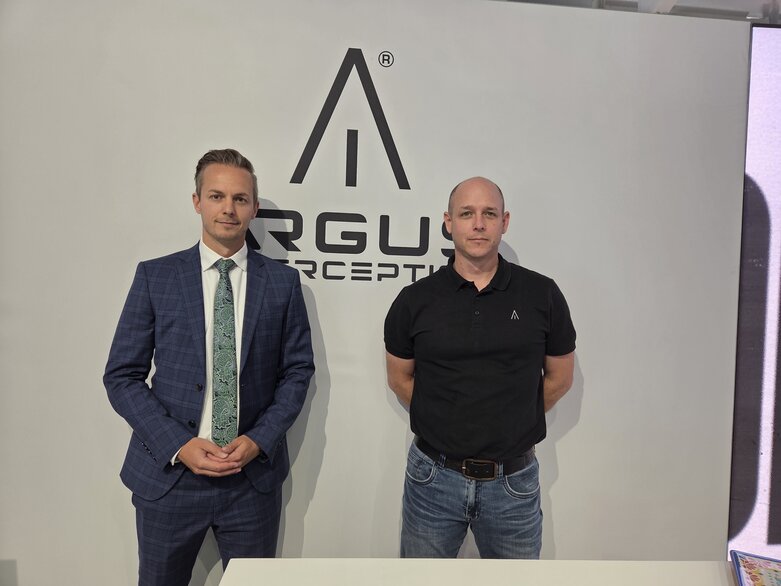
The name ‘Argus’ comes from Greek mythology, where Argus Panoptes was a giant with a hundred eyes, who never slept completely and saw everything. For a modern company that provides airspace surveillance and security services, it’s certainly not a bad choice of name, as became clear during a conversation with its management at the ILA in Berlin.
Whereby ‘Piscator’ would also have been a fitting name, referencing the work of fishermen in the Roman Empire. Like their historical counterparts, the A1 Falke drone – developed by Argus Interception in collaboration with the Bundeswehr University in Hamburg – deploys nets to capture other drones. It is a dual-use interceptor drone. It can protect ports, industrial facilities, power plants, airports, or other critical infrastructure sites. It has been in use for some time and has proven its worth, reports CFO, Christoph Rau. He does not specify exactly where this happened, citing confidentiality reasons. However, Ukraine is certainly among the users, the Baltic countries presumably as well. It costs a “mid-six-figure million-euro amount” per unit, says Rau. The A1 Falke is part of a customized package solution, which also defines the costs, special sensors, staff training, etc., and can be booked by users according to their specific needs.
Protecting critical infrastructure
If a drone is detected – for example, heading towards an airport – and is classified as a security risk by Argus operators or security personnel, the A1 Falke is dispatched to intercept the intruder. Capable of high speeds, it positions itself above the approaching drone and deploys a capture net as soon as it is directly above it. It is this innovative net-casting technology that sets the A1 Falke apart. Thanks to this automated technology, the hostile drone caught in the net is intercepted in a controlled manner and, after being placed on the ground, is forensically analyzed and identified to determine its origin. This is because the number of drone flights over critical infrastructure in Europe has increased sharply in recent times, with the origin and purpose of most of them remaining in the dark.
Oslo, Copenhagen, Munich …
This happened on 22SEP25, when the airspace over Copenhagen and Oslo was disrupted by unidentified unmanned aerial vehicles, leading to extensive security measures and temporary no-fly zones.
Just one month later, in OCT25, several drones disrupted traffic at Munich Airport for days, partially bringing it to a complete standstill. Thousands of passengers were stranded. According to the DLR (German Aerospace Center), it was likely the most expensive drone incident in Germany last year. In 2025, drone flyovers were recorded at 25 German airports, causing disruptions. Where they came from and where they headed to after completing their missions, remains unclear to this day, even though military sources point at Russia as the initiator by utilizing their shadow fleet of aging tanker vessels navigating in the Baltic Sea as operational platforms.
Shooting hostile drones down is too risky
Although drones now seem almost commonplace and are being used increasingly frequently in many areas, they are subject to legal regulations such as data protection laws and aviation rules. This is because as the number of drones in the airspace increases, so does the risk of collisions with civil aircraft. Security authorities suspect that most drone sightings in Western and Central Europe are being used for espionage purposes. They can also be used for cybercrime, smuggling, espionage, or terrorism.
Drones could be eliminated by targeted shooting. However, the danger of falling components is significant and can endanger people on the ground or set buildings on fire. This is precisely what the A1 Falke is designed to prevent thanks to its network technology. “Our product has proven itself as a superior solution to prevent collateral damages,” emphasizes Argus Manager, Timm Bölke. However, he does not say in which country or where exactly this has been proven.