
In around six years from now, Poland aims to be inaugurating a state-of-the-art gateway in fitting with its position as the largest economy in Central Europe and the sixth largest in Europe. Centralny Port Komunikacyjny (the company delivering the Port Polska investment program) is coordinating the planning and construction of Port Polska – a new Polish airport located between Warsaw and Łódź, designed to act as a major multimodal, international hub for Central Europe and beyond – both for passengers and cargo – featuring high-speed rail connections and expanded road infrastructure around the area to ensure maximum airport connection efficiency.
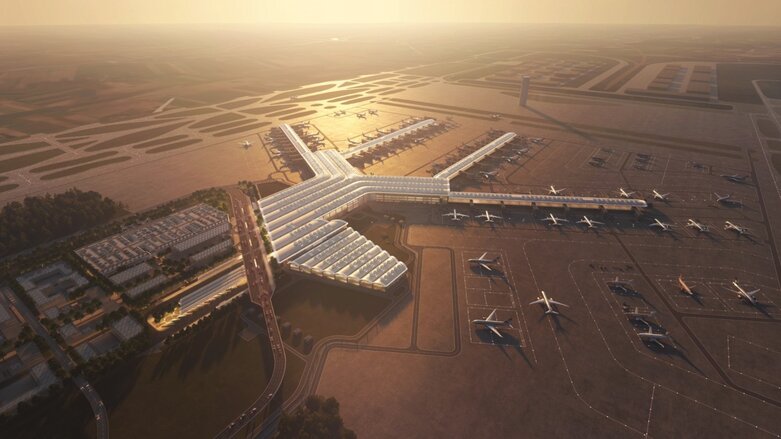
And its long-standing plans are taking shape. Just last week, Poland’s Port Polska program has moved forward on two fronts – with authorities issuing a key location decision for the rail junction east of the planned national airport, and Centralny Port Komunikacyjny signing a contract for the first foundation works on the airport’s passenger terminal. Together, the developments mark a significant step in the delivery of a strategic transport project intended to integrate air, rail and road links between Warsaw and Łódź and strengthen connectivity across Central Europe. The estimated cost of building, by 2032, what CPK states “will be the most advanced facility of its kind in this part of Europe”, capable of annually handling over 300,000 aircraft movements, with two independent runways, is PLN 131.7 billion (c. EUR 30.7 billion/USD 35 billion).
Ready to rail/road…
The Mazovian Voivode recently approved a location for the Eastern Junction serving the new airport, which means that Centralny Port Komunikacyjny, can now move ahead with seeking the necessary construction permits for the required rail and road components. The Eastern Junction’s rail element will link sections of Lines 5, 85 and 88, to the future airport railway station and to existing and planned rail routes. The investment also includes new road infrastructure alongside the reconstruction and, where necessary, removal of existing roads. The goal is to ensure swift and safe traffic flows and efficient connectivity on the airport premises and beyond.
The planned investment is located in the Mazowieckie Voivodeship, within Grodzisk County, across the municipalities of Baranów and Grodzisk Mazowiecki. The area covered by the location decision for the Eastern Junction totals 212 hectares. Under the Voluntary Property Acquisition Programme, 85.2 hectares have already been acquired, representing nearly 40% per cent of the total area.
Putting people first…
… or at least getting started on the airport’s passenger terminal, since CPK signed a contract to the value of almost PLN 146 million contract with Budimex S.A., last week, for the deep foundation works of the new terminal. Among the six offered tenders, Budimex S.A.’s offered the most advantage at the lowest gross bid: PLN 145,952,189.91. The company is specialized in roads, railway lines and airport projects. Construction is due to start in SEP26. However, prior to this, the Mazovian Voivode must issue a building permit, and required plots of land [the ground reinforcement will exceed 140 km in length] need to be formally acquired.
Infrastructure Minister Dariusz Klimczak announced: “Having completed the preparation and design stages, we are now moving into the construction phase. Foundation works for the terminal, including deep piling, will begin this autumn. This will mark the symbolic start of the construction of a new state-of-the-art airport, which will be built between Łódź and Warsaw and will be one of the most advanced airports in Europe.”
Dariusz Kuś, Port Polska, Member of the Management Board of Centralny Port Komunikacyjny, pointed out: “The contract for the terminal foundations, which will enable construction works to begin, is just one of many tasks currently being carried out. By the end of this year, we intend to select the contractor for the passenger terminal itself. At the same time, preparatory works are ongoing across the future airport site, including demolition works and the relocation of high-voltage power lines and other infrastructure.”
A strong cargo focus
And among that ‘other infrastructure’ is a Cargo City. At the recent TIACA Executive Summit in Warsaw, Dr. Filip Czernicki, Port Polska, CEO of Centralny Port Komunikacyjny, revealed: “At the heart of this vision is Cargo City – a unique logistics and industrial ecosystem designed as a platform for global airlines, integrators and logistics operators, enabling the integration of logistics and production. Our ambition is to create one of the most advanced and digital cargo hubs in Europe – responding to the needs of e-commerce, specialised transport and modern industry, while advancing sustainability and operational efficiency.”
Paweł Zagrajek, Commercial Deputy Director at Centralny Port Komunikacyjny, speaking on the Executive Summit’s panel “Central European Challenges & Opportunities, Plotting the Pathway to Further Success” (moderated by CargoForwarder Global), summarized: “We see not only challenges, but above all the opportunities the future air cargo market will bring. A greenfield airport creates a unique chance to build an ecosystem fully tailored to cargo needs – from runway design and cargo zone infrastructure to dedicated cargo systems, road access, truck facilities, customs solutions, and logistics and manufacturing functions supporting supply chains. Although the airport will open in six years, we are already actively supporting industry growth. We initiated the creation of a cargo community in Poland focused on removing legislative barriers, developing talent, fostering innovation, and addressing key industry challenges. Cargo is also central to our network strategy, with ongoing work to expand freighter services and passenger routes supporting belly cargo operations. The panel also examined how closer regional cooperation and integrated infrastructure planning could help strengthen supply chain resilience and position Central Europe as a key gateway connecting European markets with Asia and other global trade corridors.”
Two of three Cargo Zone contracts have already been signed, this year – one with Cundall Polska, to the value of PLN 15.4 million, to design two cargo terminals and a freight forwarding warehouse covering an area of 42,800 m2, and the second with Przedsiębiorstwo Spółdzielcze Budoprojekt, to the value of PLN 8.9 million, to prepare the design documentation for the Cargo 2 project which includes a complex of facilities and supporting infrastructure tailored for global logistics integrators operating their own distribution networks. “The aim is to create a highly efficient and secure environment for handling courier and express shipments, responding to rapidly growing global demand for air freight,” the release states, emphasizing a core focus on security and efficiency, throughout: “At the heart of the project lies a clear objective: ensuring seamless, uninterrupted logistics processes while significantly reducing shipment handling times. This will be achieved by integrating warehousing, transhipment and sorting functions into a single, cohesive layout.”