
As the air cargo industry faces even more than the usual challenges due to the Middle East crisis, operators are searching for every advantage they can find to keep their heads above water. As does Swissport in Amsterdam, which emphasizes that on-time performance (OTP) is the most important factor, particularly when it comes to exports. To achieve higher punctuality, it is currently testing a trucking CDM platform. The tool combines data provided by airlines, RFS companies and ground handling actors, and coordinates their activities. The acronym CDM stands for ‘Collaborative Decision Making’.
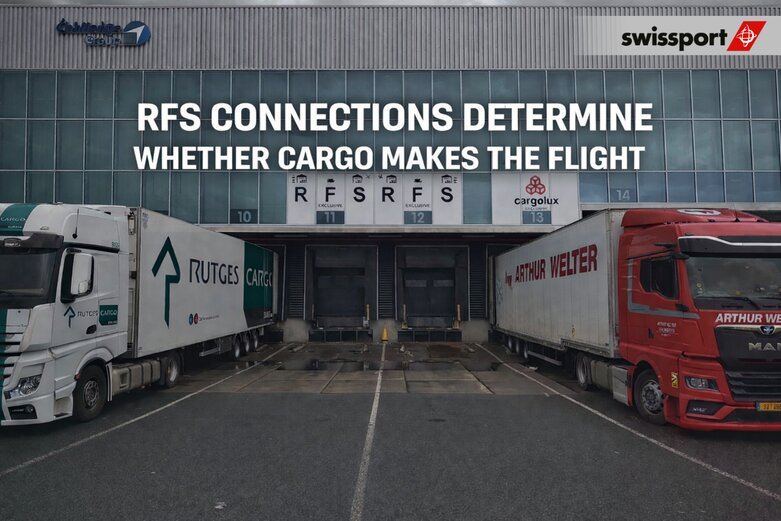
At just about every TIACA or IATA Cargo event, it is repeated ad nauseam that the digitization of air cargo processes is still proceeding too slowly. It is unclear whether Swissport in Amsterdam interpreted these complaints as a call to action. But thanks to the CDM platform, it has found a solution that uses electronically transmitted data to simplify, combine, and accelerate ground handling and road feeder activities while making processes less prone to errors.
RFS is still cargo’s main bottleneck
As is well known, delays do not occur once shipments are airborne but are caused by uncoordinated or flawed ground operations, including road feeder services. Due to the chronic congestion of the highway or Autobahn network in many EU countries, or traffic jams around major airports – RFS represent the bottleneck within the supply chain. Consequently, the ability to control trucking services can improve the process in many ways. This has been proven by a pilot of CargoHub’s CDM platform at Swissport Amsterdam that improved the punctuality of supplies.
“We wanted to move away from a situation where external parties were effectively driving the planning. Amongst the various operational challenges such as waiting times, congestions, staffing unpredictability, it was mainly truck waiting times and congestion at the warehouse causing delays and violating OTP, a critical factor for customer satisfaction, loyalty, competitive advantage and operational efficiency,” reasons Hajji Yassine, Manager Cargo at Swissport’s Service Department at Schiphol Airport.Carriers often send their planning late in the day for the next day, while they are not the only party involved.
Ground handlers grow their influence
By introducing fixed slots linked to that planning, Swissport AMS has created more structure and control forexport RFS, meaning trucking flows departing to other European airports. In the past, airlines and trucking companies largely determined the flow themselves. Thanks to CDM and slot planning, the ground handling agent is now in control of the process and able to deliver according to plan.
“When we started taking more control, we did experience resistance from airlines and truckers, mainly because they wanted to keep their flexibility. We were seeking to control the request and allocation of slots across different operational areas, so we can better manage the flow,” illustrates Hajji Yassine.
“First come, first served” is out
To safeguard the Delivered-as-Promised (DAP) performance for airline customers, more areas would need to be included before full DAP performance is accomplished. At present, only a small part of the RFS export flow works with slots. “We don’t want to overcomplicate things by making every step visible. For RFS export, OTP is the most important factor. That gives enough insight and keeps it practical. The success of the pilot will be measured by reducing waiting times, ideally to the point where they are no longer an issue,” reasons the executive.
The outcome of the pilot will be measured by the extent to which waiting times have decreased, ideally to the point where they are no longer an issue.
From chaos to structure
For a long time, the “first come, first served” principle worked well. The issue is that at certain moments, multiple parties choose the same time to arrive, which leads to peaks and waiting times. To deal with that, Swissport AMS had always allowed a high level of flexibility. Introducing a slot system now changes this. It puts structure in place, but at the same time reduces flexibility and requires all parties to adapt to fixed time windows. On the one hand, there is a clear need for more control to manage volumes and avoid congestion. On the otherhand, there is still a strong need for flexibility in day-to-day operations. Finding the right balance between those two will be key, especially if the digital slot system is expanded further.