
World Cup year, 2026 is also broadly being framed as The Year of the AI Agent – one that will see a shift from stand-alone proof-of-concept pilots just testing the waters, to actually training and embedding AI agents into daily business processes. And not just single agents working on automated individual tasks, but an intelligent team of multiple specialized agents collaborating on complex workflows, while ensuring human judgment is called in at critical decision points.
This reality is already coming into play in the world of cargo – in particular, through a German start-up founded last year by Technical University of Munich graduates, Yagiz Abik and Fehmi Sener: 5U AI is an Agentic AI specialist that is scaling up a digital workforce platform for European freight forwarding teams. It recently raised USD 3.2 million in a pre-seed funding round led by London-based Emerge Capital. 5U AI Workers are capable of managing quotes, bookings, shipment tracking, data entry and more. CargoForwarder Global put a number of questions to 5U AI’s Founder and CEO, Yagiz Abik (YA), to find out how 5U AI came about and learn more about the people behind the technology.
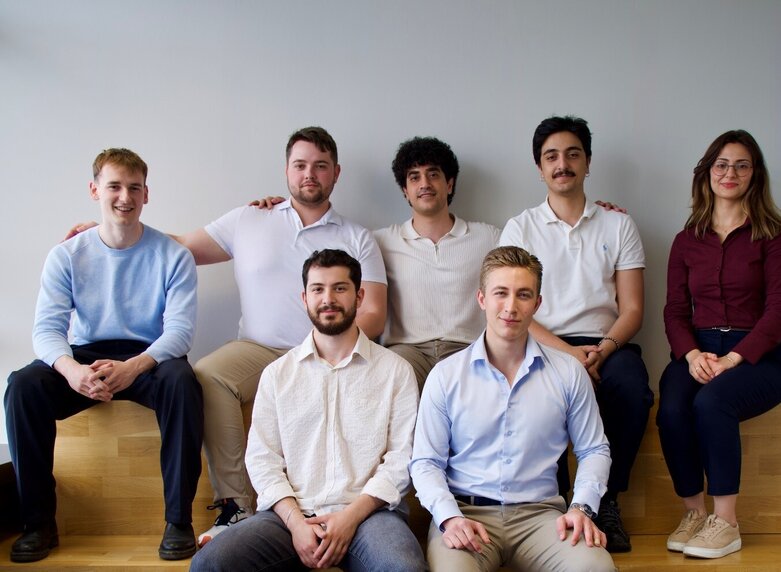
BOTTOM left to right: Fehmi Sener – Co-founder/CTO / Yagiz Abik – Co-founder/CEO – image: courtesy 5U AI
CFG: How did the idea for 5U AI come about?
YA: I’ve been a physical-trade guy since the day I opened my eyes. At 18, I was importing consumer electronics from Shenzhen and selling them across Turkey – my first contact with freight was as a customer. Later, I worked at a B2B trade startup in Hamburg, where part of my day was chasing logistics companies about orders. By mid-2025, AI models had reached the point where agents could genuinely do work, and we knew that window wouldn’t stay open long. Our thesis was simple: agents only create real value if you go deep into one industry.
So, we did dozens of discovery calls with logistics operators and visited their offices. Everywhere, the same picture: two screens – email on one, a 20-year-old transport management system on the other – and people copy-pasting between them all day. Up to 70% of forwarding work is repetitive like that. An industry that runs on email and phone calls is exactly where AI agents belong. And honestly, we fell in love with the people. You cold-call a forwarder and they talk to you like they’ve known you for five years. I wanted to love my customers – these are my people.
CFG: How did you and Fehmi meet and decide to found the company?
YA: On a football pitch. We became friends at the Technical University of Munich – Fehmi organizes one of Munich’s biggest amateur football communities, about 150 players, matches every week. We always wanted to be on the same team, and before and after every game we talked about what we could build together. Fehmi was an engineer at BMW and, in his own words, the job was too easy for him. He also knew logistics: he wrote his graduation thesis with CEVA Logistics on machine learning and had worked with their road freight department. When I came to him with the 5U idea, a first prototype and pilot customers already lined up, he didn’t blink. He quit BMW and we started in late 2025. He’s the strongest technical mind I’ve ever met. People call us yin and yang: my urgency, his calm.
CFG: What does 5U stand for?
YA: Look closely at our logo – it’s a multi-agent system. That’s the name. We’re building the first multi-agent AI system of its kind for freight: no single AI can run logistics end-to-end. One quotation alone touches carrier rates, margin rules, customer preferences, the TMS, and sometimes a colleague who has to clarify a surcharge. Our agents communicate with each other to get the job done, the way a team of colleagues does – and bringing that to freight is exactly what 5U stands for.
CFG: How are the AI agents trained for operational tasks across air, sea and road?
YA: On real freight. Our AI Workers run on a combination of frontier models and small, specialized open-source models. Because we’ve found that a specialized small model often beats a generic one at narrow tasks: reading a rate sheet, extracting shipment data from a messy PDF, classifying what an email thread is actually about. The training material is the industry’s operational reality across air, sea and road, and it’s multi-modal by nature – emails, carrier documents, rate sheets, TMS entries, phone calls. Industry professionals annotate real cases for us to create ground truth: what the correct quotation, booking or invoice match actually looks like.
Every model and every change then runs through our evaluation platform, which simulates thousands of freight scenarios – an expired surcharge, a customs broker joining a thread halfway, a rush request at midnight – and scores the outcome before anything touches production. And before an AI Worker goes live, it gets fine-tuned on that specific customer’s own historical cases in shadow mode that stays with the customer: their margin rules, their carrier preferences, their formats. The models arrive knowing freight; then they learn the company and become more specialized to them over weeks.
CFG: How are they quality-controlled? Who checks, and how do corrections enter the memory?
YA: Every decision an AI Worker takes is captured as a record: what it decided, on what data, with what confidence. That’s our Decision Layer. On top of it sits a human approval flow. In the first days of deployment, nothing goes out without a person: for example, the AI Worker prepares a quotation and messages the operator on Teams or Slack – ‘Here’s my pricing, can I send it?’ The operator gives a thumbs-up or corrects it, and the correction is written into the AI Worker’s memory.
The memory even defends itself. In one of our regular check-in meetings, one Managing Director asked why the AI was calculating a margin a certain way – it turned out his own operations lead had taught it that rule, and the AI Worker asked: ‘Your colleague taught me this. Do you approve changing it?’
AI Workers also self-heal on the job. When something breaks mid-task – a carrier portal changes, a rate source stops responding, two systems disagree – the Worker notices, finds another route to finish the job and repairs its own flow instead of stopping or guessing. Then, it puts how to do this job in the new way to its memory and saves it. Only when it truly can’t, it escalates to a human with full context, and the fix is written into memory, so the same problem doesn’t come back.
As confidence builds, we remove the approval step for routine cases – live customers reach 85-95% automation on individual use cases, and every SOP change is regression-tested in simulation environment in our internal ‘Grader’ product before it touches production.
CFG: A use case: how do AI agents complement the human team at an average forwarder?
YA: Take a typical mid-sized European forwarder: 100 to 500 people, air and ocean. Operators sit in front of two screens – the inbox on one, a TMS that’s sometimes older than they are on the other. Two to three hundred quotation requests arrive every day; three or four people do nothing but answer them, and many still go unanswered.
Our AI Worker joins the team inside that same inbox and Teams. It pulls rates from the preferred airlines, applies the company’s margin rules, knows this account never ships via a certain carrier, asks a teammate when a rate sheet looks expired, sends the quote and logs everything in the TMS. A human needs around 15 minutes per quotation; the AI Worker needs about two, and answers tens in parallel. Requests arriving at midnight from Toronto are won while everyone sleeps – we see more than doubled win rates within weeks at selected customers handling high volumes of quotations. The new complaint becomes keeping up with the extra business.
CFG: Since when has 5U been commercially live, and how quickly can an AI team be set up?
YA: Our first AI Workers went live with paying customers towards the end of 2025. Once we agree with a customer on the first use case, we follow it with an in-person workshop – then normally go from workshop to live within our standard four weeks. Most customers add second and third use cases within weeks.
CFG: How will you invest the pre-seed USD 3.2 million?
YA: Three things. First, we are heavily investing into our go-to-market: we are confident in our market approach, and we will scale what we have been doing quietly. We’re across all commercial and generalist functions, and building an inbound engine; we’ve spent 0 marketing dollars so far. Second, engineering: we will double down on our R&D efforts – we realized that small, specialized open-source models are better at achieving some partial tasks than a generic model, so we are investing into our inference and R&D. Third, the Decision Layer: every job our Workers complete, generates decision data this industry has never captured, and that’s the long-term product that will benefit all of our customers. We’re frugal – we think twice before buying a meal – so the money goes into people and product, and most importantly, to keeping up with the demand we are seeing from the industry.
CFG: Why European forwarders first? What triggers and challenges do you solve here?
YA: Because Europe is the densest concentration of exactly our customer. More than a million people work in European forwarding, thousands of mid-sized forwarders running systems that are 20 or 30 years old. If you’re lucky, there’s a TMS that looks modern; in truth, the industry runs on email and phone. Margins are on the floor, the cost pressure is brutal, and experienced operations people are nearly impossible to hire. It’s also a relationship industry: we deploy on site, shake hands and stay close, which is why we started here.
CFG: How unique is the concept – and how do you differ from conventional chatbots?
YA: A chatbot is a portal you type into: stateless – it answers a question and the session dies. Our AI Workers are colleagues who do the work. They live where freight actually happens – the inbox, Teams, the phone – not in yet another tab. They’re stateful: a shipment thread can go quiet for three months, and when the customer writes ‘I need the proof of delivery’, the Worker picks up the exact same case with full context. That’s the nature of logistics, and generic tools can’t handle it.
They execute end-to-end – quote, book, track, enter data into the TMS – rather than drafting text for a human to finish, and they’re trained on logistics context and its edge cases: the customs broker joining an email thread halfway, the expired surcharge sheet, the dangerous goods request that must go to a person. Early on, we made a bet against rigid workflow automation – workflows are jails for agents, RPA 2.0 – because freight is too messy for if-this-then-that. If this were prompt engineering on a chatbot, we’d have been done in three months. The proof is in how customers treat them: they give our Workers names and a seat in the team channel.
CFG: Who are Yagiz and Fehmi outside work? How do you relax?
YA: Sports. It’s literally where 5U comes from, and it also determines our team mentality: “We are not a family, we are a sports team, and we are here to win.” As said, we met on the football pitch, and we still play every week. He’s a clever playmaker, I’m an attacker, which gives you hints about how we run 5U. I grew up playing tennis competitively, and I keep telling our investors that after a certain age, I’m going back to the court. Other than that, we value being the underdogs who are obsessed with the real economy and real people. It’s not very easy to relax when you are obsessed with the problems you are solving in this great industry.
Thank you for those excellent insights, Yagiz!