
How can freight forwarders balance efficiency, resilience and growth opportunities in an increasingly unstable market? That was the lead question of a panel discussion at the EU CBEC in Liège, last week.
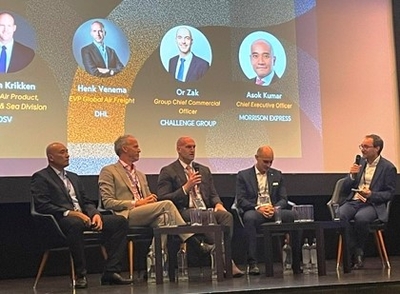
Moderator Maarten Wormer asked if the strategy to work with different gateways in Europe still stands and, if so, whether it is better to use smaller or larger gateways. Henk Venema, Executive VP Global Airfreight at DHL Global Forwarding, answered that you need capacity as well as volume, and that bigger gateways will always be more effective.
Or Zak, CCO of Challenge Group, testified on the group’s long-standing (30 years) relationship with Liège Airport. He was seconded by Mr Venema, who said that airports serving both passengers and cargo, will let passengers prevail. “You need to find a place where you can influence the process. That is why we prefer airports such as Liège, Leipzig or Cincinnati.”
Speaking from an Asian point of view, Asok Kumar, CEO of Taiwan-headquartered forwarder, Morrison Express, said that his company is actually looking at this model, even if Singapore has always been important. “We are evaluating other, regional gateways, and we are agile enough to adapt. However, ground handling is an important factor for us.” Contrary to forwarders, airlines have less flexibility, Or Zak put in. “Secondary airports may be the best solution, as the logistics community will work with you. On the geopolitical side, things get more complicated. In the end, you have to go where the cargo is.”

Thank you, Mr. Trump
DHL’s Venema thinks that the industry may be blinding itself too much with the geopolitical issue. “As long as Mr. Trump is in office, business will do well. We are always following geopolitical trends and we’re doing very well because of all these rules and regulations imposed by him.”
The debaters were convinced that there will always be a role for SME companies, especially as specialization will be the buzz word. “You cannot excel in everything,” said Henk Venema.
Know your markets
According to Stefan Krikken, DSV’s Global Head of Airfreight, you really need a good strategy which involves a yearly assessment of the market, especially as regarding infrastructure and capacity. To which Mr Kumar added that flexibility will become more important. “And gateways are one way of doing this.”
Henk Venema confirmed: “People are sometimes either overrating or underestimating capacity. In the total scheme of things, you have assets to deploy where you can make profit. Today, the balance is completely gone. U.S. exports have never been so low, imports have never been so high.”
Battle is on the ground
For an airline, deploying aircraft by combining locations may be a solution. “So, you have to know your traffic rights,” said Challenge executive, Or Zak. DSV’s Krikken thinks that a gateway approach is a long-term strategy. “Just look at Panalpina and its commitment to Luxembourg.” Henk Venema is convinced that the battle is on the ground, not in the air. “If we don’t invest more in efficient ground handling in some airports around the world, infrastructure will take us by surprise.”