Automation in air cargo is moving beyond conveyors, storage systems and ULD handling. Increasingly, software is deciding where cargo should go, when it should move and which process should come next. Yet the physical reality of air freight – irregular shipments, incomplete data and constantly changing requirements – continues to set limits to full automation. CargoForwarder Global (CFG) spoke with Björn Ussat (BU), Director Airport Logistic Solutions at Lödige Systems GmbH, at the Air Cargo Conference in Frankfurt on 02SEP26, about Cargo Direct, the role of experienced cargo staff, and why flexibility may ultimately matter more than achieving the highest possible level of automation.
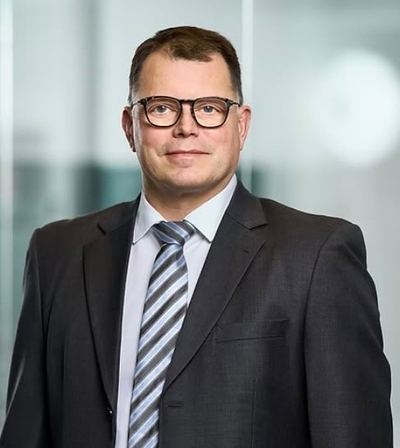
CFG: Lödige Industries has been active in airport logistics for decades and today equips major cargo hubs around the world. Mr. Ussat, you, too, have been closely involved in the development of automated cargo solutions for many years. How has the role of Lödige Industries changed during that time?
BU: The core task has remained the same for 30 or 40 years: moving large volumes of cargo through a terminal reliably and quickly. What has changed is the complexity and speed of implementation. Projects that once took six or seven years may now need to be completed in three years or less, while standards and customer requirements have become much more detailed.
Software has also fundamentally changed our role. Today, a system must do more than move a pallet from A to B. It needs to know where cargo should be stored, when it will be required and which process step should follow. We have therefore evolved from an equipment supplier into a provider of integrated material-flow and process-management solutions.
CFG: Air cargo still loses valuable payload and volume because ULDs and pallets are not always built to their optimum capacity. Cargo Direct can already combine shipment, weight and volume data for build-up planning. Is the logical next step for Lödige Industries, a system that tells the operator exactly how a ULD should be packed, and would you develop such a solution yourself or integrate technology from specialized partners?
BU: Technically, that would be a logical next step. The main obstacle, however, is data quality. We still see too much incomplete or inaccurate shipment information. If dimensions, weight, center of gravity or other characteristics are unreliable, a fully automated build-up instruction cannot be reliable either.
ONE Record and similar initiatives are important, but implementation across the market remains inconsistent. That is why our systems increasingly verify data such as weight and dimensions inside the terminal itself.
Whether a technology is developed by Lödige Industries or integrated from a specialist partner, is secondary. What matters is that it creates operational value. Even the best packing algorithm is of little use if the underlying data is wrong or the investment does not provide a convincing business case.
CFG: With Cargo Direct, Lödige Industries is moving beyond equipment automation towards process automation, with the software determining the next optimal step for individual cargo units. Does this mean that operational decisions traditionally made by experienced cargo staff will increasingly be taken over by software?
BU: Software can already take over or support many routine decisions, such as storage allocation, retrieval sequencing and choosing the most efficient process route.
The limitation appears when the digital model meets physical cargo. Air freight is extremely variable: boxes, machinery, dangerous goods, pharmaceuticals, oversized or irregular pieces. A system may calculate the ideal position on a ULD, but it may not know whether packaging can carry weight, whether it is distorted or whether the actual center of gravity differs from the declared data.
Experienced cargo staff recognize many of these issues immediately. The more standardized the process, the easier it is to automate. The more irregular the cargo, the more valuable human judgement remains.
CFG: Cargo Direct is intended to provide the foundation for future AI-assisted optimization. Looking five to ten years ahead, which operational decisions inside an air cargo terminal do you expect AI to take autonomously and where should human control remain indispensable?
BU: AI will become much stronger in areas such as storage allocation, sequencing, resource planning, retrieval priorities and cargo routing. It should also be able to predict bottlenecks and adjust processes dynamically.
Humans will remain essential when exceptions occur or when the physical characteristics of cargo are not fully reflected in the data. There is still no universal robotic solution capable of handling every possible cargo configuration.
I therefore expect a hybrid model: AI will increasingly plan and optimize, while people remain responsible for exceptions, physical judgement and situations where flexibility matters more than standardization.
CFG: Highly automated terminals promise greater efficiency, but they also create new dependencies on software, connectivity and centralized equipment. What happens if a critical system fails during peak operations and can a cargo terminal actually become too automated?
BU: The risk is not only technical. Automation can be introduced faster than an organization can absorb it. New systems change responsibilities and job profiles and therefore require substantial management changes.
Technically, resilience has to be built into the terminal from the start. That means redundant equipment, alternative process routes and different IT levels. If an external interface fails, the terminal should still be able to track and move cargo locally.
A process that can only be performed at one highly specialized point creates vulnerability. Flexibility and alternative routes are therefore as important as automation itself.
CFG: Large-scale automation requires substantial investment, while cargo volumes and customer requirements can change quickly. At what point does automation become economically compelling for a terminal and where do you see the risk of overinvesting in technology that may not deliver the expected return?
BU: There is no universal threshold. The key question is what problem automation solves – whether that is throughput, space, reliability, labor availability or peak capacity.
The mistake is to automate simply because the technology exists. Cargo terminals operate for decades, while markets and shipment structures can change very quickly. Covid demonstrated how rapidly cargo patterns can shift.
That is why flexibility must be part of the return-on-investment calculation. The best system is not necessarily the one with the highest degree of automation, but the one that combines productivity with the ability to handle tomorrow’s cargo as well as today’s.
CFG: Thank you for your time and the input.