
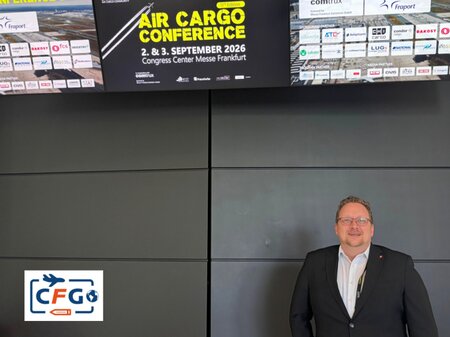
Rapid changes in U.S. trade policy are shortening planning horizons for freight forwarders and their customers, while shifts between ocean and air can occur at increasingly short notice. Speaking to CargoForwarder Global at the Air Cargo Conference in Frankfurt, Wolfgang Haibach Product Manager Airfreight Germany at Gebrüder Weiss described a market shaped by tariff uncertainty, changing capacity patterns and persistent e-commerce demand from Asia.
The political environment in the United States is having a direct effect on transport decisions. New tariff measures and regulatory deadlines can be announced at short notice, leaving importers and exporters with little time to adjust.
“The short lead times create uncertainty,” Haibach states. “In some cases, that means cargo has to be moved from ocean to air because the original transport plan no longer works,” Haibach states.
The issue is not limited to freight rates. Customs duties and increasingly complex import procedures are becoming a more important factor in supply-chain planning, particularly where goods are delivered directly to consumers.
For freight forwarders, this means that transport decisions are increasingly tied to customs considerations rather than transit time alone.
More volume, more capacity
At the same time, the air freight market has seen significant additional capacity, which places pressure on the market, even though Gebrüder Weiss recorded air freight growth of around 33% in Germany between January and July 2026, while the company’s European air freight business grew by approximately 15% during the same period.
The combination illustrates an increasingly familiar situation: cargo volumes may rise without necessarily creating a correspondingly stronger pricing environment.
For shippers, the response has been a greater focus on resilience. Fixed transport concepts are becoming more difficult to maintain when political measures, tariffs or capacity conditions can change quickly.
Haibach said closer cooperation with airlines and shipping lines, combined with the ability to use alternative routings, had therefore become more important.
“Flexibility is essential,” he said. “You need to be able to adjust the strategy when conditions change.”
E-commerce keeps Asia volumes high
Asia remains an important source of air freight demand, with e-commerce continuing to generate substantial volumes despite tighter import conditions.
Haibach pointed particularly to Southeast Asia and China-related flows. Yet the capacity model is changing.
Charters, which became a central tool during periods of severe capacity shortages, are less attractive in some markets today. Scheduled capacity has become more available, while charter economics are harder to justify when rate structures normalize.
Reliability is consequently moving back up the priority list.
The development also raises questions about how sustainable some e-commerce air freight models will remain if customs barriers increase further. So far, however, Haibach sees no fundamental collapse in demand.
AI enters operations, but with limits
Automation is another area receiving increasing attention as forwarders attempt to manage greater market complexity.
Haibach expects AI and automated processes to become a normal part of logistics operations. Gebrüder Weiss is already using technology to support certain operational processes. However, he cautioned against assuming that technology can replace operational experience entirely.
“The human factor remains important,” he stressed.
AI may help process information faster, identify disruptions and support routine decisions. Yet freight forwarding still involves exceptions, changing customer requirements and situations in which predefined processes do not apply.
That may be particularly relevant in the current environment. Political decisions can alter trade flows within days, while capacity and rates can move just as quickly.
For Haibach, the consequence is less about predicting the market correctly and more about accepting that supply-chain planning is becoming shorter-term, more conditional and increasingly dependent on the ability to switch courses quickly.
In a market where tariffs, capacity, and cargo flows can change almost overnight, the competitive advantage may no longer be having the perfect plan – but being able to change it quickly.