

Hardly a day goes by without a drone overflight reported by a German airport. This year alone, more than 330 incidents of drones in the vicinity of airports, were registered. Holger Kraft, VP of Security Operations at Munich Airport, shared this figure and other insights on drone alerts and defense, at the recent German Air Cargo Association (acd) meeting held in Frankfurt, last week. The title of his presentation: ‘Drone Alerts at Airports – a trivial offence, ignorance, or hybrid warfare?’

Right from the start, Kraft made it clear that the issue at hand is hybrid threats, which are constantly on the rise. “Last year, drone activity disrupted operations at several major hubs within a matter of weeks,” said the security expert.
Spy flights have nearly quadrupled
The evidence: in addition to Copenhagen, Oslo, and Brussels, Munich was also affected by temporary closures due to drone alerts. In early OCT26, 56 landings and a total of 250 flights had to be canceled there, and the airport had to support more than 10,000 temporarily stranded passengers. Simultaneously, cargo supply chains were negatively affected due to operational disruptions.
The increasing frequency of drone overflights raises the risk of critical infrastructure being spied on and of collisions between drones and aircraft, and fuels fears of war among parts of civil society.
Just how real this threat scenario is, was demonstrated by the deployment of a drone equipped with an explosive charge at Leipzig Airport in early AUG26 (as reported by CFG).
The Leipzig example illustrates the intensification of hybrid attacks in many parts of Europe. Considering this, effective security strategies and high-performance defense systems play a key role in countering potential threats. This hot issue was debated by the acd members, following Kraft’s presentation, specifically with regard to drone sightings in Leipzig, Frankfurt, Munich and other airports.
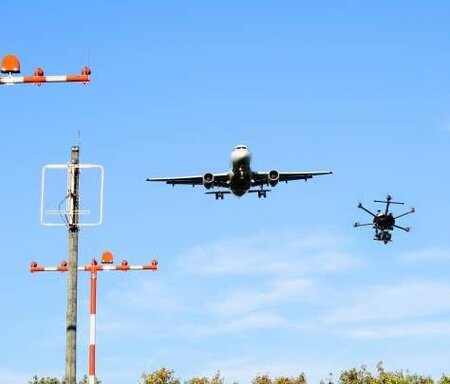
Scaling up countermeasures
This is a Herculean task, mainly because drones targeting airports must be detected early on. Only then can the threat situation be assessed in order to initiate appropriate countermeasures. However, rapid technological advancements pose significant challenges to existing defense systems. Conventional methods, such as RF sensor technology* – which is used at Leipzig and other German airports – becomes increasingly inefficient in successfully combatting more powerful and increasingly autonomously piloted drones.
Therefore, there is a need for updated, robust detection technologies and effective defense solutions.
In addition to technical capabilities, reliable risk assessment is crucial. Security officials must be able to distinguish between lawful drone flights and actual threats. The goal is to respond appropriately to suspicious activities while avoiding unnecessary disruptions for legitimate users.
(Too) many different players
If a drone is spotted in the vicinity of an airport, it is key that responsibilities are clearly defined, said Kraft. Airport operators are liable for reporting a drone. Stopping or destroying it is the task of the Federal Police, in close coordination with local police forces and German Air Traffic Control (DFS).
Alarmed by the many drone sightings, lawmakers have given the green light to extend drone detection capabilities by installing new systems, among other measures. In addition, the Berlin government has expanded the Federal Police’s drone prevention competencies and has simplified the military’s involvement in drone defense operations, by amending the Aviation Security Act.
In this context, acd President, Christopher Stoller called on politicians and institutions: “Now more than ever, our air transportation infrastructure must remain well protected. Funding for drone defense must therefore continue to come from the federal budget and the states, and must not be passed on to airport operators.”
None of the approximately 40 participants at the event objected to this appeal.
*High-frequency (HF) sensors operate using electromagnetic waves. This enables them to reliably detect movement even when the line of sight is obstructed. They are also immune to external influences such as light or temperature conditions. HS
Isabella Zoerner