
The Latin American carrier has tripled its warehouse capacity at Bogota’s El Dorado Airport by adding 46,300 sq ft to its existing facility. Colombia is a key market for the flower business, so thanks to the move the capacity provider will strengthen its position in the country.
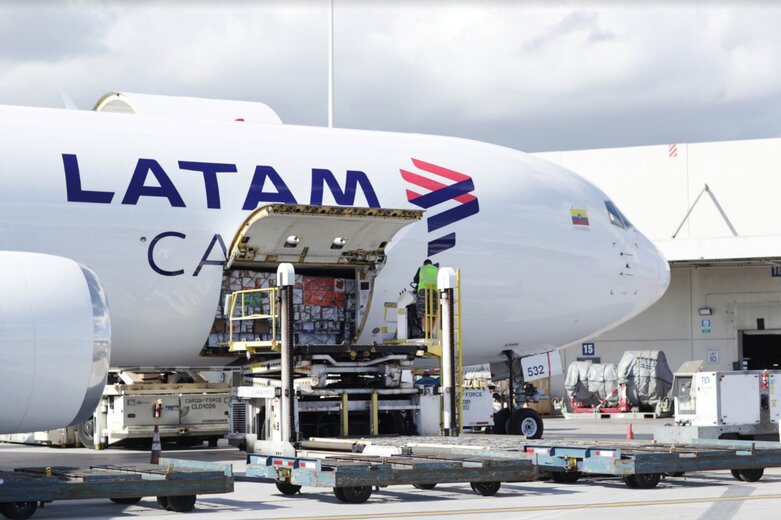
20% more cold storage capacity
The site is located in the eastern annex of the cargo terminal and provides direct connectivity between road feeder services and aircraft, facilitating seamless ramp maneuvers. This facility will allow LATAM Cargo to expand its cold storage capacity by approximately 20% to support the growth of the flower export market, where the carrier already holds a 35% market share. The airline also plans to expand its domestic cargo facilities in Bogotá and establish a new space dedicated to handling the growing inflow of import cargo.
Both moves are embedded in a digital transformation strategy designed to enhance customer experience, optimize assets, and integrate the supply chain, a press release states. Internationally, the carrier is advancing its rollout of IATA’s ONE Record program to digitalize end-to-end data exchange with industry stakeholders and customs authorities. In Colombia specifically it has deployed artificial intelligence and RFID-based tracking tools for flower shipments, complemented by the CargoLink platform for advance cargo acceptance.
Icing on the cake
Following Martinair’s market exit by shifting its freighers from South America to the Far East, and Qatar Cargo’s flight reductions, LATAM Cargo’s main competitor is Colombia-based Avianca Cargo. Jorge Carretero, Sales Director LATAM Cargo, Central Europe, takes a lighthearted view of the situation: “Competition is the icing on the cake, because it generally leads to improvements in product quality and customer service.” The executive emphasizes that thanks to the facility’s expansion his airlines not only offers upgraded warehouse services in Bogota, but due to the additional cold rooms the handling and storage of temperature sensitive items is improving considerably.
14 weekly cargo flights across the Atlantic
Further to this, Carretero highlights that Viracopos in Brazil has become the central South American hub for the airline’s freighter fleet. “Brazil is by far our largest market, where we serve numerous destinations,” says manager Carretero. The newest destination is San Jose dos Campos, which LATAM Cargo serves twice a week with freighters. In total, LATAM Cargo currently operates an almost uniform fleet consisting of 20 B767F and BCF aircraft. This includes 14 weekly flights to Brussels, seven of which are touching down in Frankfurt. “We currently offer the European market a capacity of around 2,000 metric tons, of which approximately 1,400 are carried in the bellies of the passenger fleet and 750 on dedicated cargo aircraft.”
Carretero: “Competition creates new dynamics”
Carretero does not expect increased competition for his airline from the upcoming Lufthansa Cargo – TAP Cargo merger, should the competition authorities give it the green light. ““I see this development more as an opportunity than a threat. Any changes in the competitive landscape will create new dynamics in the market, but we are confident in our positioning, our network and our ability to continue delivering competitive solutions to our customers.”
Second pharmaceutical corridor to come
Had the Portuguese government decided to favor the Air France-KLM Group’s offer instead of selecting Lufthansa as TAP stakeholder, it would likely have had more far-reaching consequences for LATAM Cargo. “The outcome could certainly have created a different competitive landscape. However, we remain confident in LATAM Cargo’s strong position in Latin America and our ability to compete successfully in this market to maintain and even grow our position on our vast home market.”
Finally, the manager notes that his airline has established a pharmaceutical corridor in Brussels in partnership with K+N, which has proven successful. LATAM Cargo is now pursuing a similar plan for Frankfurt.