
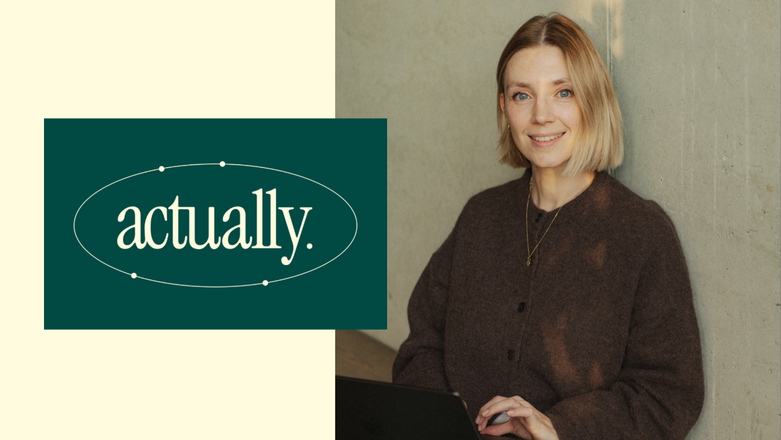
A familiar name and face in the world of air cargo technology, Sara Van Gelder (SVG) launched her own enterprise, this week. Based in Belgium, actually. offers independent advisory services to logistics companies and B2B software providers looking to successfully navigate digital product implementation. ‘Change rarely stalls because of technology. More often it stalls between people and organizations that fail to move together,’ is the observation she made during a decade of developing and supporting air cargo digitalization at airports in Europe, the U.S., and Asia-Pacific. And it is precisely that pain-point that actually. now addresses, offering digital strategy, transformation project recovery, product and growth direction for software companies, and interim leadership. As she puts it, Sara acts as ‘the connector between business, people and technology’, who stays involved until change is live. CargoForwarder Global (CFG) reached out to Sara to find out more about how actually. came about and how it operates.
CFG: When did you first come up with the idea for actually.? What was the main trigger?
SVG: After ten years on the digitalization journey in air cargo, first at Brussels Airport and later at Nallian, I felt ready to spread my wings and try something new. I had always kept the door open to going independent. I was looking for a new challenge, new things to learn and new stories to be part of and give direction to.
One of my strengths, and also one of my weaknesses, is that when I go for something, I go full gas: all my energy, passion and focus. Several opportunities came along, but none of them made me think “yes, this is what I want to do for the next five to ten years”. I wanted something that would keep me learning and growing, and that would make me hit a few walls too. The most interesting roles would also have meant relocating our family. We looked at that seriously, but in this phase of life we want to stay close to our loved ones, family and friends.
With actually., I can combine different projects. That brings me in touch with lots of new angles, people and challenges. I still travel and work globally, but in a way that fits what matters most in the end.
CFG: Why actually.? How did you choose the name? What is the story behind it?
SVG: I wanted a name that wasn’t my own and wasn’t tied to one service or one industry. It had to say something about how I work, who I am and the value I want to bring. “Actually” is the word you use when you stop and take another look: what is actually going on here? It stands for a different perspective, a pause and a moment to re-evaluate before you choose and move forward. That is exactly what I do with clients. I also like that it’s a conversational word. It’s something you say out loud in a meeting or over coffee, and that’s where most of my work starts: in conversations, close to people.
I’m curious by nature, so I like to find out what is really going on instead of accepting the first answer. At the same time, I’m pragmatic: the goal is to make choices and move forward, not to keep analyzing. And it always stays human, because in the end business and technology are about people.
CFG: actually. can help a software client or a software vendor. Does it also act as an intermediary between the two? Are there any no-go topics?
SVG: Yes, it can. When a logistics company wants to implement software as part of its transformation or digitalization strategy, I can help on the customer side. That covers writing the RFP, doing the fit-gap analysis with vendors and managing the implementation.
From the other side, I help B2B software companies find product-market fit, validate their ideas with potential customer groups and take the steps towards a product that can scale.
I love being the connector between business, people and technology. My no-go is becoming a reseller for one software package, provider or brand. Being direct and honest is one of my core values, and I can only be that if I stay independent.
CFG: How much ‘digital’ is there in actually.? Or is it all a human, hands-on approach?
SVG: It’s a human, hands-on approach. But one of the first things I thought about when starting my own company, was scalability. Scaling yourself is, by definition, not very scalable, so I see two routes.
The first is building a network of like-minded advisors. I’ve had many exploratory conversations with people in and out of our industry about where we could work together. The second is using technology, including AI, to make myself more scalable and to replicate my knowledge, approach and values faster.
CFG: Did you pilot the idea before going live? What feedback shaped actually.’s portfolio?
SVG: I didn’t run a formal pilot. Over the past months, I talked to warm, clever people from my network, both inside and outside the industry. We talked about where I get my energy from, how to turn that into something the market needs, what the services should be and how to make them sharp.
The timing helped. I was on my second maternity leave over the summer and had already decided not to go back to my previous job. Starting with a clean slate is stressful and feels risky at times, but mostly it freed my mind. Every time an idea popped up, I wrote it down in my digital notebook. Later, I read the notes again, did some research and fine-tuned things, step by step. It’s a creative process, and you can’t speed up or force creativity. In the end it is all coming together at the right moment.
CFG: Am I right in thinking actually. is the first air cargo company to focus on this particular niche of digital transformation problems?
SVG: Yes… As far as my market research goes, I don’t see someone offering exactly this in the air cargo industry. I haven’t found another company in air cargo, that focuses specifically on this angle, and it fits my experience completely. Luckily, I got in touch with people in other or adjacent industries that do exactly this. It’s a niche, but I think it’s a very needed one. And it also leaves plenty of room to work together with fellow entrepreneurs. That matters to me because, in the end, I’m a group person and a team player, and I’m looking for flexible ways to build a team or become part of one.
CFG: Many IT software providers offer aftersales support. Where do you see the limits, and what are the benefits of calling in actually. as an independent advisor and problem solver?
SVG: Aftersales support and forward-deployed engineers are always shaped by the vendor’s culture, way of working and sales targets. That’s good and natural, but it isn’t neutral. When an implementation isn’t going as expected, an outside perspective can add a lot of value, also for a vendor who has these services in-house. It helps to have someone who connects the boardroom and strategy with operations, and who takes in the perspectives of both the vendor and the buyer.
Also, a lot of the work happens on the buyer’s side, ideally before they even contact a vendor: getting the organization ready for change. That means mindset, change management and getting operational buy-in for the strategy that’s been set. Collect all requirements in a structured way. Those steps often decide whether a transformation project succeeds.
CFG: What does Sara do to relax when she’s not working on actually.?
SVG: I go outside. Running and cycling took a natural break during my maternity, but I’m slowly picking them up again. Spending time with our family, but also make some time without the kids and go out with friends. That’s another reason we’re staying in Belgium for now: family nearby who can step in, because it takes a village… [Smiles] I also recently discovered sauna and ice bathing, after a new Cold Club opened close to where I live. It’s absolutely the best me-time. [Smiles again]
Thank you for your insights, Sara!