LATAM Cargo has consolidated its leadership role on Europe-South America routes, achieving a 30% market share despite aggressive cut-throat competition. Currently, the carrier operates approximately 90 weekly passenger (PAX) flights offering 1,300 tons of cargo capacity in the aircraft’s lower decks. This is complemented by 15 dedicated freighter flights per week, connecting Europe with key strategic Latin American cargo hubs providing an additional 800 tons per week. In an exclusive with CargoForwarder Global, Jorge Carretero, Sales Director Cargo, Central Europe (JC), announced intentions to scale up operations triggered by the upcoming EU-Mercosur agreement on free trade.

CFG: What impact does LATAM Cargo expect the pact to have on its business between South America and the EU?
JC: LATAM Cargo sees the EU–Mercosur pact as a structural catalyst for long-term trade growth between South America and Europe. By reducing trade barriers and improving market access, the agreement is expected to accelerate cargo flows and unlock new business opportunities across key industries.
From a strategic perspective, this reinforces the importance of the Europe–South America corridor as a core market for LATAM Cargo. We anticipate sustained demand growth, particularly in high-value and time-sensitive segments, and will continue to align our network, capacity, and product offering to capture these opportunities.
CFG: Which air cargo and consumer goods do your market analysts believe will benefit most from this treaty?
JC: Perishables will remain a key growth driver, particularly exports from South America such as fresh fruits, vegetables, and flowers, where improved market access directly translates into higher volumes.
At the same time, pharmaceuticals, high-value goods, and industrial cargo, including automotive and manufacturing components, are expected to see increased flows in both directions. LATAM Cargo is well positioned to support these segments through its specialized solutions, reliability, and extensive regional coverage.
CFG: On which specific routes can tonnage growth be expected (both import/export) triggered by the EU-Mercosur deal?
JC: Our main gateway is São Paulo/Guarulhos (GRU), which concentrates the largest share of tonnage and serves as a key distribution hub for the region. We are further strengthening our footprint by adding new passenger routes from Amsterdam (AMS) and Brussels (BRU), while maintaining our established operations to Santiago (SCL) and Lima (LIM). Complementing this are our 15 weekly freighter operations between both key markets, providing a balanced combination of belly and freighter capacity to capture growth on both import and export flows across the EU–South America trade lane.
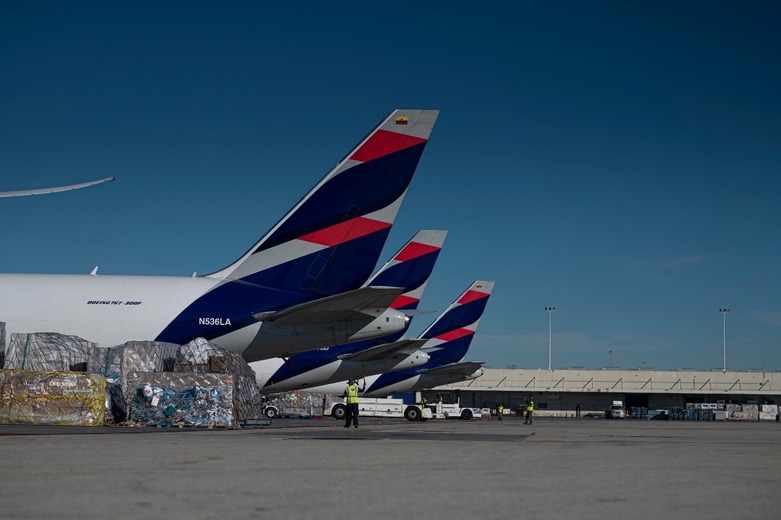
CFG: Which destinations does LATAM Cargo serve with freighter aircraft on routes between Europe and the four Mercosur member states?
JC: Currently, we operate 15 dedicated freighter flights each week, connecting Europe with key strategic cargo hubs in South America, including:
- Viracopos (VCP)
- Curitiba (CWB)
- Florianópolis (FLN)
- Santiago (SCL)
- Buenos Aires (EZE)
- Montevideo (MVD)
- Lima (LIM)
This dual-capacity model – combining extensive passenger belly space with a robust freighter network – allows LATAM Cargo to offer both scale and flexibility. As a result, we are strongly positioned as a preferred partner for customers operating between Europe and South America, particularly within the Mercosur region.
CFG: Jorge, thank you for your input.
Salmon fly (almost) CO2-neutral
In a separate announcement, LATAM Cargo and Andes Integración Logística jointly informed that they have completed the first premium salmon air shipment with a sharply reduced carbon footprint, on behalf of the Chilean salmon exporter, AquaChile. The shipment consisted of more than 3 tons of premium salmon from Chile to the United States.
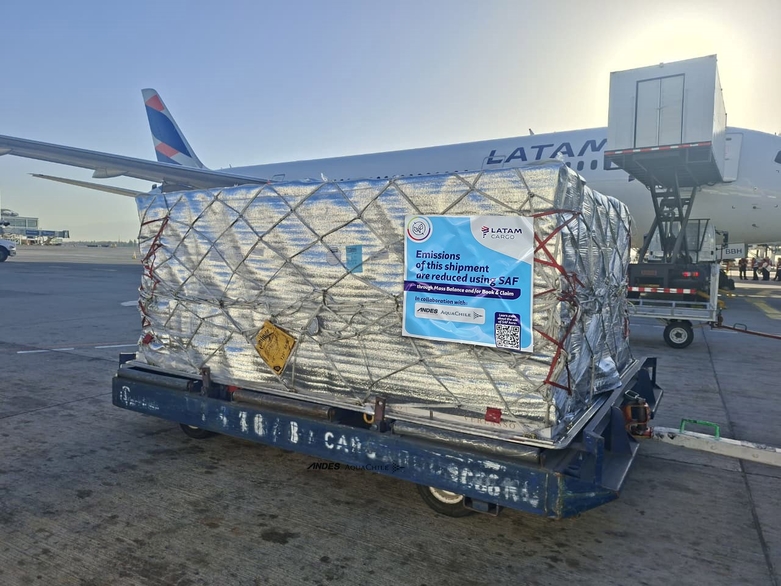
The SAF utilized – produced from animal waste residues – enables emissions reduction of 74.7% compared to conventional fossil fuels, according to the calculation methodologies employed.
“This shipment demonstrates that the decarbonization of air cargo is possible when the entire logistics chain works in tandem,” commented Cristina Oñate, Product Sustainability Manager at LATAM Cargo Group. “Our goal is to continue expanding access to concrete, traceable, and verifiable solutions based on the use of SAF, so that more South American exporters can reduce the carbon footprint of their international shipments”.
For his part, Jan-Henrik Hertel, Director of Processes at Andes Integración Logística, noted: “This agreement reinforces our role as a strategic freight forwarder. We do not just manage transport from origin to destination; we accompany our clients in fulfilling their sustainability goals. Furthermore, we are proving that the logistics chain can be an active tool for greenhouse gas reductions.”