
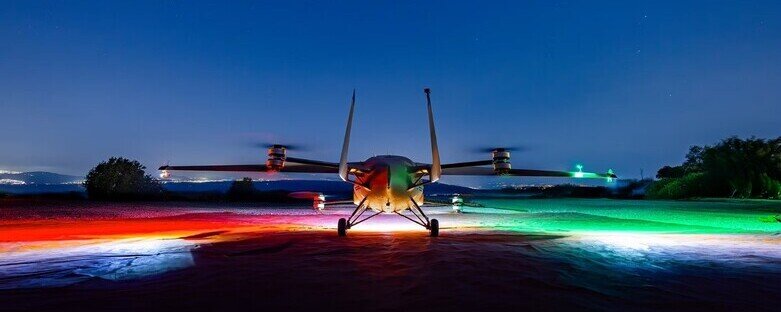
What CargoForwarder Global reported on back in 2024, became reality on 15APR26, with the first successful flight its Production AIR Cargo Heavy UAS [Unmanned Aircraft System]. A YouTube video of the event is available here. Hailed as the world’s largest quadcopter, it has been developed to address the requirements of speed, reliability and flexibility in logistics, and – in particular – to being cargo to areas that are otherwise difficult to reach with conventional transport. Israel’s company AIR is the brainchild behind the heavy-lift UAS and has been fine-tuning its invention over the past two years. The result is a production model that is one of the world’s largest VTOL-capable unmanned aircraft, classed as Group 4 UAS. That is the second largest category in the U.S. Department of Defense’s drone listing and denotes aircraft that weigh more than 1,320 pounds (almost 600 kg), which have significant endurance and payload capacity – in AIR’s case, a payload of around 550 pounds/250 kg. Its cargo bay measures 70 ft³/21 m³ and is equipped with next-generation motors, advanced battery systems, foldable wings, and fully matured avionics. The Heavy-Lift VTOL UAS lends itself for the transport of commercial or humanitarian cargo, as well as defense logistics or maritime resupply. It is FAA approved and has carried out hundreds of test flight operations in Florida. The inaugural, commercial-ready flight of its Production AIR Cargo Heavy Lift UAS, represents “a significant step forward in autonomous heavy-lift aviation”. The aircraft is capable of reliable operations in all kinds of environments, including dust, darkness and sustained mission cycles. 25 units have already been ordered and paid for.
Rani Plaut, CEO and Co-Founder, AIR, commented: “This flight milestone reflects what AIR has been building toward. We’ve spent two years refining this aircraft against real operational demands, not benchmarks or simulations. Delivering that now, at this scale, is what we set out to do.”
Chen Rosen, CTO and Co-Founder, AIR, stated: “This next-generation configuration taking flight is the culmination of years of engineering iteration and direct operational learning. Every design decision, from the motors to the flight logic, was stress-tested against what operators actually encounter in the field. The result is an aircraft built not just to fly, but to work.”