
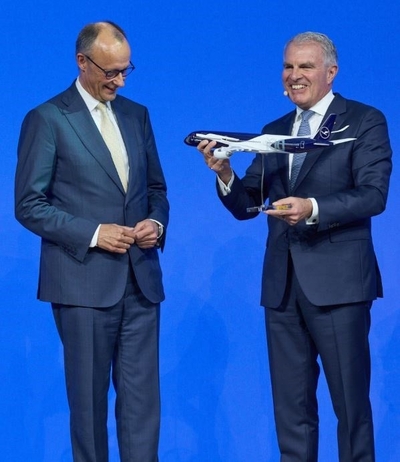
On Wednesday (15APR26), Lufthansa officially celebrated its 100th anniversary, honored by political heavyweights, top businesspeople and numerous dignitaries. While celebrations were underway at ‘Hangar One’, the Lufthansa Group’s new conference and visitor center at Frankfurt Airport, hundreds of flight attendants and pilots demonstrated outside the facility, against the airline’s management, demanding higher salaries and a better pension plan.
However, the protests outside were not heard inside the building. In his opening remarks, Airline CEO, Carsten Spohr emphasized that the founding of Lufthansa, a century ago, marked the beginning of an unparalleled success story. “With 110,000 employees across 14 airlines today, including Lufthansa Cargo and Lufthansa Technik, at six hubs in five home markets in the heart of Europe, Lufthansa is a powerhouse.” The executive further announced that, as an international group, “we will continue to fulfill our mission in the future: connecting people, cultures, and economies in a sustainable way. Air travel has been a growth factor for a hundred years and it will remain so in the future.”
Lasting stagnation
Aviation is indeed a growth industry. But not in Germany. Currently, passenger numbers still lag behind those of 2019, before the start of the COVID-19 pandemic. While other European countries have long since reported significant growth figures, the industry – once accustomed to success – is stagnating in Frankfurt (FRA), Munich (MUC), Hamburg (HAM), and Düsseldorf (DUS). Bureaucratic hurdles, night flight restrictions at main gateways such as FRA, MUC, DUS or Berlin (BER), high salaries, cost structures no longer compatible with European standards, and a fragmented labor union landscape where unions prioritize their selfish interests without considering the overall well-being of their company, are major obstacles holding back the Lufthansa’s growth. “Air France and Alitalia used to be the airlines with the most strikes; today, it’s us,” a high-ranking Lufthansa manager told CargoForwarder Global.
Ambassador of the skies and business enabler
In his speech, special guest, Federal Chancellor Friedrich Merz highlighted the significance of the anniversary: “Lufthansa is an integral part of the history of the Federal Republic of Germany and a key company for Germany as a business enabler. For a century, it has been connecting people and markets around the world. Lufthansa’s success is above all due to the more than 100,000 Lufthansa employees who, day after day, hour after hour, ensure that passengers and cargo arrive safely. I wish Lufthansa continued success for the next 100 years.”
One strike follows another
Of those 100,000 staff, some gathered outside ‘Hangar One’ on Wednesday, to voice their dissatisfaction with collective bargaining agreements they consider outdated. But is that really the case? In this regard, it is worth taking a closer look at the salary structure: The average annual salary of flight attendants often ranges from €2,800 to €3,800 gross per month, depending on years of employment. Including bonuses and company pension benefits, this is slightly above the current average gross annual salary in Germany (€57,408). In contrast, First Officers at the ‘Classic’ airline or Lufthansa Cargo, earn a fixed annual salary of €88,600 at the start of their career. As a captain at the highest seniority level – which reflects the number of active years of service – they are paid as much as €281,300 per annum.
The jug goes to the well until it breaks
Even though some of the demands made by flight crew may seem justified, their sector-specific unions – VC Cockpit (pilots) and UFO (cabin crew) – are now jeopardizing the airline’s core brand with their frequent strikes. Lufthansa pilots went on strike twice last week – in two separate waves – for the third time this year. On each day of the walkout, hundreds of flights had to be cancelled, tens of thousands of passengers had to skip their travel plans, and air cargo shipments stranded in freight terminals. To make matters worse, cabin personnel at Lufthansa Airlines and its subsidiary, Cityline, walked out on Wednesday and Thursday. This has resulted in high costs for the airline and the loss of its reputation as once reliable carrier.
The long-established Verdi union, on the other hand, pursues a policy that is significantly more open to compromise. Thus, the strikes are not merely a conflict between Lufthansa Passenger and Cargo employees on one side, and corporate management on the other, but also between various unions seeking to poach members from their rivals by echoing increasingly tough demands.
Growing where money is earned
In doing so, VC and UFO overlook the fact that Lufthansa ‘Classic’ has been flying in the red for some time and is shrinking rather than growing, due to mounting cost pressure. Now CEO, Carsten Spohr has put pressure on the unions, by announcing that Lufthansa management will only invest in those group members that are earning money. These are Swiss (Zurich), Austrian Airlines (Vienna), Brussels Airlines (Brussels), and soon ITA Airways (Rome). In contrast, Lufthansa ‘Classic’, based in Frankfurt and Munich, is not mentioned on Spohr’s list. Just one day after publishing this statement, Lufthansa management completely shut down its regional carrier, CityLine. “Exorbitant fuel prices” were cited as the official reason. CityLine’s entire workforce was furloughed. Market observers consider this a warning shot for UFO and VC Cockpit not to take their strike actions too far.