
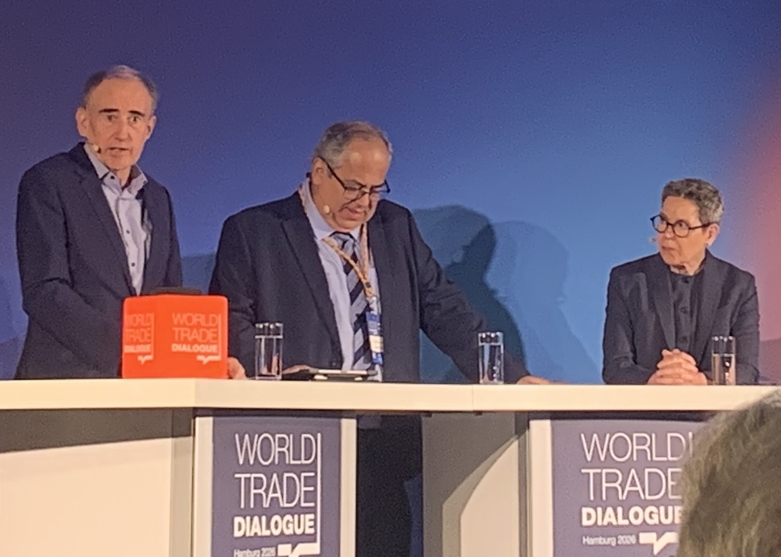
Europe could be on its way to becoming a museum if the business and political leaders do not urgently acknowledge new global realities and respond to them with targeted strategic adjustments. The goal of the EU member states must be to implement the principles of a rule-based economy, even in the face of harsh external resistance. Companies and entire systems that remain passive in the here and now, have already lost. That was a core message from scholars, economists, and logistics experts at the World Trade Dialogue. The event, attended by over 200 invitees, took place at the headquarters of the shipping line, Hapag-Lloyd, in Hamburg on 28APR26.
Old alliances have broken down; new ones are urgently needed for democratic countries and liberal economies, including a fast diversification of suppliers to reduce dependencies. This was one of the focal themes tabled and discussed by experts at the World Trade Dialogue. But sticking the head in the sand like an ostrich in the face of geopolitical tensions would not be an appropriate strategy for survival. Thinking positively and looking ahead would be the right approach instead. Based on this insight, the panelists offered a wealth of encouragement for European companies on how they can use the crisis to their advantage. And there is no shortage of crises: Russia’s ongoing war against Ukraine, the Iran conflict, the closure of the Strait of Hormuz, escalating civil wars in Sudan and Mali, Houthi attacks in the Gulf of Aden, and China’s increasingly aggressive behavior in adjacent maritime areas and toward Taiwan, including neighboring countries in Southeast Asia. The bitter truth is that the law of the jungle prevails, and a rules-based economic system is becoming increasingly rare.
Wedged between two heavyweights
The two main players in the arena of disruption are China, with the Putin system clinging to its coattails, and the increasingly authoritarian and erratic Trump system on the other side of the globe. Wedged between these two blocs is the EU. In its political and economic actions, it has so far mostly resembled a rabbit frozen in fear at the sight of a snake. Or rather, like a rabbit seeing two predators at once. There are many reasons why things have turned out like this. These were described early on in the works of the German-American analyst, Albert Hirschman (1915–2012). He analyzed how asymmetrical power relations in international trade can be used by stronger states to dominate weaker ones. Or, in its contemporary form: trade is increasingly being weaponized by dominant regimes to induce dependencies. “Today, we are fast moving from a Baron de Montesquieu-based system founded on liberal principles and the separation of powers, to an age predicted by Hirschman, in which the stronger party ruthlessly asserts its power,” Professor Moritz Schularick, President of the Kiel Institute for the World Economy and co-moderator of the Dialogue, stated in his introductory remarks.
Mercosur and more
But what are the specific consequences of this development for the EU, as well as for other democratic nations such as Australia, Japan, Brazil, and Canada, to name just a few? Forging new alliances – and doing so quickly – was a key recommendation made by experts at the conference. The Trump administration’s ever-changing tariff decrees are acting as catalysts in this process. This is evidenced by the agreement between the EU and the Mercosur bloc. “It took 25 years to discuss the treaty, during which particular interests – such as the demands of French farmers – acted as obstacles. Then Trump launched his tariff shock, trivialized as ‘liberation day’, and the agreement was ratified immediately, at least provisionally,” summarized Dr. Welber Barra, a partner at BMJ Consulting, who had traveled from Brazil. Similar agreements are in the pipeline with India, Australia, Malaysia, and the United Arab Emirates, said the Minister of Economic Affairs, Katherina Reiche, who joined in a video call. And there is interest between Ottawa and Brussels in an even closer transatlantic partnership to mutual benefit. At the same time, the minister emphasized that 450 million consumers live in the EU – a good 110 million more than in the U.S. This makes the continent a coveted global market, as well as a hotbed of innovation and technology. “We need to make much better use of these advantages,” she urged.
Basic internal reforms are indispensable
To embark on this growth road, however, obstacles must be removed and companies must foster a new spirit of optimism, emphasized Simone Menne, former CFO of Lufthansa and current President of AmCham America. “Don’t remain stuck in a state of paralysis, hoping that waiting will help until things get better. This won’t happen. Companies must save themselves if they want to survive. They should start fighting German angst!” she exclaimed. And to that end, in addition to positive thinking and forward-looking action, there is an arsenal of measures ready to get the European economy back on track. New global partnerships and diversification of production to reduce dependence on a single supplier are further components. But the question of what expectations Chinese trading partners have of German and European products, provides the clearest guide: For them, these parameters are paramount: high product quality, excellent engineering, reliable supply chains, and advanced sustainable solutions coupled with long-term trade relations. “To be ahead of the curve when it comes to smart and advanced products, we need structural changes in Europe, especially in Germany. This will cost social sacrifices, but perseverance and immobility must be overcome politically as well as socially. Ifwe fail, we will end up as huge museum or amusement park and earn money as tourist guides,” Simone illustrated.
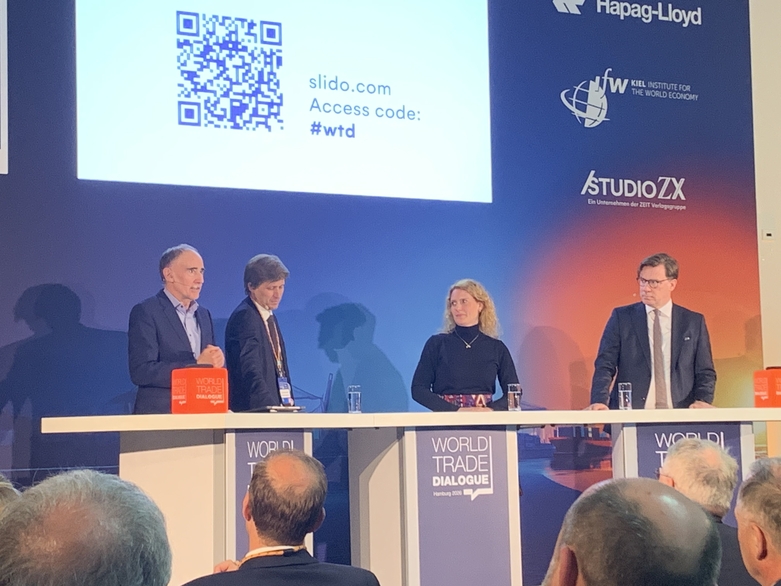
With him on stage were Silke Lehmköster and Moritz Schularick. Far left: Moderator Uwe Jean Heuser
“Team Europe” needed
Ultimately, however, the decisive factor for balanced trade relations is primarily the price that consumers or importers must pay for a product. There is no level playing field in this sector. For instance, China deliberately uses its own currency to reduce the cost of its exports. Furthermore, many measures are politically driven and therefore heavily subsidized by the Beijing rulers, particularly the export of rare earths. Commercially oriented Western companies can do little to counter this state-driven economy. Unless their governments impose sanctions on Chinese exports, thereby making them significantly more expensive. But this will most likely fire back, harming their trade relations. At least in the strategic and security sectors, countermeasures have already been taken to prevent the outflow of strategically important know-how. Nico Lange concluded: “As Germans, we must quickly learn which interests serve us best and not help others get back on their feet. This we’ve done for decades. The wind has changed. Now we must be determined – as must our European partners – to create and implement trade relations that serve us best.” Lange, a former military man, is the Founder and Director of the IRIS Institute for Risk Analysis and International Security. Thus, creating an agile ‘Team Europe’ driven by a spirit of innovation, placing greater emphasis on self-interest, might be a viable solution,” Moritz Schularick summarized in his closing remarks.