
There have been a few amusing videos making the LinkedIn rounds this week, illustrating what might become commonplace in the next decade. Japan Airlines (JAL) announced on 27APR26, that it has commenced a pilot project at Tokyo’s Haneda Airport, to test the feasibility of humanoid robots in airport ground handling. If it is a success, it could go a long way to solving the growing manpower shortage come 2028. The humanoid robots will be trialed over a period of two years. It is the first such experiment to be carried out in Japan. Japan Ground Service Co., Ltd., which is responsible for JAL Group’s ground handling operations (aircraft towing and baggage/cargo loading and unloading) at major domestic airports, is working together with GMO AI & Robotics, aiming to improve efficiency in ground handling operations and save on labor resources. The country is seeing its working-age population shrink and at the same time experiencing a rising influx of tourists.
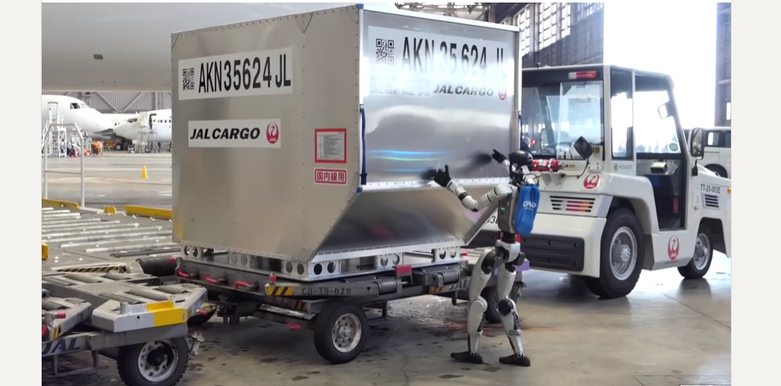
The Chinese-built, Unitree G1, silver, humanoid robot [meaning his range of motion and adaptability is comparable to that of a human], measures 130 cm in height and weighs 35 kg. On the videos, he is seen working in a hangar, pushing cargo containers from trolleys towards an aircraft high-loader. Since he has two legs, he can work in much the same way as a human, and this is an advantage over wheeled bots, which would require facility adaptions for them to be able to function properly. That said, the video shows that his movements are still somewhat unsteady, his feet require better traction, and he needs to be taught how to touch the container so as not to damage it by accident.
From now until 2028, he will be tested in scenarios where he can operate safely, with a view to then being deployed in baggage loading/unloading, aircraft cleaning, and possibly even operating GSE, as these are areas where employees are short-staffed. JAL’s aim is to automate wherever possible to remove the burden from its human staff.
“Ground handling operations require highly skilled personnel to maintain safety, such as aircraft marshalling and baggage/cargo handling, while also imposing significant physical burdens. […] Both companies aim to establish an environment in which humanoid robots can operate safely and effectively on the frontlines of airport operations. […] This initiative will contribute to sustainable development in the aviation industry and promote work-style reform at airports,” JAL’s press release concludes.