

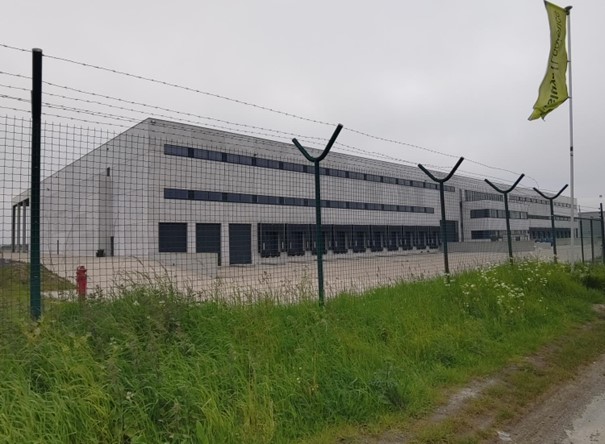
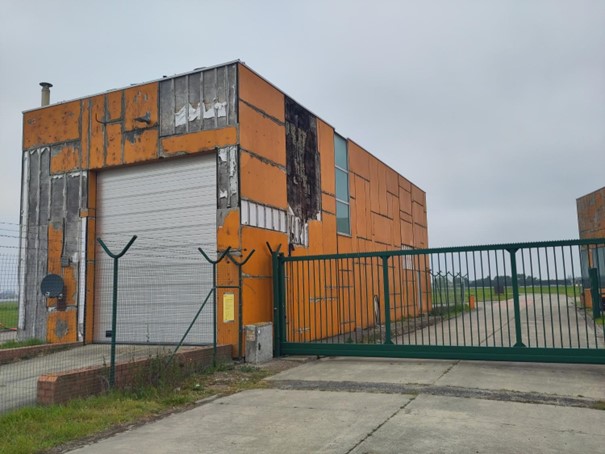
Abandoned warehouses, limited air traffic. Some buildings at Ostend-Bruges Airport (OST) are in a state of advanced decay – particularly the cargo facilities. This part of the Belgian airport resembles a patient lying on a psychiatrist’s couch, in urgent need of therapy. Its operational permit is also at stake. What happens next depends primarily on external political decisions.
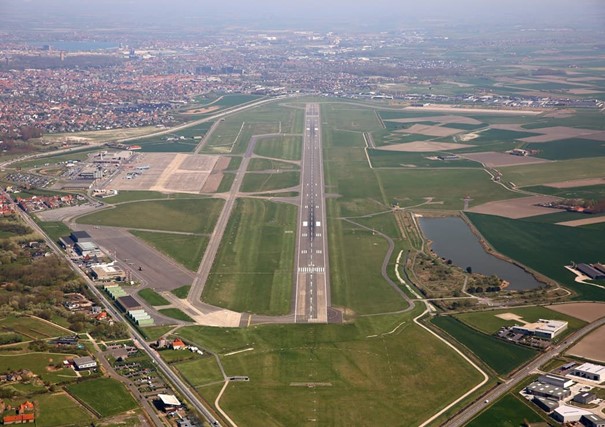
After much personnel turnover, Nathan de Valck – an experienced and dynamic cargo veteran – took the helm at OST, exactly one year ago. (CargoForwarder Global reported). However, shortly after he took office, legal hurdles severely limited his leeway to act. The braking factor was the highly controversial expansion of an operating permit decided by the Council of State of the Belgian province of Flanders. The grant was issued on 30OCT24 by the Flemish Minister for Environment and Agriculture (Flemish Government, File number 536.614.688). According to the amended allowance, night flights taking place between 23:00 and 07:00 were authorized to grow from 1,256 movements in 2019, to an annual 6,860 movements by 2040.
Steep increase of night flights
The Council’s reason for this decision: According to the Flemish government, air freight at OST will climb from 24,757 tons in 2019, to as much as 386,451 tons come 2040. Most cargo flights will take place between 23:00 and 06:00, as stated on page 29 of the operational permit tabled by the Council of State.
The Committee justifies its broad approval of night flights by arguing that Flanders is convinced of the airport’s economic importance and its potential as a cargo airport and therefore wishes to ensure its long-term sustainability and economic success. The Committee argues that there is still a very wide margin for additional traffic growth within the noise envelope of the current environmental permit, including night flights. “The number of people potentially seriously affected by noise is, in fact, much lower in the current situation than the maximum number allowed under the special environmental permit conditions,” is stated in their revised operational grant.
Further to this the Committee assumes that the growth of the cargo segment can lead to a net benefit for society. A sustainable transition to a greener airport is crucial in this regard, the Committee members argue. However, critics counter that this is only possible under conditions different from those currently specified in the Council of State’s operational permit.
The Raad voor Vergunningsbetwistingen [Council for License Disputes] has now endorsed most of the complaints presented by critics. As a result, the law enforcement officials recently turned down the Council of State’s revised operational permit and its support of the alleged growth trajectory due to grave omissions and sloppy mistakes. As consequence, the Raad has ordered the Committee to submit a new operational scheme within the next five months.
The complaint was lodged by two local initiatives named ‘npo WILOO’ and ‘Bond Beter Leefmilieu’. They questioned the environmental permit for Ostend-Bruges Airport as presented by the Council of State, pointing to multiple violations of legal requirements. Most of their objections have now been adapted by the Raad.
Legal deficiencies
And these are the main weak spots of the Council’s revised operational version, argue the Raad members: For example, their amended permit omits the requirement to at least halve SOx emissions at OST by 2030. The decision also does not include the mandated scaling up of low-sulfur fuels in civil aviation, criticizes the Raad.
In addition to these legal deficits and growing noise emissions caused by more air traffic, ultrafine particles, nitrogen, and many other harmful substances emitted by aircraft turbines severely endanger the future of nearby nature reserves and the health of Ostend’s residents, is emphasized in the appeal filed by local initiatives.
In a nutshell, it looks like the Council of State will have to start from scratch and redo its homework. Critics expect that the new environmental and operational scheme will also include a restructuring plan for the dilapidated cargo facilities.
CargoForwarder Global has twice asked Airport Management for clarification and an explanation regarding the above-mentioned issues but has received no response from OST’s top deck.