
During U.S. President Trump’s recent trip to China, Beijing agreed on the purchase of 200 Boeing aircraft, likely involving the B737 MAX 8 series. Trump himself remained vague, describing them simply as “large aircraft”, while his Chinese counterparts did not comment on a particular variant. However, it is China’s first major order of Boeing aircraft since Trump’s first term in 2017, when Beijing purchased 300 aircraft. Meanwhile, rival Airbus is celebrating an order from an African carrier.
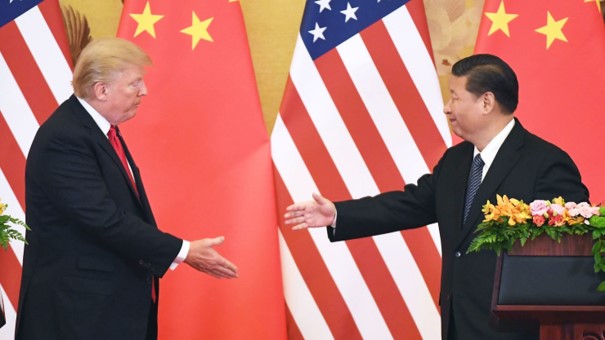
First, regarding the Boeing deal: Despite Trump’s celebratory pose in Beijing, the U.S. aircraft manufacturer’s stock price fell following the announcement, as analysts had expected a significantly larger order volume. And there is no word on whether Boeing CEO, Kelly Ortberg – who was part of the Trump delegation – applauded the verbal agreement reached by both political leaders.
Advantage: Tianjin
Market observers, in any case, did not. They had expected an order for at least 500 Boeing aircraft from the Xi Jinping government, including a significant number of wide-body jetliners from the B787 and B777 series. That did not materialize.
The negotiations took place against the backdrop of fierce competition between two industrial heavyweights. Airbus had overtaken Boeing in the Chinese market – the second largest in the world – in the second half of the last decade, and has a strong local presence by running a final assembly line for its A320 family members in Tianjin, China, since 2009. The customers for the jetliners manufactured there are primarily Chinese state-owned airlines.
High demand for new passenger and cargo aircraft
Analysts estimate that the demand for new aircraft in China is enormous. Market projections from both manufacturers, updated annually, indicate that China will need 9,000 new commercial aircraft by 2045. COMAC’s own C909 and C919 models will only be able to meet a small portion of this demand, despite ramping up production. And the long-range C919 model is not expected to roll out of the Shanghai factory until 2036 at the earliest.
Almost at the same time as Boeing’s deal with China was aired, rival Airbus announced the sale of 20 narrow-body and six wide-body aircraft to Ethiopian Airlines. The aircraft belong to the A220 and A350-1000 series. The A220, originally designed by Bombardier as CSeries before the Canadian manufacturer was acquired by Airbus in mid-2018, stands out for its efficiency at high-altitude airports – a decisive feature for the airline’s hub at Addis Ababa’s Bole International Airport (ADD), built more than 2,300 meters above sea level. The lower air density under these conditions affects engine performance and lift, a challenge that the A220’s Pratt & Whitney PW1500G engines handle with an operational advantage over other models, states Ethiopian Airlines.
Largest African hub is emerging
The A350-1000s offer greater passenger and cargo capacity and are capable of covering very long distances, making them ideal for serving routes between ADD and GRU, EZE in South America, or PEK and even SYD in the Far East/Oceania.
Ethiopian Airline’s fleet expansion is a key component of the airline’s strategic plan through 2035, which centers on the construction of the new Bishoftu International Airport. With an investment of USD 12.5 billion, it will feature four runways and offer a capacity of 100 million passengers per year. Upon completion, Bishoftu will be Africa’s largest hub for passenger and cargo transport. Construction began in JAN26.