

Ostend-Bruges Airport (OST), known primarily for its perishables segment and leisure flights, is significantly growing its scope of operations. In addition to these core areas, e-commerce is emerging as a new key pillar of the business. Further to this, OST is expanding its MRO activities, while a dedicated special mission and border-control unit will also be based at the airport.
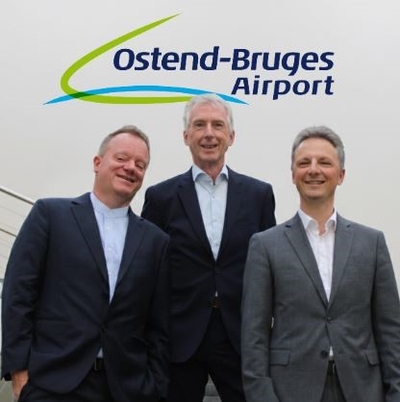
On 03JUN26, CEO Nathan De Valck celebrated his one-year anniversary as helmsman of the Belgian regional airports of Ostend-Bruges and Antwerp. However, he didn’t have time for a leisurely celebration that day. The reason: his schedule is packed with issues that need to be addressed step by step, one of them being the expansion of OST’s traditional perishables business. So far, this has primarily consisted of strawberry imports from Egypt, which are flown by EgyptAir Cargo from Cairo (CAI) to OST each fall, following the start of the harvest season. Although the airline’s Airbus freighters also land at Hahn Airport in southwestern Germany, the bulk of the shipments is handled at OST. There, they are customs-cleared and transported by truck via the nearby Eurotunnel to a warehouse in London, from where they are immediately distributed to local wholesalers.
London’s easternmost runway
Although Nathan – a polite man – does not wish to comment on competitors, he at least does not dispute the claim that this routing via OST and the Eurotunnel is faster compared to direct flights to London-Heathrow (LHR) and customs clearance of goods coming from an Arabian exporter. From this perspective, OST is London’s easternmost runway. Next, OST intends to step into the cut-flower business, for example through flights from Nairobi, Kenya. Pharmaceuticals are another target segment for the airport. After all, Belgium is a European hotspot of this high-value industry.
Focusing on e-commerce
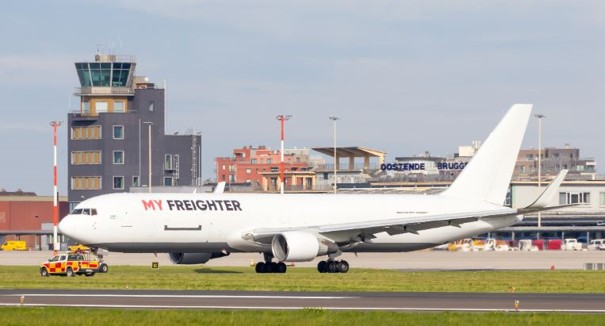
In addition, management aims to drive e-commerce revenue. Negotiations with a Chinese supplier are in the final stages. Operations commenced in mid-APR26 with two weekly flights but have been stepped up since then to 5/7. OST has chosen not to disclose the name of the Chinese partner at this stage, pending final approval. The flights are operated by Uzbek carrier, MyFreighter, which deploys B767F equipment on the route China-Ostend, with a stopover in Tashkent. Discussions are underway to identify suitable export cargo for the eastbound leg of the operation.
Enhancing ground infrastructure
Also on the airport’s to-do list is the construction of two hangars offering a combined 5,000 m² of MRO facilities. For instance, for maintaining the EASP Air fleet that will be based at OST. “This MRO business segment will create numerous new, highly skilled technical jobs at our airport,” enthuses De Valck. Thanks to the investments in apron upgrades, OST can accommodate six wide-body freighters at the same time on a dedicated cargo apron.
Facilitator of business
When asked what sets the cargo activities at OST apart from neighboring competitors, management responds: “We see our role as an enabler or facilitator of logistics activities, working closely with local partners to offer the market a comprehensive portfolio of logistics services. Selling traditional airport services to airlines is old school.” Further to this, OST emphasizes that it is not an airport where goods are handled in transit. Instead, what lands there is moved directly into local distribution channels, following customs clearance at the airport.
A look at the process confirms this statement. Various partner companies have set up facilities at the airport, operated by their own staff. OST provides real estate and the framework for their business and enables the community to develop the processes required.
Support from government and the private sector
The airport management’s progressive approach is supported by stakeholders, particularly its shareholder, Egis, and approved by the Flemish Government, which holds a financial stake in the airport. The political body has indicated that the environmental permit – which has recently been the subject of controversy – will be updated shortly, thereby cementing the legal framework for aviation activities at OST.
Final question to CEO Nathan de Valck: Is OST profitable or does it rely on government subsidies? “We have been in the black every year since 2016 (apart from the 2020-2021 Covid years), although the annual profits were modest. In 2025, we generated a net profit of EUR 75,000, with a significant portion of the cash flow reinvested directly back into the airport.”