
… but nobody expects the calm to last.Three consecutive weeks of declining air freight rates would normally be seen as a clear sign that the market is returning to normal. This year, however, the picture is more complicated.
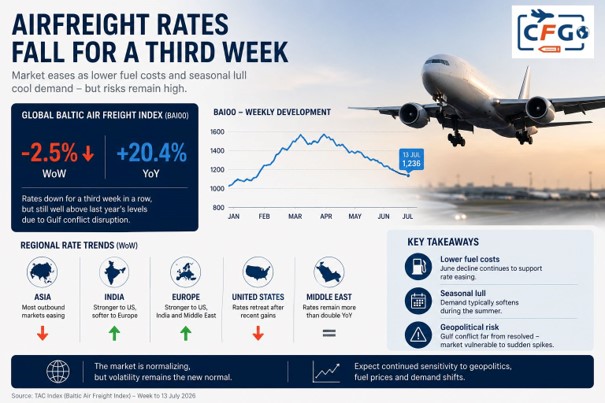
According to the latest figures from TAC Index, the global Baltic Air Freight Index (BAI00) fell another 2.5% in the week ending 13JUL, marking its third consecutive weekly decline. At first glance, this suggests that the extraordinary pricing pressure seen earlier this year is finally easing. Yet global rates remain more than 20% above last year’s levels, a clear reminder of the effects of months of geopolitical disruption on the market.
The recent decline reflects a familiar seasonal pattern, demand has softened as industry enters the traditional summer lull, while lower jet fuel prices have gradually filtered through into carrier pricing. But neither development tells the whole story.
A market finding its balance
Only a few months ago, the air cargo industry was facing one of its most volatile periods since the pandemic. Earlier this year, the conflict in the Gulf disrupted established trade flows, increased operational uncertainty and temporarily pushed jet fuel prices up sharply. Although an easing of tensions in June helped lower fuel costs, the geopolitical situation remains fragile and continues to weigh on market sentiment.
Market conditions, however, have started to stabilize.
Lower fuel costs have gradually filtered through into carrier pricing, while the traditional summer slowdown has softened demand across several major export markets, particularly in Asia. Together, these factors have contributed to three consecutive weeks of declining air freight rates. Yet, despite improvements, the situation is still far from stable. The more recent increases in fuel prices have so far had little impact on rates, but they illustrate how quickly operating costs and freight prices could rise again should tensions in the Gulf escalate.
Regional markets tell very different stories
One of the defining characteristics of today’s air freight market is its lack of uniformity.
While outbound rates from China and much of Southeast Asia continue to soften, other regions are moving in the opposite direction.
India has shown renewed strength on several trade lanes, supported by resilient export demand and continued sensitivity to developments in the Gulf region. Northern Asian markets such as Taiwan and South Korea have also demonstrated selective resilience, particularly on routes into Europe. Meanwhile, European export markets remain comparatively firm, with pricing holding up on corridors to North America, India and the Middle East.
This fragmented picture highlights a broader structural change.
Global air cargo no longer moves as one synchronized market. Regional disruptions, geopolitical developments, and changing manufacturing patterns increasingly create multiple markets operating at different speeds.
For shippers and freight forwarders, that means broad market averages reveal only part of the story.
Geopolitics still sets the tone
If there is one lesson the industry has learned over the past two years, it is that geopolitical events can reshape air freight markets almost overnight.
The easing of rates does not mean those risks have disappeared.
Although the immediate pressure from the Gulf conflict has moderated, airlines continue to monitor developments closely. Any renewed escalation affecting regional airspace, fuel prices, or cargo hubs could quickly tighten available capacity and reverse the current pricing trend.
The industry has become increasingly accustomed to operating in an environment where disruption is no longer the exception but part of normal business planning.
Whether the trigger is armed conflict, sanctions, extreme weather, or trade policy, logistics networks are now expected to absorb shocks far more frequently than in the past.
This reality makes today’s lower rates appear less like a return to normality and more like a temporary pause between periods of volatility.
Looking beyond the summer
Peak season planning has started earlier than usual, particularly as retailers continue to diversify sourcing strategies and manufacturers adjust inventories in response to an uncertain geopolitical environment. Some shippers are also securing capacity earlier to reduce exposure to potential disruptions later in the year.
At the same time, digitalization and AI-driven forecasting are giving airlines and freight forwarders far greater visibility into booking patterns and capacity utilization. That improved transparency may help smooth future market fluctuations, but it is unlikely to eliminate volatility altogether.
External events continue to influence pricing far more quickly than technology can compensate.
A new definition of “Normal”
The latest TAC Index figures suggest that the exceptional pricing seen earlier this year is beginning to return to normal.
That is good news for shippers facing rising transportation costs and for supply chains seeking greater predictability.
Yet the broader market has fundamentally changed.
Rate movements are no longer driven solely by supply and demand. They increasingly reflect geopolitics, energy markets, regulatory developments, and the resilience of global logistics networks.
The recent decline therefore signals something different from traditional market correction: It suggests that air cargo is entering a new operating environment where volatility has become permanent, stability has become temporary, and market participants must remain prepared for sudden shifts in both capacity and pricing.
Three weeks of falling rates may indicate that the market is cooling.
Few in the industry, however, expect the story to end there.