
Electric trucks are still a rare species on European highways. However, latest developments show that, following rising sales of e-cars, operating electric trucks is also becoming an issue for an increasing number of forwarding agents.
Latest example is the Andreas Schmidt Group from southern Germany. It has obtained two fully electric Mercedes-Benz eActros 600 trucks which they deploy on a route linking their headquarters near Augsburg in Bavaria and its hub in Neuenstein, Hesse. Both locations are 400 km aside, so as round trip adds to 800 km.
This is an ideal distance for electric vehicles, which, according to the manufacturer Mercedes, have a nonstop range of 500 km when fully charged. According to Managing Director, Konrad Wenninger, of the Andreas Schmidt Group, the vehicles are used for nighttime transport. He cites the government’s decision to stop imposing road fees for low-emission trucks as a key prerequisite, upping the attractiveness of e-mobility for the transport industry. The new regulation is in effect since fall 2025 and runs out on 30JUN2031. A timeframe that gives his company planning certainty when calculating operating costs.
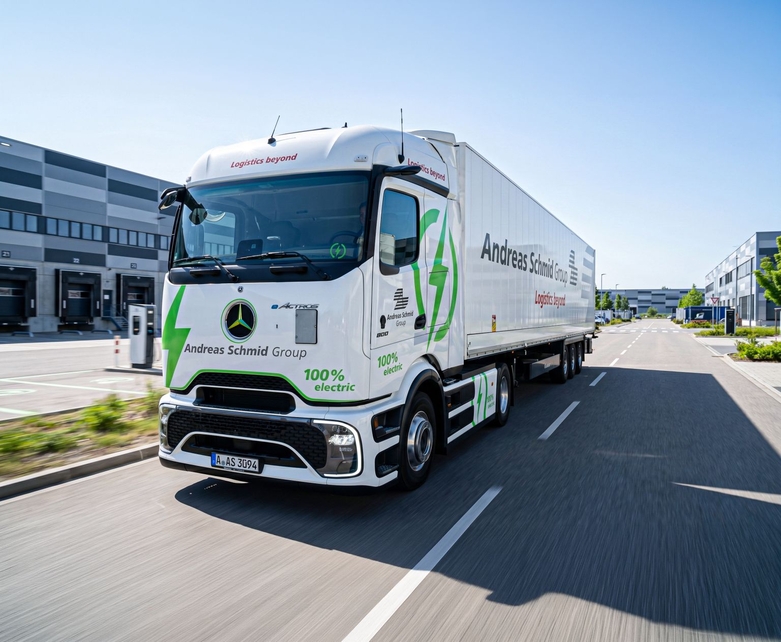
While electric trucks are significantly more expensive when buying than diesel vehicles – Wenninger cites price differences ranging from 120,000 to 300,000 or 400,000 euros per vehicle, depending on the manufacturer – they are already competitive in comparison when surpassing a driving distance of 12,000 km. Calculations have shown that on long-haul routes, the total cost per kilometer for electric trucks is 1.08 euros, compared to 1.21 euros for diesel trucks. However, the diesel costs are meanwhile significantly higher due to the general rise in fossil fuel prices caused by the price hike for crude oil following the total or partial closure of the Strait of Hormuz.
“The key question is no longer whether electric trucks work from a technical standpoint. The key question is where they can be used reliably and in a way that makes economic sense,” says Thomas Schledorn, CEO of the Andreas Schmid Group. “On specific long-haul routes, such as our night route from Gersthofen to Neuenstein in Hesse, we can now demonstrate that electric mobility in heavy-duty transport is predictable, practical, and increasingly economical.” As of the end of last year, road fees accounted for about a quarter of operating costs, says his colleague Wenninger. This cost burden is now a thing of the past.
However, a big stumbling block remains: The limited charging infrastructure along highways and major roads. It needs to be expanded rapidly to motivate forwarding agents to switch from diesel to e-trucks, manager Wenninger urges.
Meanwhile, the IDS Logistik Alliance has set up its own charging network by allowing its members to use all stations belonging to the club, which includes players such as the Andreas Schmidt Group, Kuehne + Nagel, the Geis Group, the Rieck Logistik and some other contenders. This network of charging stations significantly expands the operational possibilities of their electric truck fleets.
Although the transport of general cargo is the group’s core business, it is also active in air and ocean freight. However, of the 160 million euros in annual revenue, only 5 million come from air and ocean freight, says Manager Wenninger. His group primarily offers customized solutions to its customers. “Whenever one of our customers needs a special service in the area of air or ocean freight, we’re there to help,” says Wenninger. A dedicated business unit is responsible for this, serving as the central hub. As far as air freight is concerned, 70% of all the Group’s shipments are handled through Munich Airport, and 30% are processed through Frankfurt. For ocean freight shipments, the Andreas Schmidt Group uses the North Sea ports of Antwerp, Rotterdam, Bremerhaven, and Hamburg, as well as Genoa and Trieste for short-sea transport.
In total, the group operates 120 trucks and employs around 200 drivers. In addition to the two eActros 600s, the investment plan for the current year includes the purchase of five additional electric trucks.