
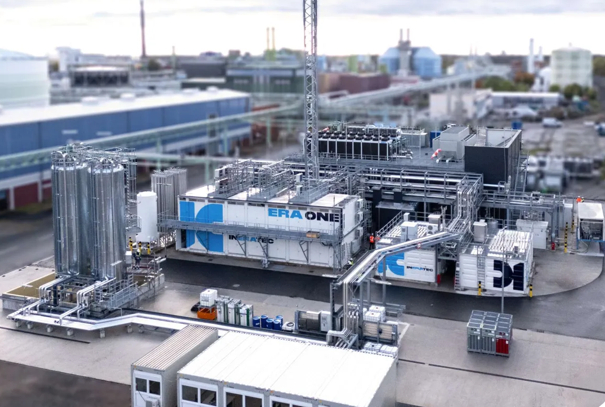
The Power-to-Liquid (P2L) plant, ERA ONE, has received the International Sustainability and Carbon Certification (ISCC) under the EU’s Renewable Energy Directive. This makes ERA ONE the first P2L plant globally whose synthetic fuels are fully recognized as Renewable Fuels of Non-Biological Origin (RFNBO). E-fuels play a central role in aviation decarbonization programs.
RFNBO are climate-friendly energy sources, such as green hydrogen and e-fuels, which are produced without fossil raw materials and in accordance with strict EU sustainability criteria. Following the EU certification, the synthetic fuels produced by ERA ONE can be utilized in aviation, transport, and the industry at large. ERA ONE is a pioneering facility developed by P2L specialist INERATEC, located in Frankfurt; it is capable of producing up to 2,500 tons of e-Fuels per year. With the facility’s inauguration in 2025, INERATEC completed its transformation from plant manufacturer to fuel producer. The certification of ERA ONE confirms that the e-Fuels produced at the plant derive entirely from renewable, non-biological sources and achieve a greenhouse gas reduction of at least 70% compared to fossil fuels across their entire life cycle. It also guarantees an audited chain of custody, giving customers, off-takers, and regulators confidence beyond voluntary self-reporting by the industry.
Not a single drop
On the occasion of the presentation of the concept, Tim Böltken, CEO and Co-Founder of INERATEC states: “This [RFNBO] milestone shows that regulation, certification, and industrial production are finally starting to come together. With International Sustainability and Carbon Certification, [ISCC] the e-Fuels from ERA ONE are not only technically ready but also fully recognized in the market – exactly what is needed to make synthetic fuels a real industry in Europe.”
The certification comes at a decisive moment for the market. Under the EU’s Renewable Energy Directive (EU RED III)the first binding renewable liquid and gaseous RFNBO sub-targets are now phasing in across the transport, aviation, and industry sectors, creating concrete demand for synthetic fuels whose renewable origin can be verified. By securing the European Union’s International
First e-Fuel powered flight between AMS and HAM
INERATEC’s International Sustainability and Carbon Certification limits regulatory risk for airlines, shipping companies, and industrial off-takers, and supports long-term planning and off-take agreements. The practical relevance of certified e-Fuels was already demonstrated in June 2026, when e-Fuel produced at ERA ONE was used on a KLM passenger flight from Amsterdam to Hamburg and back via existing infrastructure, confirming that certified e-Fuels are ready for real operations.
INERATEC plans to upgrade its Frankfurt ERA ONE plant in early 2027. By doing so, the pioneer in synthetic fuels continues to bring regulation, certification, and industrial production together – laying the groundwork for the broader market ramp-up of these fuels in Europe.
Zaffra was liquidated
Meanwhile, South African Sasol and Danish Topsoe decided to dissolve their sustainable aviation fuel (SAF) joint venture, Zaffra. By doing so, Zaffra ceases operations just two years after its founding. It is the end of a partnership that had sought to accelerate industrial-scale production of SAF by combining Sasol’s Fischer-Tropsch technology with Topsoe’s advanced fuel processing practices. Despite the original ambitions, the partnership concluded without producing any amounts of commercial significance, underlining the widening gap between technological capability and commercial viability in the decarbonization sector.