
Or should that be 30 good causes – since the air cargo industry got involved in the rehoming of 30 lions and tigers, recently – carrying them on behalf of the animal welfare organization, Four Paws International, from Argentina to forever homes in the US and South Africa. LATAM Cargo transported the ‘lion’s share’ (pardon the pun!), of 15 lions and tigers to North America, whilst the other half, destined for South Africa, was split between Air France KLM Martinair Cargo, and – it is to be presumed, since Frankfurt was one of the two European hubs – Lufthansa Cargo.
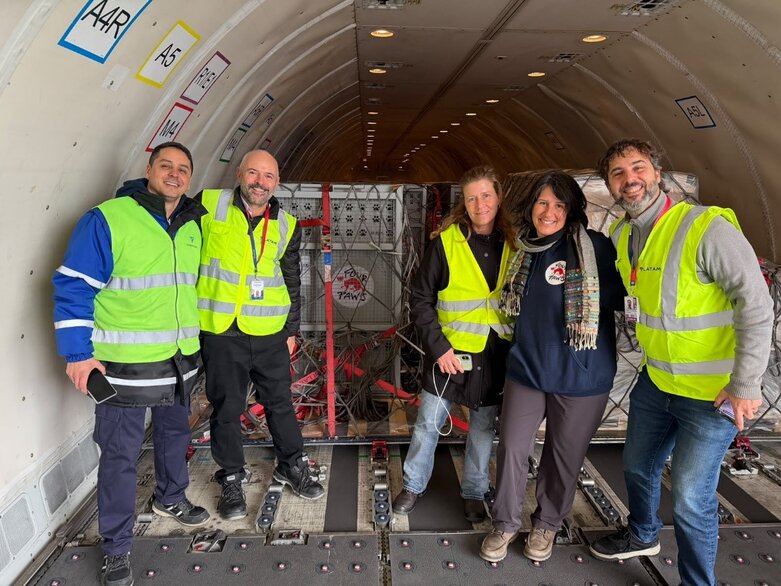
The backstory is a terrible one. All 30 lions and tigers were rescued from a former Argentinian zoo. Luján Zoo, just outside Buenos Aires, was closed down by the Argentinian authorities back in 2020, already, because of safety and animal-welfare concerns. At the time, some 200 wildcats were still being held there. Four Paws became involved in 2023, by which time, just over half of the cats were still alive, and when it finally gained control of the facility in JUL25, there were just 62 lions and tigers left – all in a dreadful state of health, given the appalling, cramped conditions they had been held in. Following months of preparation, half of those have now been flown to a new and better life, while Four Paws is still looking for forever homes for the 20 or so animals still at the former Luján Zoo.
LATAM Cargo carries 15 lions and tigers
Hailed by Four Paws as “the world’s largest relocation of wild cats”, the animals were split into two groups, ready for transport to sanctuaries on two separate continents. Care was taken to ensure that families and lifelong companions were kept together, and their various ailments registered to ensure the required treatment in their new home.
8 tigers and 7 lions were entrusted to LATAM Cargo for transport to The Wild Animal Sanctuary, in Keenesburg, Colorado, US. The big cats were flown on a dedicated charter aircraft from Buenos Aires, Argentina, to Denver, United States, via Santiago, Chile (technical stop).
Compliant and with the utmost care
Daniel Leng, Senior VP of Operations at LATAM Cargo, explained: “Operationally, executing a charter for 15 big cats means coordinating a highly complex operation where there is no margin for deviation. It requires aligning multiple teams in strict compliance with IATA LAR [Live Animals Regulations], ensuring a controlled environment inside the Boeing 767 cargo hold, and ensuring efficient ground transfers. It is a high-precision logistics operation that demonstrates our technical capabilities and expertise in transporting live animals safely.”
Those multiple teams were LATAM Cargo in cooperation with freight forwarder DSV, Four Paws International, and the origin agent, Intermodal Logistics Services S.A.. All have collaborated on similarly sensitive projects before, so are used to ensuring smooth operations. Nevertheless, “given the scale of the challenge – involving 5.4 metric tons of cargo (2.5 tons corresponding to the animals and 2.9 tons to the specialized transport crates) – the operation required extensive planning that began weeks before takeoff. To support the operation, LATAM Cargo mobilized a multidisciplinary team of more than 15 professionals across Commercial, Products, Operational Standards & Procedures, Legal, Quality, Operations, Ramp, and Warehouse, among other areas. The teams worked in close coordination to ensure technical alignment, route feasibility, and regulatory compliance of the transport crates,” the release underlines.
Animal welfare above all else
Every effort was made to ensure that the animals had as stress-free and smooth a journey as possible. Transportation was arranged in line with the IATA Live Animals Regulations (LAR), meaning care was taken to provide the correct hold pressure, temperature, and continuous ventilation inside the Boeing 767 freighter. Vets checked the animals and their documents before loading, during transit, and at destination. “The journey also included continuous monitoring by a dedicated specialist, who accompanied the animals on board and supervised ramp procedures. Every movement was planned in advance to minimize exposure, waiting times, and handling of the animals,” the release informs. “Finally, upon arrival in Denver, the animals were transferred directly and swiftly to specially equipped trucks provided by the sanctuary, minimizing the time spent on the ramp before beginning their final ground journey to Keenesburg.”
Air France KLM Martinair Cargo transports 6 lions
Of the other 15 animals destined for South Africa, a LinkedIn post by Air France KLM Martinair Cargo, last week, briefly celebrated its part in the massive Four Paws-led relocation undertaking. It transported 6 lions from Buenos Aires, Argentina, to Johannesburg, via its Amsterdam hub. The animals are now safely delivered to LIONSROCK Big Cat Sanctuary.
“Bringing together animal welfare experts, veterinarians, and specialist logistics teams across the globe, this initiative shows what is possible when animal welfare, aviation, and expert wildlife logistics come together. At Air France KLM Martinair Cargo, we are proud to have contributed our global network and expertise to help make this journey possible,” it read, pointing out: “From Argentina to South Africa, this has been about more than transportation. It has been about giving these animals a new beginning.”
Four Paws mentions Frankfurt hub as one of the operation’s European gateways, so it is assumed that the remaining 9 tigers traveled on Lufthansa Cargo, though no press release or LinkedIn post was issued by the company.
A new start for the animals
Luciana D’Abramo, Chief Program Officer at FOUR PAWS, stated: “Today [17AUG26 – start of the air cargo flights] marks a fantastic milestone for these lions and tigers and for animal welfare in Argentina. While we are proud of what we have achieved, our work is far from over. Our focus now is on securing sustainable, long-term solutions for the remaining big cats at the former Zoo Luján. And we keep working with the Argentine government to strengthen legal protections for big cats and prevent such suffering in the future.”
FOUR PAWS Veterinarian, Dr Amir Khalil, head of the emergency mission at Luján, declared: “Bringing 30 big cats out of Argentina has been far more than a simple relocation. It has been an enormous logistical undertaking, but seeing these animals begin their journey to a better future makes every effort worthwhile. After years of inadequate conditions, they finally have the chance to receive the specialized care and species-appropriate environment they deserve.”