
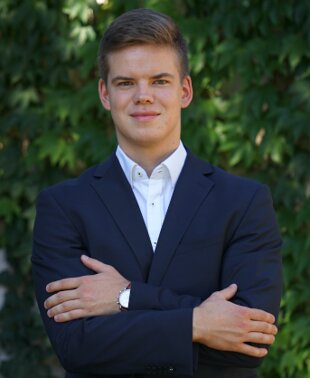
Every week, CargoForwarder Global’s ‘Spotlight On…’ shows just how broad the air cargo industry is and the multitude of career paths and possibilities it offers. The industry’s diverse set-up is simply one aspect – the regulations and frameworks it needs to comply with, are just as varied and often complex. Independent consultants specialized in those fields advise, inform and guide companies in the implementation and compliance of required changes. This week, Moritz Hampel, Air Cargo Consultant at aeroconcept, shares insights into his role and his views on the air cargo industry.
CFG: What is your current function and company? And what are your responsibilities?
MH: I work as an air cargo consultant at aeroconcept in Leipzig. I also lecture at the University of DHSN in Glauchau, Germany. At the moment, my primary focus is on the implementation of Safety Management Systems (SMS) in accordance with the new EU Regulation No 2025/20, which will come into force on 27MAR28. This regulation imposes significant new obligations on a wide range of organizations within the industry, from ground handling companies, cargo agents to catering companies and cleaning services. By 2028, companies must comply with the very same safety regulations that airlines and airports have been required to implement for several years now. This ensures a level playing field, and compliance with these regulations is monitored by the national civil aviation authority. Consequently, this regulatory framework is of immense importance to many businesses operating within the EASA/EU area. I support a diverse range of clients in preparing to meet these requirements and implementing them. In addition to working with individual clients, I am currently developing and leading this pan-European program designed to help businesses across the continent enhance safety in a structured and sustainable manner.
CFG: What does a normal day look like for you?
MH: To be honest, there’s no such thing as a ‘typical day’ in this role. Every client presents different challenges, a different level of sophistication in their security systems and a different organizational culture, so there simply aren’t any standard solutions that I can apply in every case. It’s this diversity that shapes the course of my days. I mostly work from home, which allows me to organize my schedule flexibly and adapt to the needs of a particular project on any given day. At the same time, a significant part of my work involves visiting clients in person, whether somewhere in Germany, elsewhere in Europe, or occasionally in more distant locations. So, although there is a certain rhythm to the work when it comes to research, analysis, writing reports and preparing training sessions, the actual course of each week can look completely different, depending on where clients need me.
CFG: How long have you been in the air cargo industry, and what brought you to it?
MH: I have been working in the air transport industry since 2019. I started out on a dual study Bachelor program in Air Transport Management and Logistics at DHL Hub in Leipzig (Germany), which included an international placement at DHL’s UK Hub in East Midlands. I then spent six months in the fleet management department at Lufthansa in Munich. Upon my return to Leipzig, I completed a Master’s Degree in Business Management, working as a student at DHL on operational projects at Leipzig/Halle Airport. At the same time, I started a Masters of Law (LL.M.) in Business and Economic Law, and spent a semester at Chongqing University of Political Science and Law in China. Since the start of this year, I have been working alongside James Wyatt at aeroconcept, advising clients on a wide range of topics relating to air cargo, with a particular focus on safety and security matters.
CFG: What do you enjoy most about your job?
MH: I’ve always loved to travel. As a child, I was fascinated by airplanes and for a long time I wanted to become a pilot myself. My parents played a big part in this; from a very young age, they showed me what it means to love travelling and exploring the world. What I like most about my current job is that it allows me to combine all of this. I work in the aviation industry, have found my niche in air cargo, and advise international clients all over the world, which means I’m constantly discovering new markets and new ways of working. What’s more, the job gives me a great deal of freedom. I’m independent; I can organize my time in whatever way suits me best and fits the project in question, and I value this flexibility immensely.
CFG: Where do you see the greatest challenges in our industry?
MH: The classic challenges facing our industry are well known and have been extensively described in the literature. However, from my generation’s perspective, I believe that the greatest challenges can be divided into four pillars. Firstly, sustainable development. In this area, airlines, ground handling operators and cargo agents alike still have enormous scope for improvement. Secondly, regulatory frameworks, which concern both sustainability and safety, and which are currently my main focus. Companies, particularly small and medium-sized ones, which often lack the resources to keep pace with EU regulations, are facing a host of new requirements. Thirdly, artificial intelligence and digitalization. Air cargo is and remains a people-centered industry, but it cannot afford to cut itself off from technological progress; otherwise, it risks falling behind on the international stage. And fourthly, a shortage of young talent. Logistics does not seem particularly attractive to many people, even though it involves forward-looking, exciting challenges to be solved, something that also appeals to my generation.
CFG: What advice would you give to people looking to get into the air cargo industry?
MH: My advice would be to just try it out. Especially for young people doing an apprenticeship or studying, I would recommend an internship at an airport, since cargo operations exist almost everywhere in the world, given that every commercial passenger aircraft also carries cargo in its lower deck. You can get a taste of it almost anywhere, and dual study programs like mine certainly are not unique to Germany. Dedicated air cargo degree programs are rare, and in my view, not strictly necessary either. What matters most is hands-on experience, having worked on the ramp or in a cargo warehouse, talking to people on the ground, and letting yourself get excited about the industry. The barrier to entry is low, you just need to see it live once.
CFG: If the air cargo industry were a film/book, what would its title be?
MH: ‘The Invisible Backbone.’
To me, that is the most fitting title. A personal anecdote to go with it: during Covid, as a 20-year-old, I had just started in the cargo division at DHL, Leipzig/Halle Airport. In the middle of the lockdown, we received an A4 sheet from the government, certifying that we were ‘systemically relevant’, and while almost everyone else had to stay home, I could keep going to work, because this industry keeps world trade moving. Air cargo is not just contracts and documents, it is vital shipments such as medicines and lab samples, all the things people depend on. At the end of the day, it is about human lives, and that is what makes this job so valuable. Few people realize that every aircraft taking off is not just carrying passengers, it is carrying all of that too. And it’s precisely for all these reasons that this industry is so special, so important and, for me personally, so rewarding and fulfilling to work in, making it a little bit better every day, somewhere in the world.
Thank you, Moritz!
If you would like to share your personal air cargo story with our CargoForwarder Global readers, feel free to send your answers to the above questions to cargoforwarderglobal@kopfpilot.at We look forward to shining a spotlight on your job area, views, and experiences.