
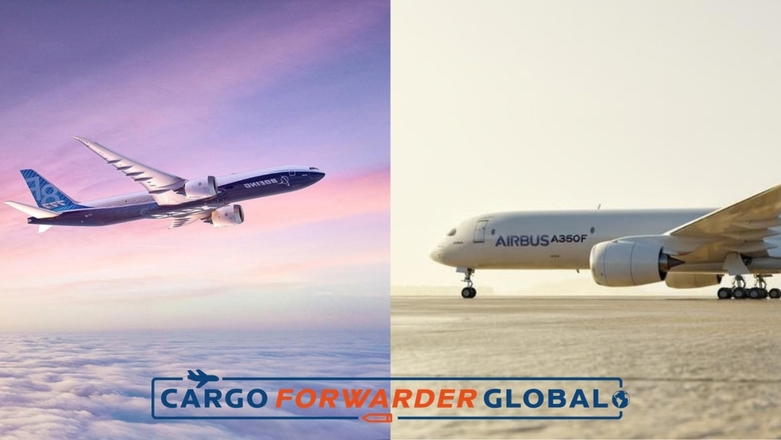
The first flight of Airbus’ A350F on 29SEP26 was the highlight of this year’s aviation events. Not only is it a milestone in the development of new freighter aircraft, but it also raises a fundamental question that affects the entire air cargo industry: what will the global freighter network of the future look like?
The A350F is scheduled to enter service in the second half of 2027. Airbus says the aircraft can carry up to 111 tons over a range of up to 8,700 kilometers and has accumulated 115 orders from 14 disclosed customers. Airbus rival, Boeing’s forthcoming 777-8F, meanwhile, has 81 orders.
The figures underline that airlines, cargo carriers and lessors are preparing for substantial fleet renewals. Yet, the next generation of freighters will not simply replace ageing aircraft on a one-for-one basis. The economics and requirements of air cargo networks are changing, and fleet strategies will have to change with them.
Replacing an aging fleet
For decades, the Boeing 747F was the benchmark for operators requiring very high payload and volume. Its successor, the 777F subsequently became a backbone of many long-haul cargo networks, combining payload, range and operating economics.
Many of these aircraft are now aging. Replacing them is therefore becoming increasingly important, but the decision is no longer simply about adding more capacity.
For an operator, the relevant question is whether the next aircraft should offer more payload, lower fuel consumption, greater range or greater flexibility. The answer can differ considerably between routes.
This is where the new generation of freighters enters the picture. Airbus highlights the A350F’s lower weight, advanced materials and latest-generation engines as key factors in reducing fuel consumption and emissions compared with older widebody aircraft.
The strategic debate is therefore shifting from maximum capacity to network economics.
New-build or converted?
Passenger-to-freighter (P2F) conversions will remain an important part of the market. Boeing forecasts demand for around 930 new-build freighters over the next 20 years, alongside roughly 2,000 converted aircraft.
For operators, P2F aircraft offer an important advantage: additional cargo capacity without the capital expenditure associated with a factory-built freighter. They can be particularly attractive on regional and medium-haul routes where maximum payload and long-range efficiency are less critical.
Newly built freighters, however, combine less fuel-thirsty engines, advanced materials and cargo-specific designs leading to improved operating economics.
The future is therefore unlikely to be a choice between P2F and new-build aircraft. Instead, operators will have to determine which aircraft type fits which network.
Is bigger still better?
The changing composition of air cargo makes that question even more relevant. E-commerce has been one of the major drivers of freighter demand in recent years. Now, another category is attracting increasing attention: semiconductors, servers and other equipment associated with the expansion of artificial intelligence.
These shipments can be extremely valuable without necessarily being particularly heavy or voluminous.
Reuters has reported that AI-related cargo is reshaping Asian air freight flows, with semiconductor and server shipments increasingly replacing e-commerce as a growth driver on some routes.
For airlines, this changes the calculation.
A shipment worth millions of dollars or euros does not necessarily require an aircraft capable of carrying 100 tons. Security, reliability, frequency and range can be just as important as maximum payload.
This could gradually shift fleet planning away from simply asking how much cargo an aircraft can carry towards asking how efficiently it can serve a particular cargo flow.
Efficiency becomes strategic
Fuel efficiency is consequently becoming more than an environmental consideration. It is becoming a network issue. Airbus says the A350F is designed to consume up to 40% less fuel than competing aircraft with a similar payload-range capability.
Over thousands of flight hours, such differences can significantly influence route economics.
At the same time, established aircraft will remain part of the market for years. Boeing has received regulatory permission to sell additional 777Fs under a temporary emissions waiver, extending the relevance of the current generation while the 777-8F remains in development.
The result will be a mixed fleet: proven older aircraft, converted passenger jets and increasingly efficient production freighters operating alongside each other.
The network will determine the aircraft
Future cargo fleets could therefore become more differentiated rather than simply larger.
A long-haul trunk route with consistently high demand may justify a large new-generation freighter. A medium-haul network could be better served by a converted aircraft. A specialized cargo flow may place greater value on frequency and reliability than on maximum payload.
Atlas Air’s order for 20 A350Fs illustrates this changing landscape. The company, traditionally closely associated with Boeing freighters, is adding Airbus aircraft to its future fleet. MSC Air Cargo, meanwhile, has ordered Boeing’s 777-8F, demonstrating that demand for large, long-range freighters remains strong.
The significance is not simply which manufacturer wins more orders.
It is that operators are increasingly building fleets around the requirements of their networks.
The cargo map itself is changing. Production and supply chains are becoming more diversified while large parts of Asia, India and Southeast Asia are gaining importance. Simultaneously, semiconductors, AI, pharmaceuticals, automotive and industrial cargo continue to demand different requirements.
The next generation of freighters will therefore arrive at a point when the assumptions behind the traditional cargo network are changing.
The key question for operators may no longer be how many freighters they need.
It may be which combination of aircraft allows them to serve an increasingly diverse cargo market most efficiently. In a nutshell: Driver of the coming freighter cycle is a more differentiated approach based on the question which aircraft is best suited for which products and markets to be served. The trendsetters in this regard are the integrators, with their variety of cargo aircraft in their fleets.