
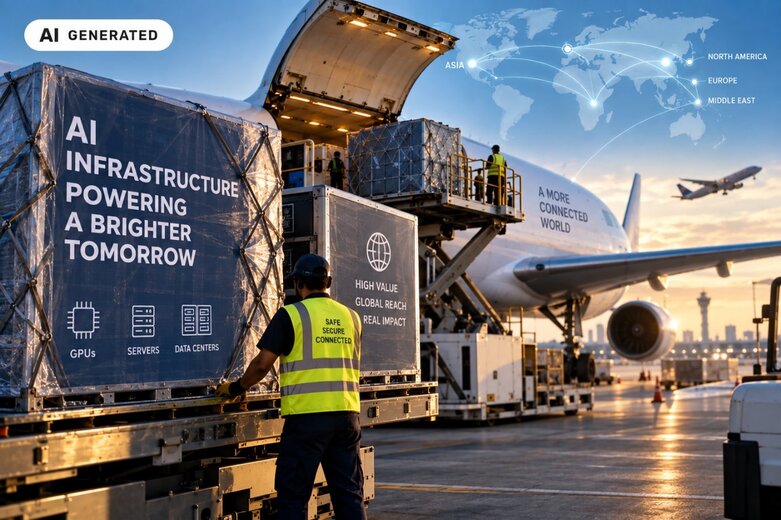
The AI boom isn’t only changing how cargo operates, but what air cargo carries. Semiconductors, GPUs, servers and data-center equipment are becoming major high-value air freight flows. Reuters reported in JUL2026 that AI hardware was replacing e-commerce as a growth engine on some Asian air-cargo lanes. AI infrastructure supply chains connect semiconductor manufacturing and assembly hubs across Taiwan, South Korea, Japan and Southeast Asia with rapidly expanding data-center markets in North America, Europe and the Middle East. These flows could develop into a distinct air-cargo vertical, reshaping trade lanes and increasing demand for specialized handling, security, authentication, and chain-of-custody systems.
AI’s truly global supply chain
There is no single country that can currently build the entire advanced AI stack independently at a competitive scale. From raw materials and semiconductor manufacturing to server assembly and final data-center deployment, the supply chain spans virtually every region of the world.
Japan exports semiconductor manufacturing equipment, South Korea produces advanced memory chips, and Taiwan is the center of leading-edge chip production with one of the world’s most concentrated ecosystems for semiconductor and computer manufacturing; Taiwan Semiconductor Manufacturing Company, or TSMC, is strategically important to the AI industry. Its manufacturing operations sit at the center of a broader Taiwanese base that supplies many of the world’s leading AI and digital-systems companies.
In addition, Vietnam, Malaysia, Thailand, and Singapore are emerging as increasingly important manufacturing and assembly hubs for AI servers destined for North America and Europe.
AI lifts air cargo economics
Strong air cargo demand is also showing up in yields and financial performance. Korean Air’s cargo revenue increased 46.1% year over year to ₩1.542 trillion in Q2 2026, accounting for approximately 31% of the airline’s total quarterly revenue. Korean Air attributed the stronger cargo performance to increased air-freight demand driven by expanding global AI-related investment and strong K-beauty exports, alongside efforts to secure high-value cargo and operate charter flights.
Singapore Changi Airport handled approximately 1.08 million tonnes of air freight in the first half of 2026, up 8.7% year over year, with Reuters attributing the growth partly to strong demand for semiconductors and AI-related electronics shipments.
Lufthansa Cargo provides a broader indication of the strength of the air-freight market. While Lufthansa Group’s Adjusted EBIT fell 56% year over year to €383 million in Q2 2026, Lufthansa Cargo moved in the opposite direction. Its Q2 Adjusted EBIT increased to €116 million from €73 million a year earlier, while persistently strong air-freight demand, against the backdrop of the Middle East crisis, contributed to a 27% year-over-year increase in cargo yields.
High-value cargo handling
A GPU may be expensive, but that’s not the fundamental reason companies put it on an aircraft. The bigger issue is the economic cost of waiting.
AI infrastructure combines high cargo value with unusually high time sensitivity. A delayed shipment of chips, servers, or other critical components can hold up the deployment of a much larger data-center project, making the cost of delay far greater than the premium paid for air freight. This makes speed and reliability particularly valuable as AI infrastructure investment accelerates.
Specialized handling capabilities for this type of cargo were already developing before the current surge in AI-related air freight. Cathay Cargo refreshed its Cathay Expert solution in 2024 for shipments requiring additional handling, including sensitive semiconductor-manufacturing equipment, and has since expanded its digital tools for planning and securing heavyweight cargo.
Digital security for increasingly valuable cargo
The surge in compact, high-value technology shipments also increases demand for authentication, chain-of-custody visibility, anomaly detection, and theft prevention. Cargo thieves are increasingly targeting precisely this type of freight.
Verisk’s CargoNet, a cargo-theft intelligence and recovery network, reported that cargo-theft losses in the U.S. and Canada reached $304.6 million in Q2 2026, more than double the prior-year level, even as the number of incidents fell 26%. The average reported loss per incident climbed to approximately $564,000, with enterprise computing and networking hardware among the categories increasingly targeted.
The risk is not confined to North America. In a report published in APR2026, BSI Consulting and TT Club found that electronics were the most frequently stolen cargo category in Europe in 2025, accounting for 15% of reported thefts, with Germany recording the largest share of European incidents at 27%.
The more valuable AI cargo becomes, the more economically viable it becomes to surround such shipments with sophisticated digital security such as verified identities, electronic seals, anomaly detection, and continuous chain-of-custody records.
AI infrastructure isn’t merely creating more air freight; it is developing a cargo category with its own routes, economics, handling requirements, and security infrastructure.