
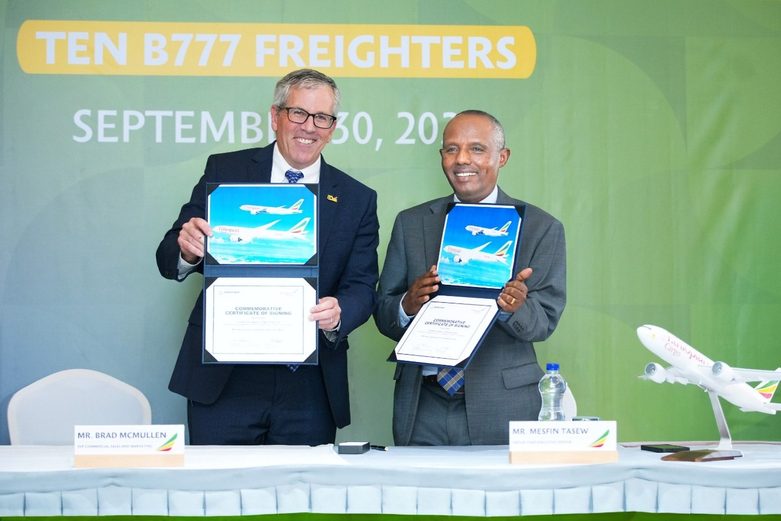
Ethiopian Airlines has signed an agreement with Boeing for ten additional freighters, comprising eight Boeing 777-8F and two 777F aircraft. The order is intended to expand the airline’s cargo capacity, modernize its freighter fleet and support the continued growth of its international logistics network.
The 777-8F will become the newest addition to Ethiopian Airlines’ cargo fleet and, according to Boeing, offers a maximum structural payload of 118 tons. The manufacturer also claims up to 30% better fuel efficiency and emissions performance compared with the aircraft it is designed to replace, alongside lower operating costs per ton and a reduced noise footprint. The 777F, meanwhile, is already established within Ethiopian Airlines’ cargo operation.
“Ethiopian Airlines’ order […] highlights both the strength of our partnership and growing demand for air cargo worldwide,” said Brad McMullen, Boeing senior vice president of Commercial Sales and Marketing. “We appreciate Ethiopian Airlines’ continued confidence in Boeing and the 777 and 777X family of airplanes as it expands its cargo capabilities and global network. The airline continues to make history as the first in Africa to order the new 777-8 Freighter.”
The order will add to a fleet that currently comprises twelve Boeing 777F, two Boeing 767 freighters and four Boeing 737-8F aircraft. Ethiopian Airlines operates dedicated cargo services to more than 70 destinations across Africa, Asia, Europe, the Middle East and North America. The additional aircraft are expected to provide further capacity and flexibility as the airline continues to expand its cargo network.
The agreement also makes Ethiopian Airlines the first African carrier to order the new 777-8F. For Boeing, the deal further strengthens its relationship with one of the largest cargo operators in Africa, while highlighting continued demand for large twin-engine freighters. Mesfin Tasew, Group CEO of Ethiopian Airlines, said the new aircraft would support the carrier’s efforts to increase payload capacity, operational flexibility and efficiency while strengthening Ethiopia’s role as a cargo gateway between Africa and international markets.