
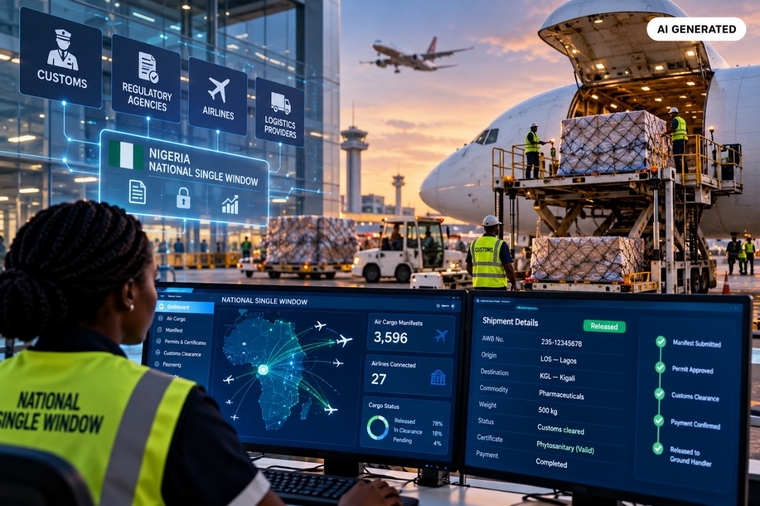
Nigeria’s National Single Window (NSW) has processed 3,596 electronic air cargo manifests submitted by 27 airlines since its operational launch in MAR26. The figures, presented by NSW Project Director Tola Fakolade at a press briefing in Abuja on 13OCT26, mark an early step in the country’s efforts to digitalize customs procedures and streamline cargo clearance.
The NSW initiative was launched by President Bola Tinubu in APR24. As reported by The Guardian, its first operational phase went live on 27MAR26, with DHL serving as the initial air cargo operator in the electronic manifest submission pilot at Lagos airport facility. As of OCT26, the government was preparing to test the second phase, focused on export procedures, as part of the platform’s gradual rollout.
Singaporean technology behind Nigeria’s NSW
Nigeria selected Singaporean technology company CrimsonLogic as a partner for its NSW. The company developed Singapore’s TradeNet in 1989 to centralize electronic trade declarations and regulatory approvals. Over subsequent decades, Singapore developed a broader digital trade ecosystem linking government agencies, logistics providers, and businesses.
The Nigerian platform aims to integrate customs and other government agencies, enabling electronic document submissions and more coordinated cargo clearance. However, Nigeria’s system remains in its early operational stages, and the extent of its end-to-end interoperability has yet to be established.
Africa’s digital trade challenge
A report jointly published in AUG26 by the World Bank and Agence Française de Développement identifies interoperability as a major challenge to African trade integration. Beyond adopting digital systems, countries need to ensure that customs authorities, government agencies, and logistics operators can exchange information efficiently across borders.
In practical air cargo terms, this means connecting airline manifests with customs processing, transmitting cargo release information electronically to ground handlers, and giving freight forwarders access to consistent shipment and regulatory data.
The report recommends interoperable border procedures, electronic documentation, shared performance indicators, and standardized customs data protocols.
Nigeria’s NSW represents an effort to address these challenges, although its effectiveness will depend on how seamlessly the participating systems operate together.
What is driving demand for customs technology in Africa?
According to the World Bank, approximately 60% of Africa’s trade costs originate from unilateral, or behind-the-border, constraints, including inefficient customs procedures, fragmented logistics, regulatory inefficiencies, and inadequate infrastructure.
These challenges are driving demand for customs automation and interoperable trade platforms. Governments are seeking to improve tariff classification, customs valuation, risk management and duty collection. Automated controls can help detect irregularities, strengthen compliance and reduce revenue leakage.
Digital customs progress across Africa
Customs administrations in Egypt, Kenya, Morocco, and South Africa are simultaneously developing advanced automated compliance and risk-management capabilities.
Rwanda’s customs digitalization experience delivered a reduction of border dwell time at major entry points by more than 40% over five years, according to the World Bank. Ethiopia launched its own Electronic Single Window in 2020, streamlining trade clearance processes involving more than 20 agencies.
Beyond customs digitalization
Nigeria’s trade challenge is not simply its volume, but its composition and direction. Its exports remain heavily skewed towards raw commodities. Across Africa, however, intra-African trade is more diversified and manufacturing-intensive than the continent’s exports to the rest of the world, although it accounts for only 15% to 20% of Africa’s total trade.
A fully implemented NSW could reduce the administrative customs burden. However, the strategic priority should be to transform Nigeria’s trade structure, not merely increase trade volumes. Air cargo could help Nigeria shift from exporting predominantly bulk commodities toward higher-value products serving regional African markets.
Lower freight rates alone will not achieve this
Under the African Continental Free Trade Area (AfCFTA), Nigeria is also seeking to strengthen regional air cargo connectivity. In MAY25, the government launched the Nigeria–East and Southern Africa Air Cargo Corridor in partnership with Uganda Airlines, offering discounted freight services to regional markets. The initiative expanded in MAY26 through an agreement with RwandAir, introducing additional destinations and advertised cargo rates below $2 per kilogram on selected routes. The partnerships aim to reduce transport costs and improve market access for Nigerian exporters.
An affordable flight provides limited benefit if goods remain delayed awaiting export documentation. Similarly, faster customs processing offers limited value if freight rates make Nigerian products uncompetitive. Nigeria’s National Single Window will therefore be an important test of whether customs digitalization and improved air cargo connectivity can work together to strengthen the competitiveness of Nigerian exports and facilitate regional trade.