
At the recent Aviation Connect/ACHL, one panel generated much discussion. It bore the title ‘Cargo Handling Landscape: Corporate Giants and Independent Players’, and was moderated by HACTL’s CEO, Wilson Kwong. Three airlines, two corporate giants and two independent players took to the stage to exchange viewpoints, highlight their requirements and services, and touch on the ongoing challenges in that segment of the air cargo industry.
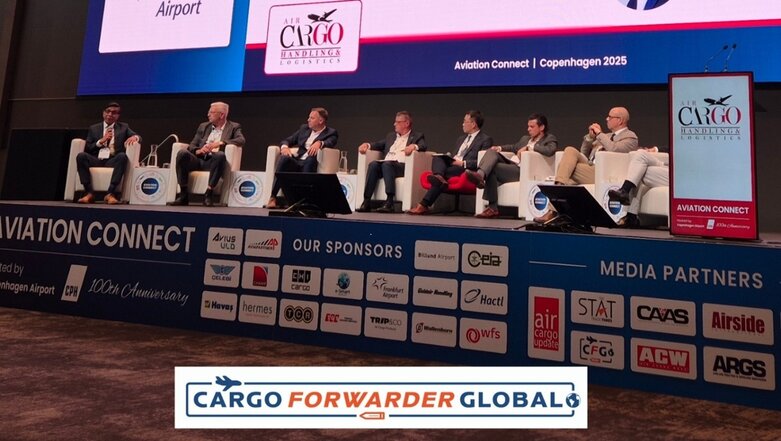
Industry expert, Wilson Kwong, who emphasized more than once during the discussion “I’m here in my function as a moderator, this time,” introduced his panel made up of LUG’s MD & CEO, Patrik Tschirsch, Delta Cargo’s MD – Operations, Vishal Bhatnagar, Emirates SkyCargo’s SVP Cargo Operations Worldwide, Robert Fordree, Cargolux’s SVP Global Logistics, Johannes Bruijs, dnata’s Chief Cargo Officer, Guillaume Crozier, Swissport’s CEO CEMEAI & Global Cargo Chair, Dirk Goovaerts, and CHI’s CEO, Kai Domscheit.
Corporate Giants vs. Independent Players
“What do you think about the panel topic?”, was Wilson Kwong’s opening question to each of his panelists. Robert Fordree stated that Emirates holds contracts with a blend of global, independent, and regional handlers worldwide. “One size does not fit all,” he said, “but we prefer to work with smaller amounts of handlers who really understand our requirements.” He emphasized the need for specialized solutions and warned that “it will get harder for smaller handlers to compete in future.” That sentiment was echoed by LUG’s Patrik Tschirsch, who observed that expanding giants make it harder for independent handlers to secure meaningful business at major hubs – but also pointed to the threat of potential monopolies: “At stations above a certain size, it is hard to get what you want from the handler.” His independent counterpart, CHI’s Kai Domscheit, passionately championed the role of independents, emphasizing their “true ownership” of operations, agility, and close customer alignment as strengths that corporate giants cannot easily replicate. “We move according to the customer’s heartbeat,” he underlined.
Mission to make an airport community tick
Guillaume Crozier picked up on the heartbeat comment: “A GHA, whether we are independent or global, has to ensure that our ecosystem [the airport community] ticks as it should. Our responsibility is down and upstream,” he explained, “It’s all down to leadership.” Johannes Bruijs pointed out “Sometimes we go beyond destinations, where there is no coverage by giants”, and that quality in any case depended on local leadership: “Some stations perform better than others.” Vishal Bhatnagar agreed that there was no one size, fits all solution, and that there is room both for giants and independent operators. What it all comes down to is how quickly an airline’s partner reacts to customer needs.
Complementary set-ups
Dirk Goovaerts reminded the audience that even today, corporate giants address only about half of global cargo handling needs. The vast industry, he argued, demands both types of players. “We need to come together and lift the industry,” he urged, listing the benefits that global networks offer: standardized, centrally governed processes and technology, complemented by local knowledge. “We are centrally governed, locally executed.” Standardized digitization – such as one common systems spanning 300 airports – is another benefit that giants bring. “We are complementary to independent operators,” he repeated.
What airlines want: quality first and foremost
“When airlines choose GHAs – what matters most?”, Wilson Kwong wanted to know: “What do airlines look for?” Johannes Bruijs emphasized: “Three things: Quality, quality, quality!” And that at an acceptable, not necessarily lowest, cost. He cited the importance of training, handling processes, and company culture. Points that were similarly put by Robert Fordree, who admitted that Emirates will first look for a global provider at the new station, due to it being familiar with the airline’s Master Services Agreement. And then ensuring that the local set-up has the capacity to handle the airline without requiring additional labor or facilities. “Best quality and best price wanted,” he said. Vishal Bhatnagar underlined that cost was the last consideration when it came to choosing a GHA. “Reliability is the most important,” he commented. “No service, no discussion!” Service, safety and trust are key, he said, followed by innovation. “Cost is last, because innovation should be able to take out cost,” he explained.
Future workforce…
Following an audience question from KLM Cargo’s Kester Meijer “What is the profile of a cargo employee in 2035?”, the panel anticipated profound shifts in the nature of cargo handling work. Automation will erase much of the paperwork and manual documentation, and the industry will need to find a way to be relevant for the next generation of employees – that means increasing the speed of innovation and ensuring that all the experience and knowledge in the currently aging and retiring workforce is captured and transmitted to new employees via AI systems. Dirk Goovaerts said: “The new generation needs access to knowledge quickly – they are less interested in books.” Everyone agreed on the need for passion, adaptability, and problem-solving skills. Guillaume Crozier summarized: “The expectation is always Attitude plus Data-Driven Skills.” The panel imagined careers increasingly focused on process management, innovation, and sustainability – the latter being a crucial value for younger workers.
… and the path ahead
The consensus was that, going forward, the global giants will take a bigger share of the network business, and that the dependency of global carriers on global giants will increase. However, Kai Domscheit said that success will hinge not on size but on adaptability: “Fast eats slow, not big eats small.” The industry will remain a hybrid landscape, with the best independents potentially becoming tomorrow’s giants and non-performing operators falling by the wayside. “In some places, there are too many global or independent players,” Guillaume Crozier reasoned: “The market will regulate this. Data-wise, I hope we will be in a much better place in 5 years’ time.”
The panel agreed that lasting quality, adaptability, and commitment to customer needs are universal. Both giants and independents have distinct strengths, and often, the best outcomes arise via partnership, not rivalry. Wilson Kwong brought the panel discussion to a close with his conclusion: “We are all very passionate and want to serve with high quality. Let’s work together. There is more room to cooperate than to compete!”