
Even before the European frame maker launched the A350F program, Crawford Hamilton, Head of Freighter Market at Airbus, emphasized in an interview with CargoForwarder Global, that his company had plans to achieve at least a solid 50% market share in the category of cargo aircraft with a payload of over 80 tons. This was a bold announcement for the manufacturer, for whom freighters had previously played only a minor role and whose archrival, Boeing, had been flying high for decades with its B747F and B777F variants. But now the tide is turning, as the latest orders show.
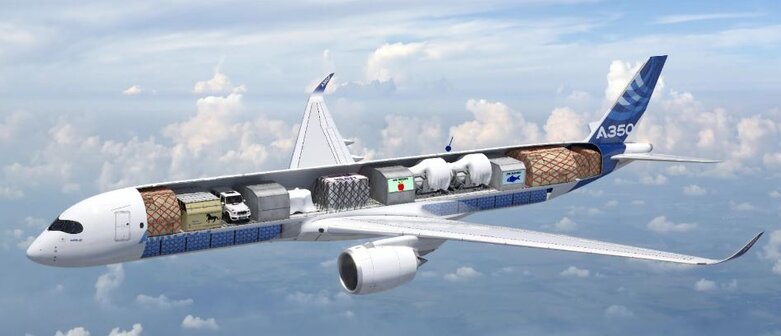
There are now 82 firm orders for the Airbus A350 freighter, from 15 different airlines or leasing companies. “This already represents a global share of 58% in this market segment,” the manager summarized in a team call with trade journalists on Tuesday, 25NOV25. In comparison, the competing model from Seattle, the B777-8F, has so far only received 59 firm orders from 6 customers, Hamilton remarked.
For the times ahead, the executive sees further high sales potential due to the remarkable diversity of previous buyers. Traditional cargo carriers such as Korean Air, Cathay Cargo, and Air France-KLM Cargo have ordered the freighter, as have newcomers such as CMA CGM Cargo and Taiwanese Starlux Airlines, which was founded in 2018.
A small step from A350 to A350F
In addition to the growing market demand for air lift, the commonality of the A350F is a particularly strong argument for further orders. Many airlines already have passenger versions of the A350 in their fleets, which is why adding the large freighter makes sense for some of them. Neither he nor the other three Airbus experts participating in the Teams call, named any potential customers, but Hamilton hinted that Ethiopian Airlines could be a possible candidate, becoming the first African operator. He also sees great potential in India, as demonstrated by the recent large orders for passenger aircraft placed by local carriers, spurring sales figures at Boeing and Airbus.
Similar freighter demand predictions
In terms of global freighter demand, the figures presented by Boeing some weeks ago, are very similar to those now tabled by Crawford Hamilton. Airbus anticipates global demand for around 2,600 additional freighters by 2044, of which 935 will be newbuilds (Boeing: 955) and 1,670 (conversions (Boeing 1945). Of these, 1,120 units belong to the small category (10t – 40t), 855 to the mid-size widebodies (40t-80t) and 630 to the larger category of widebodies (>80t).
The A350F offers users a payload of around 110 tons per flight. The temperature on its main deck can be set to a range of 4-26 degrees Celsius, depending on the type of products flown. Cockpit crews also benefit from innovation. They will be supplied with segregated fresh air so that they are not exposed to any odors from animals or products loaded on the main deck of the aircraft.
The A350F could set new standards
In terms of market demand, the freighter could set new standards on transpacific routes between East Asia and North America, where freight volumes are expected to grow by an average of 3.2% annually until 2044, say Airbus’ market observers. Flows between the APAC, CIS and Europe will see a plus of 2.6% while APAC > < Africa increases 4.4% but based on a much lower level. Africa < > Europe/CIS is expected to grow 3.5%, followed by +3.4% on routes connecting APAC and Latin America.
However, these figures could prove worthless if political or new military conflicts break out in the next 20 years and disrupt global trade and supply chains.