
Each week, CargoForwarder Global’s ‘Spotlight On…’ looks at a different segment of the air cargo industry to demonstrate how broad its career palette. Airports form the essential backbone of the air cargo system, acting as interchange points between air and road transport, and offering dedicated cargo terminals and warehousing space, to ensure the safe, secure and efficient build-up, storage, and movement of goods going out and coming into the region. This week, Kaspar Andreas Nissen (KN), Senior Manager, Air Cargo, at Billund Airport, talks about his role and shares his views and advice.
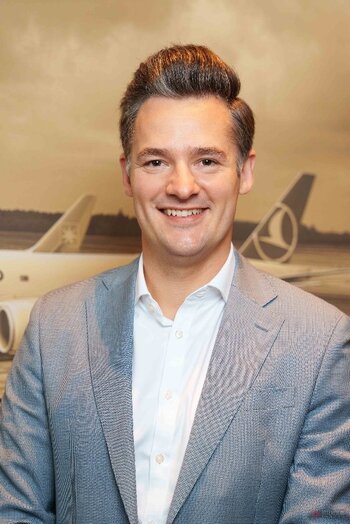
CFG: What is your current function and company? And what are your responsibilities?
KN: I am Senior Manager, Air Cargo at Billund Airport and responsible for commercial cargo development, e.g. dialogue with freight forwarders, trucking companies and handlers, route development with airlines, participation in worldwide air cargo conferences, internal stakeholder management, etc.
CFG: What does a normal day look like for you?
KN: 3-4 office days per week, a few days per week from home office when it’s conference off-season. ‘Normal’ days are a lot of e-mails internal and external and videocalls to update and coordinate efforts with airline and industry partners. Also, spending quite some time on various analysis of market trends and how to market this to relevant customers and partners, and coordinating internally to align initiatives.
CFG: How long have you been in the air cargo industry, and what brought you to it?
KN: 15 years exactly. Five years with SAS Cargo, two years with Qatar Airways Cargo, a year with Danish freight forwarder, LEMAN, three years with Copenhagen Airport, and the past 4 years with Billund Airport. I guess what brought me to the industry is the fascination and passion for the aviation industry. My father’s family was brought up next to Copenhagen Airport (CPH) and aviation was therefore a natural part of the family.
CFG: What do you enjoy most about your job?
KN: I truly enjoy the responsibility that lies within my job. Driving and developing air cargo activity through Billund Airport with all that falls under this as earlier mentioned. I enjoy representing Billund Airport around the world at conferences and marketing the services the airport, the handlers and affiliated partners are delivering on a daily basis.
CFG: Where do you see the greatest challenges in our industry?
KN: In short: Uncoordinated efforts across the sector, both political and within the industry, to drive digitalization and easier legislation. General lack of cargo aircraft capacity and imbalanced trade lanes.
I believe customs authorities from country to country have very different ways of implementing European legislation. Some authorities are very liberal, and some are very restrictive, e.g., on e-Commerce imports from China and other Asian countries. Bilateral agreements are also very different within the European countries, some are very updated and fit for modern global trade, whereas some countries really suffer from slow political processes. Both these elements should be better coordinated and easier implemented on a European level, to create efficient and regional flows across Europe, ultimately boosting the competitiveness of European trade and the economy.
CFG: What advice would you give to people looking to get into the air cargo industry?
KN: I would advise future colleagues to focus on digitalization and AI, an area that will heavily transform our industry in the years to come. The major breakthrough has just not happened yet, though tremendous efforts have been done to accelerate it over the years.
AI and digitalization can transform operational processes such as cargo-build-up on ULDs, truck coordination to avoid empty capacity on roads, documents processing and AI data sharing, etc. So many areas could be way more efficient if the industry could actually get together to define standard processes and would be willing/able to invest in the necessary and not be so afraid of the immediate competition. In my view it’s a joint responsibility on behalf of the industry, to keep it competitive towards the much cheaper sea freight industry.
CFG: If the air cargo industry were a film/book, what would its title be?
KN: ‘The Day After Tomorrow.’ The operational logistics industry is just very much on a day-to-day basis. One day you can be on top of everything because the whole supply chain has delivered as promised, the next day can be a giant mess because of one missed deadline somewhere, however it’s normally fixed, rebooked or utilized anyway. Always just remember, it goes on and you never know what to expect the day after tomorrow.
Thank you, Kaspar!
If you would like to share your personal air cargo story with our CargoForwarder Global readers, feel free to send your answers to the above questions to cargoforwarderglobal@kopfpilot.at We look forward to shining a spotlight on your job area, views, and experiences.